
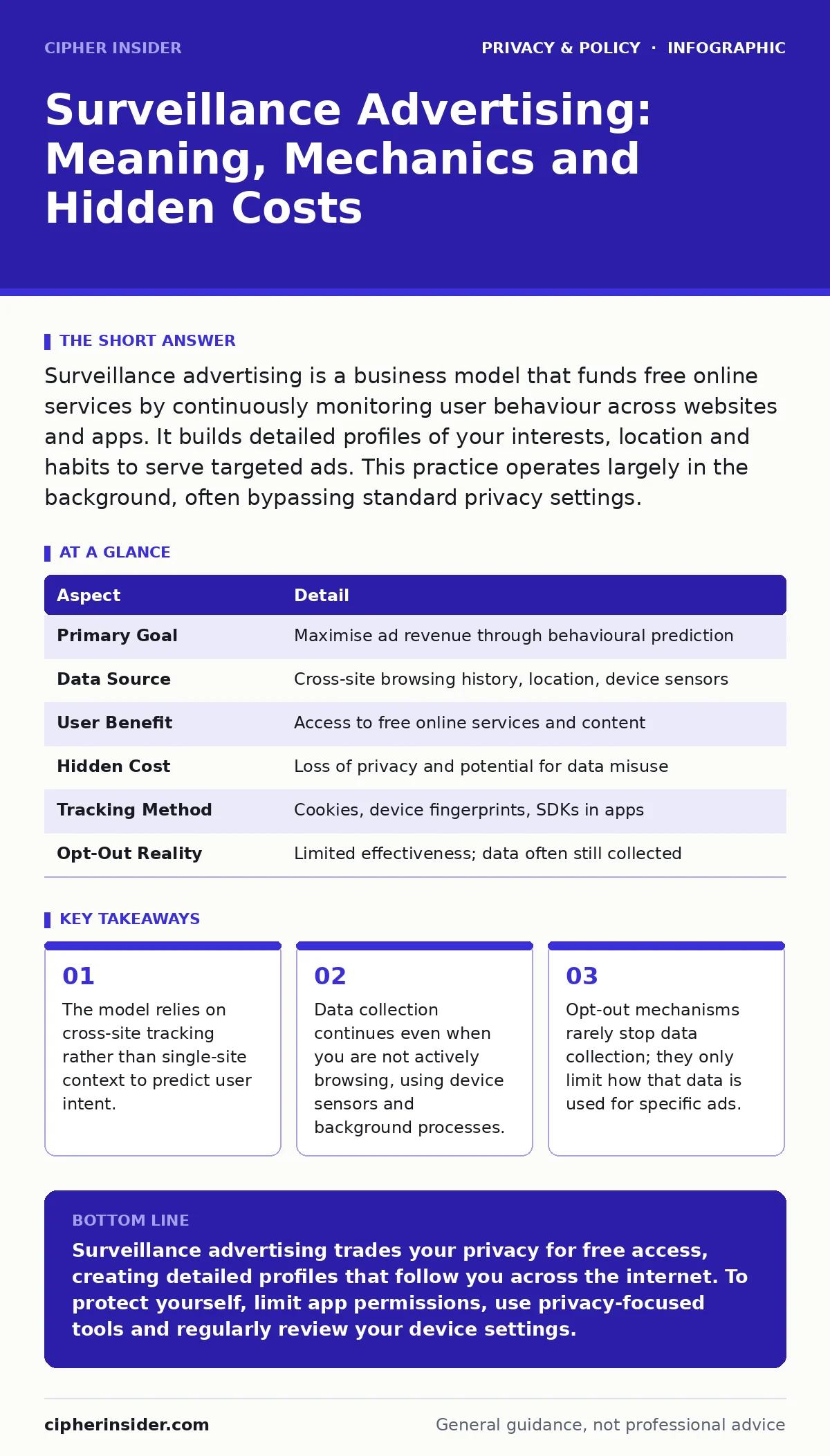
Surveillance advertising is a business model that funds free online services by continuously monitoring user behaviour across websites and apps. It builds detailed profiles of your interests, location and habits to serve targeted ads. This practice operates largely in the background, often bypassing standard privacy settings.
The Library Analogy
Imagine a library where the librarians do not care what books you read. Instead, they follow you home, noting which shelves you walk past, how long you linger, and who visits your house. They sell this map of your movements to publishers, who then send flyers to your door based on your habits. You get free entry to the library, but the price is your anonymity. This is the core mechanic of surveillance advertising. It shifts the focus from the content you consume to the person you are. The service is free because you are the product being sold to advertisers.
Defining the Mechanism
Surveillance advertising is the practice of collecting, aggregating and analysing user data to deliver targeted advertisements. Unlike traditional advertising, which places a car ad in a motoring magazine, this model places a car ad on a cooking blog because the system knows you recently searched for family vehicles. The term "surveillance" highlights the continuous, passive nature of this monitoring. It is not a one-time transaction but an ongoing observation of your digital life. The goal is to build a profile so detailed that it can predict your future purchases or political leanings. This profile is then used to serve ads that are more likely to generate clicks.
| Aspect | Detail |
|---|---|
| Primary Goal | Maximise ad revenue through behavioural prediction |
| Data Source | Cross-site browsing history, location, device sensors |
| User Benefit | Access to free online services and content |
| Hidden Cost | Loss of privacy and potential for data misuse |
| Tracking Method | Cookies, device fingerprints, SDKs in apps |
| Opt-Out Reality | Limited effectiveness; data often still collected |
Where the Term Comes From
The phrase emerged from the growing disconnect between user expectations of privacy and the technical reality of the internet. Early web tracking was limited to single-site cookies, which only remembered your preferences on that specific domain. As technology advanced, third-party scripts allowed advertisers to track users across multiple unrelated sites.
This cross-site tracking created a comprehensive view of individual behaviour. Critics began to describe this as surveillance because it mirrored the methods used by intelligence agencies, albeit for commercial gain. The term stuck because it accurately describes the asymmetry of power: the advertiser sees everything, while the user sees nothing. It also highlights the lack of meaningful consent in most data collection practices.
How It Works Day to Day
You open a news site to read an article. Embedded within the page are small scripts from advertising networks. These scripts send information about your device, your location and your browsing history to remote servers. Even if you do not click any ads, your presence is recorded. The system updates your profile with this new data point.
Later, you visit a social media platform. The advertising network recognises your device fingerprint and serves an ad related to the news article you just read. This happens in milliseconds and is invisible to you. The process repeats thousands of times daily across browsers and mobile apps. It creates a persistent thread of data that follows you everywhere online.
The Hidden Costs of Free Services
The most obvious cost is the loss of privacy. However, there are subtler consequences that affect how you interact with the internet. Surveillance advertising creates filter bubbles, where you only see content that aligns with your existing views. This happens because algorithms prioritise engagement over diversity. You are shown what the system thinks you will click, not what you need to know.
This narrows your exposure to new ideas and reinforces biases. Another hidden cost is the security risk. The same data pipelines used for advertising can be exploited by malicious actors. If a data broker is breached, your detailed profile becomes available to criminals. This makes you a target for phishing or identity theft. The convenience of free services comes with a significant long-term risk.
See also: What is online tracking: how data follows you and how to stop it · Differential Privacy Meaning: How Noise Protects Your Data
What People Usually Get Wrong
Many users believe that deleting cookies stops tracking. This is incorrect. Modern tracking methods use device fingerprinting, which identifies your device based on its unique configuration. This includes screen resolution, installed fonts and battery level. Deleting cookies does not change these hardware characteristics. Another common misconception is that using private browsing mode protects you.
It only prevents your local device from storing history. The advertising networks still see your activity in real-time. They just do not save it to your hard drive. Users also assume that opting out of personalised ads stops data collection. It usually only stops the use of that data for specific ad targeting. The data is still gathered, stored and potentially sold for other purposes. Understanding these limitations is key to managing your privacy.
Managing Your Exposure
You can reduce the impact of surveillance advertising, but you cannot eliminate it entirely. Start by adjusting your smartphone privacy settings to limit ad tracking. Most mobile operating systems offer options to reset advertising identifiers or limit ad personalisation. This disrupts the link between your device and your profile. Next, consider using privacy-focused browsers that block third-party scripts by default. These tools prevent the initial data collection from happening. You should also review your mobile app permissions regularly. Many apps request access to your contacts, location or microphone without needing it for their core function.
This is a form of mobile app permission abuse that feeds the advertising ecosystem. Reducing your digital footprint requires consistent effort. It involves choosing services that respect your privacy and configuring your devices to minimise data leakage. For families, understanding children's online privacy risks is also critical, as young users are often targeted with deceptive practices. Finally, staying informed about consent management helps you navigate the complex web of privacy notices. While you cannot opt out of the entire system, you can make it harder for advertisers to build a complete profile of you.
Key takeaways
- The model relies on cross-site tracking rather than single-site context to predict user intent.
- Data collection continues even when you are not actively browsing, using device sensors and background processes.
- Opt-out mechanisms rarely stop data collection; they only limit how that data is used for specific ads.
- The economic incentive prioritises data volume over user privacy, creating inherent conflicts of interest.
Surveillance advertising trades your privacy for free access, creating detailed profiles that follow you across the internet. To protect yourself, limit app permissions, use privacy-focused tools and regularly review your device settings.
Frequently asked questions
Does turning off personalised ads stop data collection?
No, it typically only prevents the use of your data for targeted ads. The data is often still collected and stored by the platform or third parties.
Can I opt out of all online tracking?
Completely opting out is difficult due to pervasive tracking methods like fingerprinting. You can significantly reduce tracking, but some level of data collection is inevitable.
Is surveillance advertising illegal?
It is generally legal in most jurisdictions, though regulations like GDPR and CCPA impose stricter rules on consent and data handling. Compliance varies by region.
Why do free services rely on this model?
It generates significant revenue by selling user attention and data. This allows companies to offer services at no direct cost to the user, shifting the cost to privacy.
How this guide was produced: written by the Cipher Insider editorial team with AI assistance, checked against the public references listed below, and reviewed when the facts change. See our editorial policy or report an error.