Respond to smart home privacy leaks by severing cloud connections, revoking third-party app permissions, and inspecting local network logs. Recovery requires factory resetting compromised devices and auditing integration permissions before reconnecting hardware to domestic networks.
How to identify an active smart home breach
Smart home privacy breaches manifest through unauthorized audio streaming, unexpected device movement, or unfamiliar automation routines. Network anomaly detection involves monitoring outbound DNS (Domain Name System) requests to unrecognised domains operated by foreign manufacturers or third-party analytics firms. Strange connection spikes during idle hours usually indicate active data exfiltration by compromised IoT (Internet of Things) hardware.
Reviewing router administration panels reveals unfamiliar MAC (Media Access Control) addresses communicating with internal smart devices. Hidden microphones and optical sensors rarely emit physical warning lights when streaming telemetry upstream. Hidden data flows bypass local user interfaces entirely, communicating directly through encrypted tunneling protocols maintained by cloud intermediaries.
First hour
Immediate containment prevents further telemetry leakage while preserving forensic artifacts on local storage media.
- Unplug smart speakers, smart displays, and network-connected cameras from wall power outlets.
- Log into primary cloud accounts associated with domestic automation and terminate all active sessions.
- Access router configuration pages to block unknown wireless clients from accessing the internet.
- Disable UPnP (Universal Plug and Play) protocols on the main router to close automatic port forwarding holes.
First day
Isolating compromised hardware requires segmenting local networks to prevent lateral movement across domestic computing equipment. Network segmentation involves configuring VLANs (Virtual Local Area Networks) to separate untrusted smart devices from personal workstations and network-attached storage. IoT hardware belongs on an isolated guest network with strict firewall rules blocking internal RFC1918 traffic.
Revoking API (Application Programming Interface) tokens stops third-party integrations from harvesting historical household data. Reviewing account connection logs exposes unauthorized applications granted persistent access through OAuth (Open Authorization) authorization grants. Removing these integrations severs covert data pipelines feeding external profiling databases.
First week
Rebuilding a secure environment demands methodical verification of device firmware and authentication credentials. Manufacturers frequently patch critical remote code execution vulnerabilities through silent background updates that require manual verification. Checking vendor advisory portals confirms whether specific hardware models remain supported with security updates.
Smart home recovery often parallels practices found in smartphone privacy settings, where granular permission audits restrict background data collection. Restoring functionality requires provisioning new, unique credentials for every device instead of reusing master account passwords. Hardcoded default administrator passwords present on budget sensors must be replaced immediately during initial provisioning.
Containment strategies for persistent peripherals
Persistent peripherals include smart doorbells, robotic vacuums, and connected thermostats that retain cached video recordings and spatial maps locally. Storage media inside these devices requires physical destruction or secure cryptographic erasure before disposal or return to vendors. Cloud-backed appliances constantly synchronize indoor layout data with remote servers, exposing floor plans to unauthorized entities.
Revoking cloud access breaks legitimate automation scripts, creating friction that tempts users to restore unsafe default settings. Balancing convenience with privacy requires accepting manual control over sensitive sensors rather than permanent cloud connectivity. Local-only automation hubs process sensor data on-premises without transmitting telemetry to external cloud storage.
See also: Zero-knowledge encryption: mathematical privacy for small firms
Who to tell and when to report
Notifying relevant stakeholders depends on the scope of the compromised data and local regulatory frameworks. Domestic occupants must be informed immediately if ambient audio or video feeds were accessed without authorization. Data protection officers at corporate employers require notification if corporate assets connected to compromised domestic networks faced exposure risks.
Regulatory reporting applies primarily to commercial environments or landlords operating smart rental properties under specific privacy mandates. Law enforcement agencies rarely possess the technical capability to investigate domestic IoT telemetry thefts without substantial preliminary forensic data provided by the victim. Documenting network packet captures and authentication logs aids professional incident responders during formal investigations.
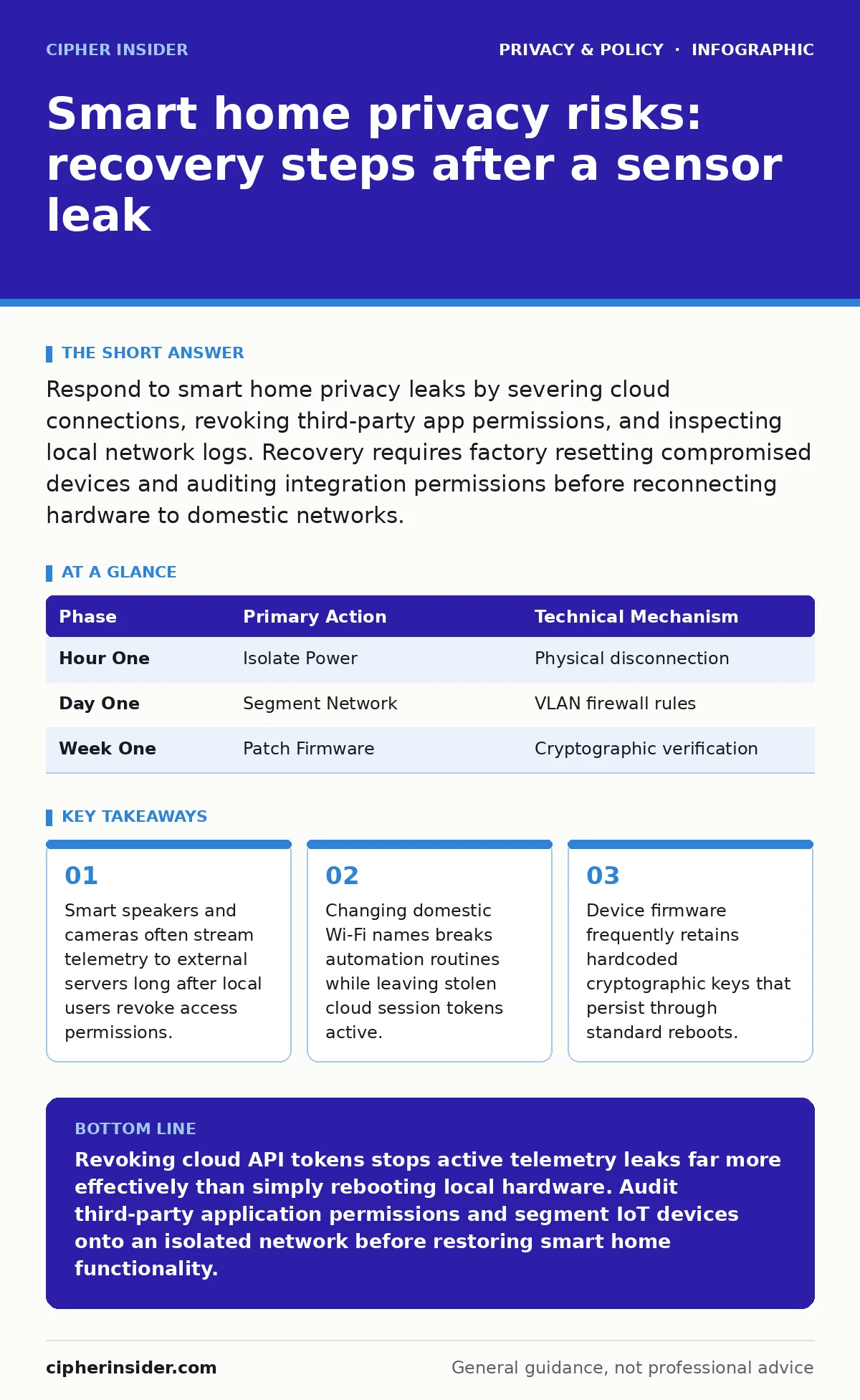
| Phase | Primary Action | Technical Mechanism |
|---|---|---|
| Hour One | Isolate Power | Physical disconnection |
| Day One | Segment Network | VLAN firewall rules |
| Week One | Patch Firmware | Cryptographic verification |
How to stop a repeat incident
Preventing future privacy incidents involves implementing strict access controls and minimizing unnecessary sensor deployment throughout living spaces. Minimizing data collection requires disabling cloud storage for indoor cameras and relying solely on local, encrypted storage mediums. Regular firmware audits ensure vulnerabilities are patched before malicious actors exploit them remotely.
Avoiding repeat intrusions also means auditing family access habits, similar to the discipline required when configuring password managers for families to prevent credential sharing. Limiting guest network access prevents visitors from inadvertently bridging untrusted mobile devices into secure internal network segments. Zero-trust architecture applied to domestic environments assumes every connected appliance is hostile until proven otherwise.
Key takeaways
- Smart speakers and cameras often stream telemetry to external servers long after local users revoke access permissions.
- Changing domestic Wi-Fi names breaks automation routines while leaving stolen cloud session tokens active.
- Device firmware frequently retains hardcoded cryptographic keys that persist through standard reboots.
Revoking cloud API tokens stops active telemetry leaks far more effectively than simply rebooting local hardware. Audit third-party application permissions and segment IoT devices onto an isolated network before restoring smart home functionality.
Frequently asked questions
Can I use my smart speaker safely after a privacy breach?
You can use a compromised smart speaker safely only after performing a complete firmware reflash and connecting it to an isolated guest network.
Why do smart devices keep communicating after I change my Wi-Fi password?
Many modern IoT appliances cache cryptographic session tokens or use cellular failover connections that bypass local Wi-Fi entirely.
How do I know if my smart TV is recording conversations?
Determining if a smart TV is recording requires inspecting outbound router traffic for sustained data transmission spikes during idle states.
Should I throw away smart devices that suffered a security breach?
Discarding hardware is unnecessary unless the device lacks secure firmware update mechanisms or stores unencrypted sensitive telemetry locally.
How this guide was produced: written by the Cipher Insider editorial team with AI assistance, checked against the public references listed below, and reviewed when the facts change. See our editorial policy or report an error.