
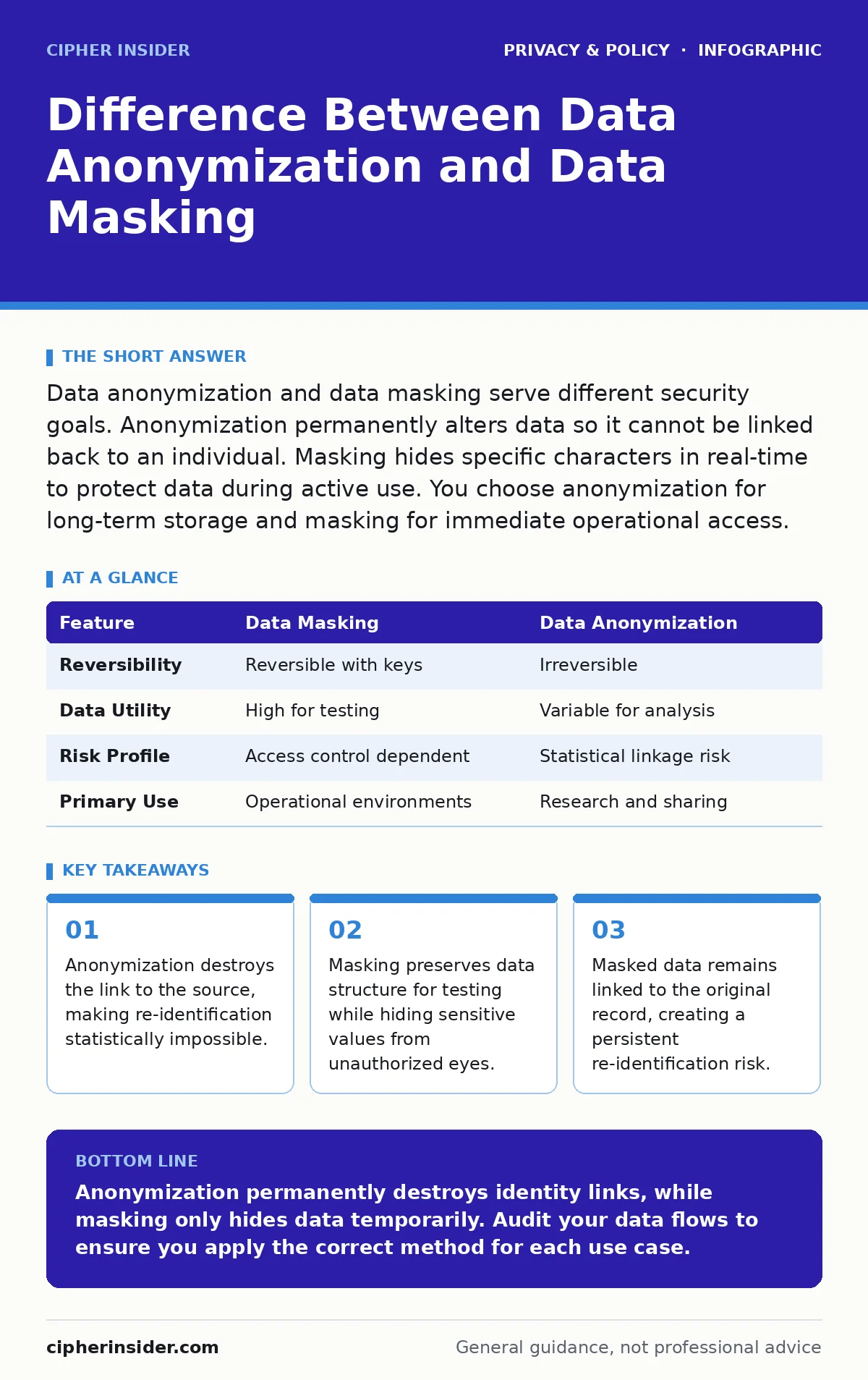
Data anonymization and data masking serve different security goals. Anonymization permanently alters data so it cannot be linked back to an individual. Masking hides specific characters in real-time to protect data during active use. You choose anonymization for long-term storage and masking for immediate operational access.
What is the difference between data anonymization and data masking?
Data anonymization and data masking differ primarily in reversibility and purpose. Anonymization permanently transforms data so that individuals cannot be identified, even by the data owner. Masking temporarily obscures sensitive information while preserving the underlying data structure. You use anonymization for research or public datasets. You use masking for development environments or customer support screens. The core distinction lies in whether the original data can ever be recovered.
How does data masking protect information during active use?
Data masking replaces sensitive characters with dummy data while the system remains live. This technique allows developers to test software without exposing real credentials. Imagine a software engineer debugging a payment module. They see "*--*-1234" instead of the full card number. The system still processes the transaction correctly. This approach prevents accidental exposure in logs or screenshots. It does not remove the data from the database, only from the view.
Why is data anonymization considered irreversible?
Data anonymization applies statistical techniques to remove identifying attributes. Methods include generalization, suppression, and noise addition. The goal is to ensure that the data cannot be linked to a specific person. Once anonymized, the original record is lost. You cannot reverse the process to retrieve the true value. This permanence makes it suitable for sharing with external researchers. It eliminates the risk of insider threats accessing raw data.
When does data masking fail to provide privacy?
Data masking fails when the underlying data remains accessible through other channels. If an attacker compromises the database directly, masked views offer no protection. The original data sits in the storage layer, waiting to be extracted. Masking relies on strict access controls to the backend. If those controls fail, the mask disappears. This hidden cost means masking is a control layer, not a data transformation. It protects the view, not the asset itself.
What are the risks of re-identification in anonymized data?
Anonymized data can sometimes be re-identified through linkage attacks. Attackers combine the anonymized dataset with other public records. If unique patterns remain, they can pinpoint individuals. Imagine a dataset containing job titles and zip codes. Even without names, this combination might uniquely identify a small number of people. This risk persists if the anonymization technique does not reduce specificity enough. You must assess the residual risk after applying any method.
See also: Differential Privacy Meaning: How Noise Protects Your Data · Data Subject Rights Request: How to Process and Respond Correctly
How do k-anonymity and differential privacy improve security?
K-anonymity ensures each record is indistinguishable from at least k-1 others. This prevents singling out an individual based on quasi-identifiers. Differential privacy adds mathematical noise to query results. This noise guarantees that the presence or absence of one record does not affect the output. These methods address the failures of simple anonymization. They provide measurable guarantees against re-identification. Using differential privacy allows you to share insights without exposing individual contributions.
| Feature | Data Masking | Data Anonymization |
|---|---|---|
| Reversibility | Reversible with keys | Irreversible |
| Data Utility | High for testing | Variable for analysis |
| Risk Profile | Access control dependent | Statistical linkage risk |
| Primary Use | Operational environments | Research and sharing |
Where should you implement these controls in your stack?
You should implement masking at the application or presentation layer. This keeps the database clean and fast for legitimate queries. Anonymization should happen at the data ingestion or export stage. Transform data before it leaves your secure environment. This separation of concerns ensures that operational needs do not compromise long-term privacy. It also simplifies compliance audits by clearly defining data states.
How do consent management and data brokers affect your strategy?
Consent management dictates whether you can process data at all. If users withdraw consent, you must delete or anonymize their records. Data brokers often aggregate information from multiple sources. This aggregation increases the risk of re-identification. Even if your data is anonymized, brokers might link it to other profiles. Understanding opting out of data brokers helps you assess the broader ecosystem. You cannot control external data, only your own handling.
What is the role of encryption in this context?
Encryption protects data at rest and in transit. It is distinct from both masking and anonymization. Encrypted data can be decrypted with the correct key. This makes it reversible, unlike anonymization. However, encryption is essential for securing the masked or anonymized datasets. It prevents unauthorized access to the storage layer. For sensitive communications, consider zero-knowledge encryption to ensure even service providers cannot read the content. This adds a layer of trust to your privacy architecture.
How do you choose the right technique for your needs?
Choose masking when you need to maintain data integrity for testing. Developers require realistic data formats to catch errors. Choose anonymization when you need to share data externally. Researchers need statistical validity without privacy breaches. Evaluate the sensitivity of the data and the trust level of the recipient. High-sensitivity data demands stronger transformation. Regularly review your choices as technology and threats evolve.
Key takeaways
- Anonymization destroys the link to the source, making re-identification statistically impossible.
- Masking preserves data structure for testing while hiding sensitive values from unauthorized eyes.
- Masked data remains linked to the original record, creating a persistent re-identification risk.
Anonymization permanently destroys identity links, while masking only hides data temporarily. Audit your data flows to ensure you apply the correct method for each use case.
Frequently asked questions
Can you reverse data masking to get the original data?
Yes, if you have the decryption key or the mapping table. Masking is designed to be reversible for authorized users.
Does data masking affect database performance?
It can add slight overhead if performed in real-time. Pre-masked datasets in test environments usually perform better.
How does this relate to browser fingerprinting?
Browser fingerprinting tracks users without cookies. Anonymization of web logs can help prevent this tracking from being linked to individuals.
How this guide was produced: written by the Cipher Insider editorial team with AI assistance, checked against the public references listed below, and reviewed when the facts change. See our editorial policy or report an error.