
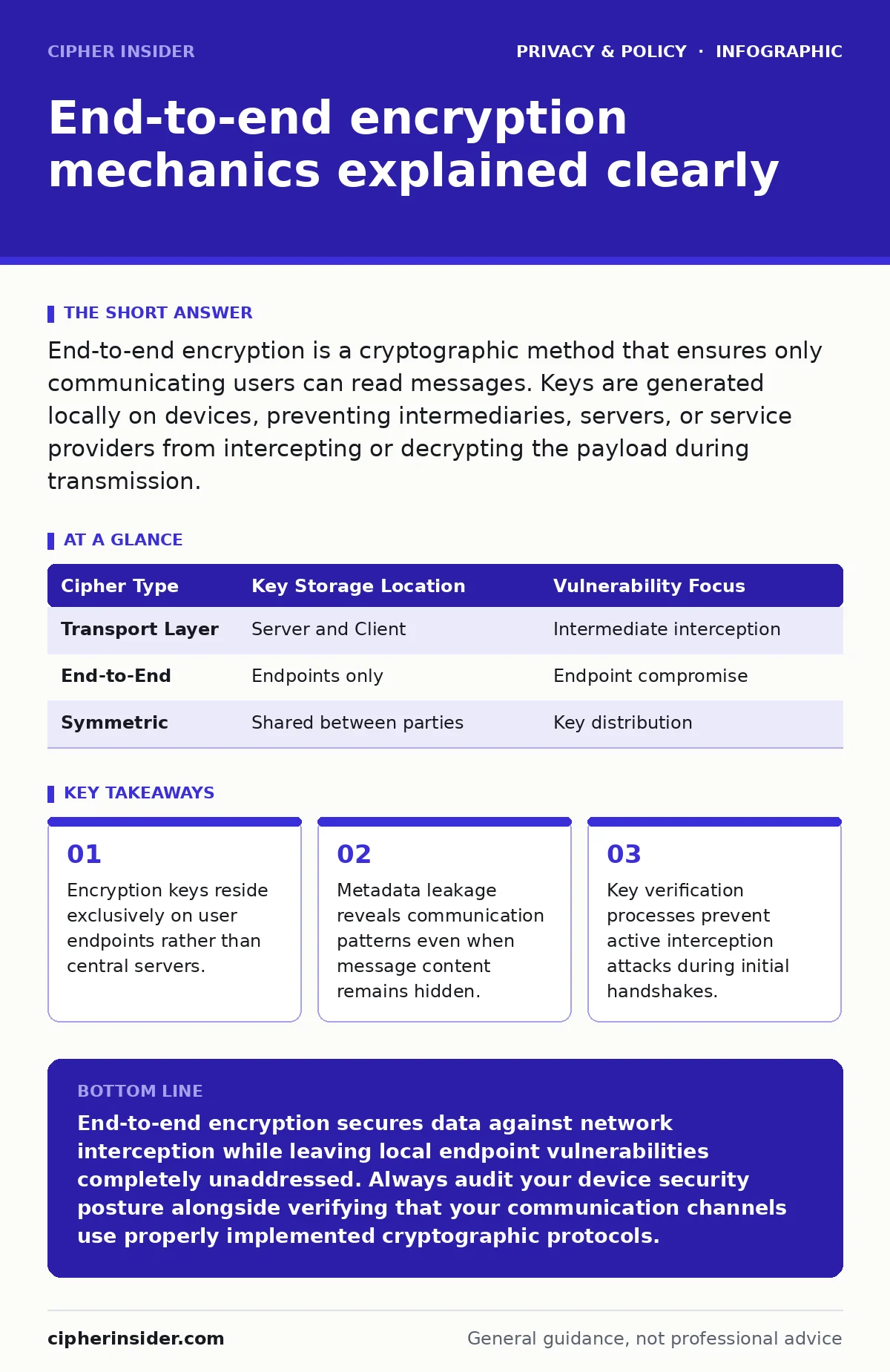
End-to-end encryption is a cryptographic method that ensures only communicating users can read messages. Keys are generated locally on devices, preventing intermediaries, servers, or service providers from intercepting or decrypting the payload during transmission.
What is end-to-end encryption and how does it work?
End-to-end encryption is a data transmission method that secures messages from the sender device to the receiver device without intermediate decryption. 3 distinct phases govern this process: local key generation, cryptographic wrapping on the source device, and final unwrapping on the destination device.
Plaintext data transforms into ciphered text using mathematical algorithms before leaving your hardware. Servers relay the scrambled bytes blindly, possessing zero capacity to inspect the contents. Mathematics guarantees that unauthorized parties seeing the network traffic observe only random noise rather than readable words.
Why do encryption keys matter more than passwords?
Encryption keys are cryptographic strings that dictate how data locks and unlocks, superseding traditional passwords in security architecture. 2 primary key types operate in tandem: public keys shared openly to lock messages, and private keys kept secret to unlock them.
Passwords merely authenticate your identity to a gatekeeper system that might hold administrative access over your data. Mathematical keys reside solely on your physical device, meaning authentication servers never touch the decryption material required to read your private communications.
How does metadata leak despite message encryption?
Metadata is descriptive information surrounding communications that leaks valuable operational intelligence even when the core message remains securely locked. 3 prominent metadata categories include message timestamps, communication frequency, and participant routing addresses.
Network observers track connection endpoints and traffic volumes to map social graphs without breaking the underlying ciphers. Protecting message content provides zero defense against sophisticated traffic analysis that infers sensitive activities purely from communication patterns.
What happens during a key exchange handshake?
A key exchange handshake is the preliminary cryptographic negotiation where communicating devices establish shared secrets over an insecure channel. 3 distinct steps occur during this mathematical dance: parameter agreement, mutual authentication, and session key derivation.
Devices mathematically combine their local secrets to compute an identical session key without ever transmitting that final key across the wire. Interlopers listening to the conversation gather public parameters but lack the private components required to replicate the derived session key.
Can service providers backdoor encrypted channels?
Service providers cannot introduce backdoors into properly implemented end-to-end encryption without fundamentally breaking the underlying cryptographic architecture. 3 unavoidable consequences emerge if a master decryption key exists: architectural vulnerability to unauthorized attackers, complete loss of user trust, and internal liability risks.
Adding an administrative key creates a systemic flaw that malicious actors inevitably discover and exploit against all platform users. Mathematical proofs dictate that a lock with a universal master key offers significantly lower security than a lock possessing only two user-held keys.
| Cipher Type | Key Storage Location | Vulnerability Focus |
|---|---|---|
| Transport Layer | Server and Client | Intermediate interception |
| End-to-End | Endpoints only | Endpoint compromise |
| Symmetric | Shared between parties | Key distribution |
See also: Zero-knowledge encryption: mathematical privacy for small firms
Where does differential privacy fit alongside encryption?
Differential privacy is a mathematical framework that adds controlled statistical noise to datasets to protect individual identities during aggregation. 2 distinct protection layers emerge when combining technologies: encryption secures data in transit, while statistical masking protects data during public analysis.
Systems handling telemetry data often pair this statistical masking with zero-knowledge encryption to ensure user actions remain completely untraceable. Organizations analyzing user behaviour must balance mathematical noise against analytical utility to prevent deanonymisation attacks.
How do quantum computers threaten current ciphers?
Quantum computers threaten current public-key cryptography by executing mathematical algorithms that solve complex factorization problems exponentially faster than classical machines. 3 vulnerable cryptographic primitives dominate modern communications: integer factorization, discrete logarithms, and elliptic curve operations.
Future computing power will likely render widely used asymmetric key exchanges mathematically obsolete within decades. Security engineers actively standardize post-quantum algorithms designed to resist attacks from both classical and quantum computing architectures.
What are the limits of endpoint security?
Endpoint security limits emerge because encrypted communications rely entirely on the physical devices operating at the edges of the network. 3 primary threat vectors bypass encryption algorithms completely: compromised operating systems, malicious keyboard loggers, and hardware screen capture tools.
Malware residing on your smartphone or laptop reads messages in plaintext before the encryption routine or after the decryption phase occurs. Cryptographic protection secures data moving across hostile networks, but provides zero safety if the local device environment is fundamentally compromised.
Key takeaways
- Encryption keys reside exclusively on user endpoints rather than central servers.
- Metadata leakage reveals communication patterns even when message content remains hidden.
- Key verification processes prevent active interception attacks during initial handshakes.
End-to-end encryption secures data against network interception while leaving local endpoint vulnerabilities completely unaddressed. Always audit your device security posture alongside verifying that your communication channels use properly implemented cryptographic protocols.
Frequently asked questions
Can my internet service provider read my end-to-end encrypted messages?
Internet service providers cannot read encrypted message contents because the decryption keys remain strictly on your personal device. They only observe encrypted data packets travelling through their infrastructure.
What is the difference between transport layer security and end-to-end encryption?
Transport layer security protects data between your device and a central server where it gets decrypted and stored. End-to-end encryption secures data all the way from your device to the recipient device without server decryption.
Why do some secure messaging applications store backups in plain text?
Cloud backup providers often store backups unencrypted or use server-managed keys to allow account recovery if you lose your password. This convenience trade-off compromises the strict security guarantees of local endpoint encryption.
How can I verify that my secure messenger is actually using end-to-end encryption?
You can inspect safety numbers or public key fingerprints provided in the application settings by comparing them with your contact in person. Matching fingerprints confirm that no intermediate server has tampered with your session keys.
How this guide was produced: written by the Cipher Insider editorial team with AI assistance, checked against the public references listed below, and reviewed when the facts change. See our editorial policy or report an error.