
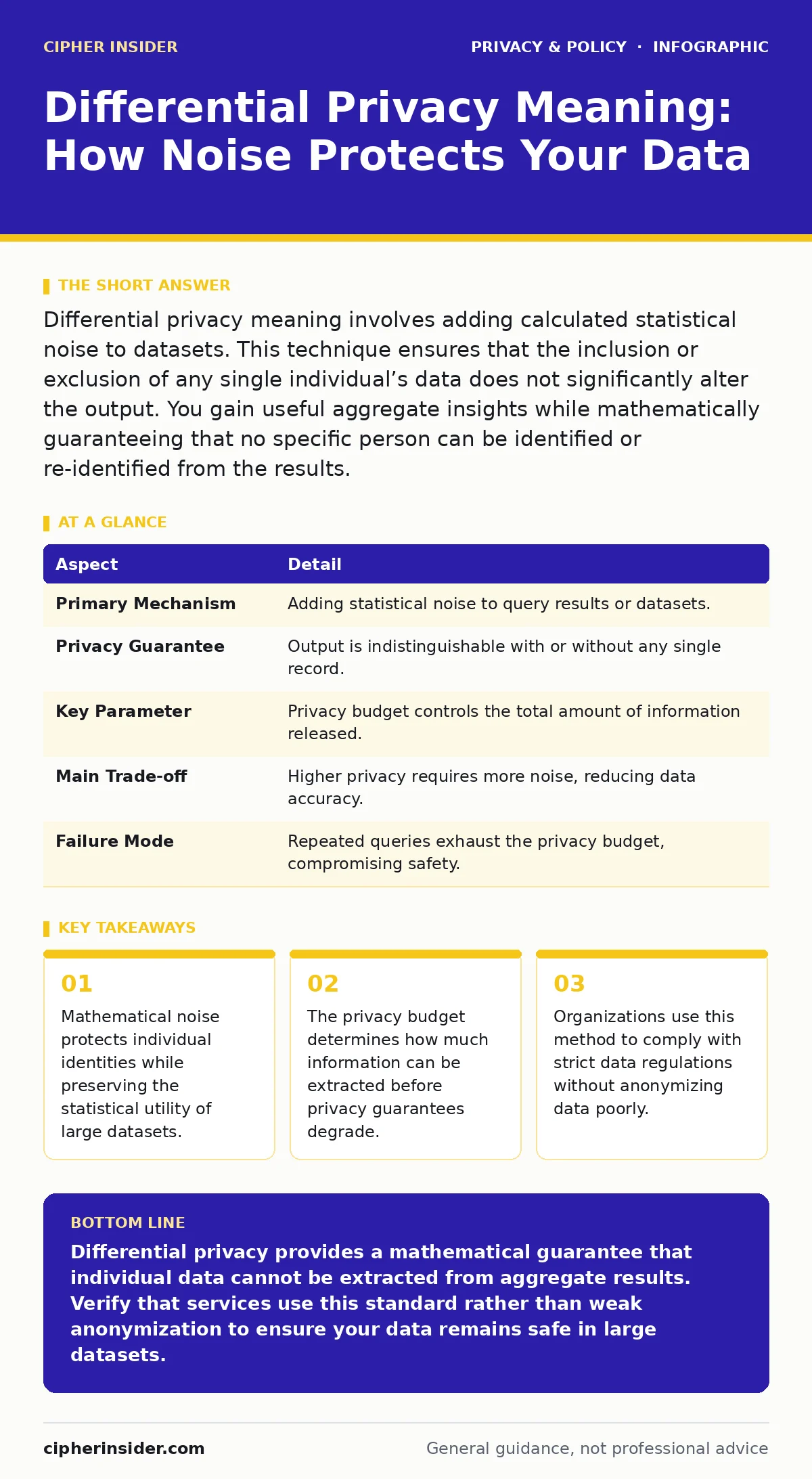
Differential privacy meaning involves adding calculated statistical noise to datasets. This technique ensures that the inclusion or exclusion of any single individual’s data does not significantly alter the output. You gain useful aggregate insights while mathematically guaranteeing that no specific person can be identified or re-identified from the results.
Understanding the Core Concept
Imagine a librarian who is asked how many books a specific patron checked out. To protect privacy, the librarian adds a random number to the actual count before answering. If you ask the librarian about 100 patrons, the random errors cancel out, revealing the average reading habits of the group. However, you cannot determine exactly what any single person read. This is the essence of differential privacy.
Differential privacy meaning relies on this principle of calibrated noise. It is a mathematical framework that quantifies the risk of re-identifying individuals within a dataset. Unlike simple anonymization, which strips names and addresses, this method adds uncertainty to the data itself. The system ensures that the output looks statistically similar whether or not any one person’s data is present.
This approach shifts the focus from hiding data to protecting the result. You do not need to trust the data holder to keep secrets. Instead, you trust the mathematics that guarantees no single record can influence the outcome enough to be detected. This provides a rigorous, provable standard for privacy that holds up against sophisticated analysis.
At a Glance: How the System Works
| Aspect | Detail |
|---|---|
| Primary Mechanism | Adding statistical noise to query results or datasets. |
| Privacy Guarantee | Output is indistinguishable with or without any single record. |
| Key Parameter | Privacy budget controls the total amount of information released. |
| Main Trade-off | Higher privacy requires more noise, reducing data accuracy. |
| Failure Mode | Repeated queries exhaust the privacy budget, compromising safety. |
The Mechanics of Noise and Budgets
The system works by injecting random noise into the data before it is published or analyzed. The amount of noise depends on the sensitivity of the query. If a query asks for a count of people with a rare disease, the noise must be high because one person’s presence changes the result significantly. If the query asks for the average age of millions, less noise is needed.
You must manage a privacy budget carefully. This budget represents the total privacy loss allowed for a dataset. Every query against the data consumes part of this budget. If you run too many queries, the accumulated noise becomes predictable, and an attacker can reverse-engineer individual records. Organizations track this budget to ensure they never exceed the safe threshold for information disclosure.
The noise is usually generated using Laplace or Gaussian distributions. These mathematical functions ensure that the noise is unpredictable and symmetric. Positive and negative errors balance out over large datasets, preserving the overall trends. This allows researchers to study population-level patterns without ever seeing the raw data of individuals. The security does not rely on obscurity but on verifiable mathematical properties.
Who Is Affected by This Technology
You are affected whenever an organization collects data about your behavior. Tech companies use this method to improve services without exposing your personal history. For example, a keyboard app might learn new words from user inputs while ensuring no single typing pattern is leaked. This allows for better predictive text without compromising your specific searches or messages.
Governments use this technique to publish census data. They need to share demographic trends for planning schools and hospitals, but they cannot risk revealing details about small communities or unique families.
Researchers benefit from access to rich datasets that would otherwise be too sensitive to share. Medical institutions can collaborate on disease studies without sharing patient records. This accelerates scientific discovery while maintaining ethical standards. You, as a user, get the benefit of improved services and public goods without the risk of your personal data being exposed in a breach.
Common Misconceptions About Privacy
People often confuse differential privacy with simple anonymization. Anonymization removes direct identifiers like names and email addresses. This is insufficient because attackers can cross-reference remaining data with public records to re-identify individuals. Differential privacy does not remove data; it obscures the truth with mathematical noise. It protects against linkage attacks that anonymization cannot stop.
Another mistake is assuming the data is perfectly accurate. The added noise introduces error. You must accept that individual-level precision is sacrificed for population-level accuracy. If you need to know exactly what one person did, this method will not help you. It is designed for trends, averages, and distributions. Expecting exactness from a differentially private system is a fundamental misunderstanding of its purpose.
Some believe that once data is processed, it is safe forever. This is false. If an organization releases multiple differentially private reports without managing the privacy budget, the cumulative information can leak private details. You should check if the organization uses a strict budget management system. Without it, the privacy guarantees degrade over time, eventually revealing the very information they were meant to protect.
See also: What is online tracking: how data follows you and how to stop it · Data Subject Rights Request: How to Process and Respond Correctly
What You Should Do Next
You cannot implement this technology yourself on your personal device. It requires centralized data processing and careful mathematical tuning. However, you can identify which services use it. Look for privacy policies that explicitly mention "differential privacy" rather than just "anonymization" or "aggregation." This distinction indicates a higher standard of protection. Services using this method are less likely to sell your identifiable data to third parties.
Consider how you manage your other digital footprints. While this technology protects data in aggregate, your online anonymity is still vulnerable through other channels. Combining knowledge of online anonymity techniques with an understanding of backend privacy measures gives you a fuller picture of your digital safety. You should also review your settings for ad tracking to minimize the data collected in the first place.
Be cautious of services that claim total privacy without explaining the method. Vague promises of safety are often marketing speak. True privacy engineering involves trade-offs and specific mechanisms. If a company does not explain how they balance utility and privacy, they may not be using rigorous standards. You can explore right to be forgotten options to remove historical data, but for future data, prefer services that employ mathematical privacy guarantees.
Integrating Privacy Into Your Routine
Protecting your data requires a layered approach. Differential privacy protects you at the system level, but you still need to protect yourself at the application level. Use encrypted email for sensitive communications to ensure end-to-end security. This complements the backend privacy measures by securing the data in transit and at rest on your device.
For families, managing permissions is complex. Parental controls can limit data collection from children’s devices, reducing the amount of sensitive information that enters these systems. Fewer data points mean less risk, even if the privacy mechanisms are strong. You should also use password managers for families to ensure that strong, unique credentials are used, preventing account takeovers that could expose data before it is even processed.
Understanding consent management helps you control what data is collected initially. Even with strong backend privacy, less data collected means less potential for harm. You can combine these practices with opting out of data brokers to reduce the amount of your profile available for cross-referencing. This holistic strategy ensures that your data is protected both before it is collected and after it is aggregated.
Key takeaways
- Mathematical noise protects individual identities while preserving the statistical utility of large datasets.
- The privacy budget determines how much information can be extracted before privacy guarantees degrade.
- Organizations use this method to comply with strict data regulations without anonymizing data poorly.
- Readers should verify if services use true differential privacy or weaker pseudonymization techniques.
Differential privacy provides a mathematical guarantee that individual data cannot be extracted from aggregate results. Verify that services use this standard rather than weak anonymization to ensure your data remains safe in large datasets.
Frequently asked questions
Does differential privacy make my data completely anonymous?
No, it makes it statistically impossible to determine if your specific data is in the set. It protects against re-identification rather than removing identifiers entirely.
Can companies still use my data for advertising with this method?
Yes, they can use the aggregated trends to improve ad targeting models. They cannot target you as an individual based on your specific private data within the model.
Is this better than encryption?
It serves a different purpose. Encryption protects data in transit and storage. Differential privacy protects data during analysis and aggregation. Both are needed for full security.
How do I know if a service is using it correctly?
Look for technical documentation or white papers from the vendor. They should explain their privacy budget management and the specific noise mechanisms they employ.
How this guide was produced: written by the Cipher Insider editorial team with AI assistance, checked against the public references listed below, and reviewed when the facts change. See our editorial policy or report an error.