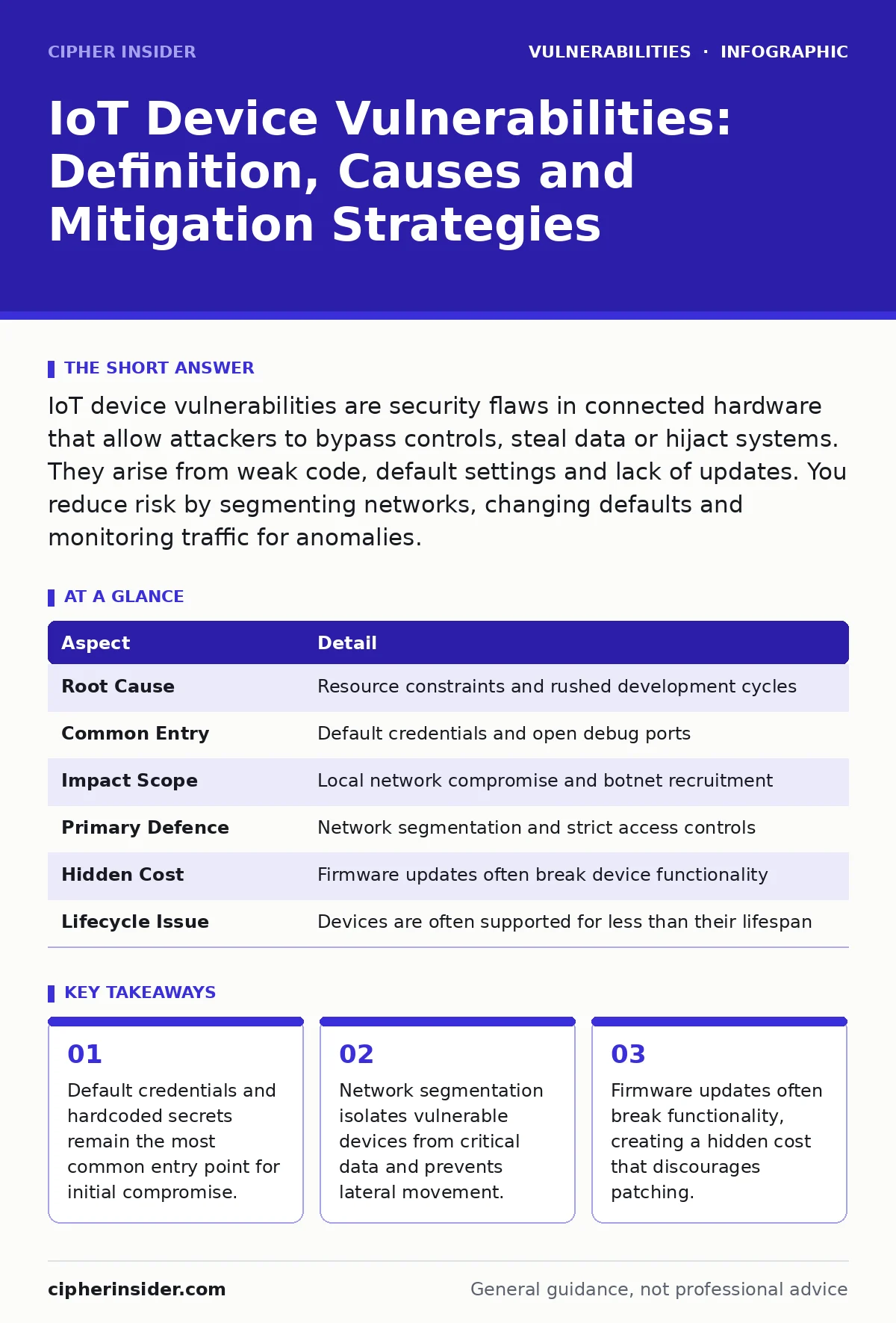
IoT device vulnerabilities are security flaws in connected hardware that allow attackers to bypass controls, steal data or hijact systems. They arise from weak code, default settings and lack of updates. You reduce risk by segmenting networks, changing defaults and monitoring traffic for anomalies.
What Are IoT Device Vulnerabilities
Imagine a smart lock that uses the same factory password for every unit sold. An attacker does not need to pick the lock; they simply try the known code. IoT device vulnerabilities are weaknesses in internet-connected hardware that allow unauthorised access or control. These flaws exist in the firmware, the network stack or the physical design. Unlike servers, these devices often run for years without human interaction. The definition extends beyond software bugs to include hardware limitations that prevent security patches. A vulnerability becomes a risk only when an attacker can exploit it to achieve a goal, such as data theft or service disruption.
At a Glance
| Aspect | Detail |
|---|---|
| Root Cause | Resource constraints and rushed development cycles |
| Common Entry | Default credentials and open debug ports |
| Impact Scope | Local network compromise and botnet recruitment |
| Primary Defence | Network segmentation and strict access controls |
| Hidden Cost | Firmware updates often break device functionality |
| Lifecycle Issue | Devices are often supported for less than their lifespan |
How Vulnerabilities Manifest in Hardware
Security flaws in internet of things devices stem from three main areas. First, firmware often contains hardcoded credentials. Developers embed these secrets to simplify manufacturing or debugging. They forget to remove them before shipping. Second, the network stack may lack encryption. Devices transmit data in plain text, allowing anyone on the local network to read sensor readings or camera feeds. Third, physical interfaces remain exposed. Debug ports like UART or JTAG allow direct access to the system memory. Attackers use these ports to extract keys or modify the operating system. The combination of these factors creates a wide attack surface.
Who Is Affected by Weak IoT Security
The impact of these flaws extends beyond the device owner. A compromised smart thermostat can disrupt home comfort. A hacked industrial sensor can halt production lines. More broadly, attackers recruit vulnerable devices into botnets. These networks of hijacked devices launch distributed denial of service attacks against other targets. The original owner pays the electricity bill and provides the bandwidth. The attacker gains a powerful tool for extortion or disruption. Critical infrastructure operators face the highest stakes. A vulnerability in a water treatment sensor can lead to physical harm. The ripple effect touches service providers, neighbours and the wider internet.
Common Forms of Exploitation
Attackers exploit specific weaknesses to gain control. One common form is the use of default credentials. Many devices ship with well-known usernames and passwords. Attackers scan the internet for these open ports. Another form is insecure direct object references (IDOR). This occurs when an application allows users to access resources they should not. An attacker changes a parameter in the URL to view another user's data. A third form is unpatched software. Vendors often stop updating devices after a short period. The known flaws remain open forever. Attackers use automated tools to find and exploit these static weaknesses.
See also: Secure Configuration Baselines for Small Businesses · Host Header Injection: Risks and Protection for Small Businesses
What People Usually Get Wrong
Many users believe that being on a private network ensures safety. This is a dangerous misconception. Attackers who compromise one device can pivot to others on the same network. They treat the IoT device as a beachhead. Another common error is assuming that biometric locks are secure. The sensor itself may be vulnerable to spoofing or side-channel attacks. These attacks measure power consumption or electromagnetic leaks to extract keys. Finally, users often ignore the physical security of the device. If an attacker can touch the device, they can often reset it or access debug ports. Physical access negates most software protections.
The Hidden Cost of Patching
Updating firmware is not always straightforward. Many IoT devices have limited storage. A new firmware image may not fit. Some updates change the device's behaviour, breaking automation rules. Users hesitate to update because they fear losing functionality. This creates a stale environment. The device runs known vulnerable code for years. Vendors struggle to balance security with compatibility. They may skip critical patches to avoid breaking user workflows. This trade-off leaves the device exposed. The cost of inaction is often higher than the inconvenience of a broken feature.
Reducing Risk Through Architecture
You can mitigate these risks through careful network design. Network segmentation is the most effective step. Place IoT devices on a separate virtual local area network. This prevents them from accessing your main computers or servers. Use strict firewall rules to limit outbound traffic. Devices should only talk to known cloud endpoints. Disable unused services like Telnet or FTP. Change all default credentials immediately. Use strong, unique passwords for each device. Monitor network traffic for anomalies. A device suddenly sending large amounts of data may be compromised. Regularly review device logs if available.
Integrating Security Testing
Traditional web testing tools often miss hardware flaws. You need a different approach. Dynamic application security testing (DAST) can scan the web interface of the device. It finds common web vulnerabilities like cross-site scripting. However, it cannot see inside the firmware. For deeper analysis, you need binary analysis tools.
These tools examine the compiled code for hardcoded secrets or logic errors. You should also test for vulnerabilities in VPN gateways and application delivery controllers if the device connects through them. These entry points are often overlooked. A secure device is useless if the gateway is weak. Combine automated scanning with manual review. Look for unusual network connections or open debug ports.
Managing the Device Lifecycle
Security does not end at purchase. You must manage the device throughout its life. Create an inventory of all connected devices. Note their firmware versions and end-of-life dates. Plan for replacement before support ends. When a device is no longer updated, it becomes a permanent risk. Remove it from the network or isolate it completely. Do not leave old devices connected to the internet. They serve no purpose and only provide attack vectors. Regularly audit your network for unknown devices. Rogue devices can appear when guests connect or when old equipment is rediscovered. Keep your documentation current.
Conclusion on IoT Security Posture
Securing internet of things devices requires a shift in mindset. You cannot rely on the device to protect itself. You must protect the network around it. Assume every device is compromised. Design your architecture to limit the damage. Use segmentation, strong authentication and monitoring. Accept that some devices will never be fully secure. Mitigate the risk by reducing their access. Stay informed about new threats. The landscape of IoT security evolves rapidly. New attack vectors emerge as devices become more powerful. Your defence must adapt accordingly.
Key takeaways
- Default credentials and hardcoded secrets remain the most common entry point for initial compromise.
- Network segmentation isolates vulnerable devices from critical data and prevents lateral movement.
- Firmware updates often break functionality, creating a hidden cost that discourages patching.
Frequently asked questions
Can a smart light bulb hack my computer?
A compromised light bulb can scan your local network and exploit vulnerabilities in other devices. It cannot directly hack your computer unless your computer has an open vulnerability that the bulb can reach. Network segmentation prevents this lateral movement.
Do I need to change the Wi-Fi password for IoT security?
Changing the Wi-Fi password helps prevent unauthorised access to your network. It does not fix vulnerabilities within the devices themselves. You must also change device-specific credentials and update firmware to address internal flaws.
Are open-source IoT devices more secure?
Open-source firmware allows independent review of the code, which can lead to faster discovery of bugs. However, it also exposes the code to attackers who can study it for weaknesses. Security depends on the quality of the code and the responsiveness of the maintainers, not just the licensing model.
How do I know if my device has been hacked?
Look for unusual network activity, such as traffic to unknown external servers. Check for changes in device behaviour, like lights turning on unexpectedly. Review logs if available. Use network monitoring tools to detect anomalies in traffic patterns or connection attempts.
How this guide was produced: written by the Cipher Insider editorial team with AI assistance, checked against the public references listed below, and reviewed when the facts change. See our editorial policy or report an error.