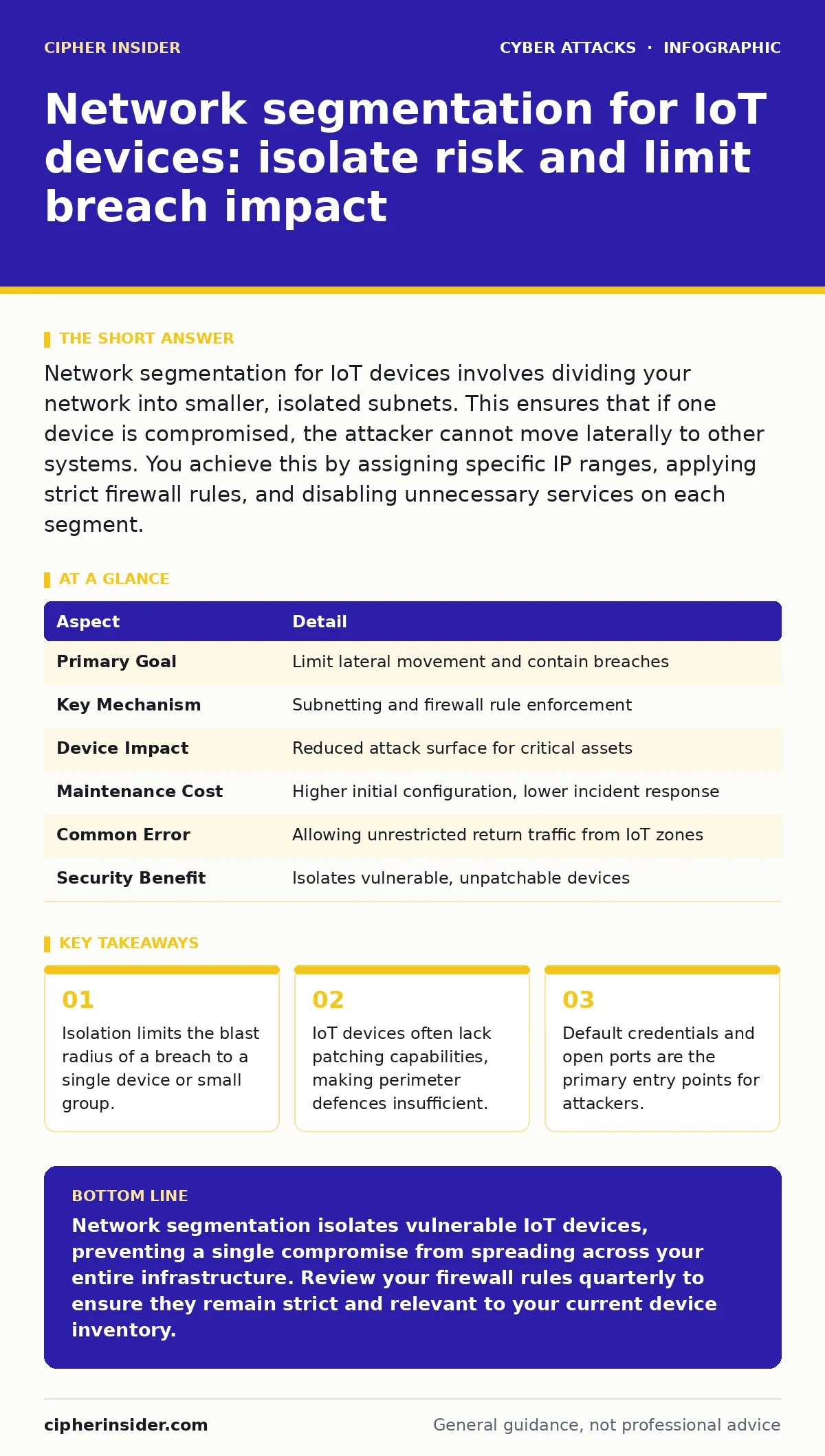
Network segmentation for IoT devices involves dividing your network into smaller, isolated subnets. This ensures that if one device is compromised, the attacker cannot move laterally to other systems. You achieve this by assigning specific IP ranges, applying strict firewall rules, and disabling unnecessary services on each segment.
Why general networks fail against connected devices
Imagine a building where every room shares the same front door and internal corridors. If an intruder enters through a broken window in the laundry room, they can walk freely into the safe deposit box area. This is how most unsegmented networks operate. Every device shares the same broadcast domain and security posture. A smart thermostat has the same potential access path to the financial server as the CEO’s laptop. This flat architecture assumes all devices are equally trustworthy and equally secure.
Internet of Things (IoT) devices break this assumption. They run embedded operating systems that rarely receive security updates. Many have hardcoded credentials that cannot be changed. Others expose management interfaces on standard ports without authentication. When these devices connect to a general corporate network, they become weak links. An attacker does not need to exploit a complex vulnerability in your main server. They only need to find one vulnerable IoT device to gain a foothold.
How network segmentation for IoT devices works
Network segmentation divides a single large network into smaller, distinct subnets. Each subnet acts as a separate zone with its own security controls. You place IoT devices in a dedicated segment that is isolated from the main corporate LAN. Traffic between these segments is filtered by a firewall or an access control list. Only explicitly permitted traffic is allowed to pass. All other traffic is dropped by default.
This mechanism relies on the principle of least privilege. A smart camera does not need to access the HR database. A coffee machine does not need to communicate with the engineering file server. By restricting communication to only what is necessary, you remove the pathways an attacker uses for lateral movement. If the coffee machine is compromised, the attacker is stuck in that segment. They cannot pivot to other systems because the firewall blocks the connection attempts. This containment is the core benefit of segmentation.
| Aspect | Detail |
|---|---|
| Primary Goal | Limit lateral movement and contain breaches |
| Key Mechanism | Subnetting and firewall rule enforcement |
| Device Impact | Reduced attack surface for critical assets |
| Maintenance Cost | Higher initial configuration, lower incident response |
| Common Error | Allowing unrestricted return traffic from IoT zones |
| Security Benefit | Isolates vulnerable, unpatchable devices |
The hidden costs of isolation
Segregation is not just about drawing lines on a network diagram. It requires understanding the communication patterns of every device. Many IoT devices use proprietary protocols or broadcast discovery messages to find their companion apps or cloud services. If you block these broadcasts, the device may appear offline or fail to function. You must identify the specific ports and protocols each device uses. This often involves packet capture analysis during the deployment phase.
There is also a management overhead. You cannot simply plug devices into the wall and expect them to work. Each device must be assigned to the correct VLAN (Virtual Local Area Network). You must configure DNS settings, DHCP scopes, and gateway rules for that segment. If a vendor changes their cloud endpoint, your firewall rules may break connectivity. This means your network team must maintain a registry of device requirements. Neglecting this maintenance leads to shadow IT, where users bypass security controls to get devices working.
What people usually get wrong
Many organisations treat segmentation as a one-time project. They create an IoT VLAN at the start of the year and never revisit it. New devices are added without review. Old devices are removed without cleaning up the rules. Over time, the firewall rules become bloated and permissive. This "rule creep" erodes the security benefits. The segment becomes a catch-all for any device that does not fit elsewhere.
Another common mistake is assuming that wireless isolation is sufficient. Many Wi-Fi access points offer a "guest network" feature that isolates clients from each other. This is often used for IoT devices. However, guest networks typically allow unrestricted internet access. If a device on the guest network is compromised, it can still be used to launch attacks against external targets or scan for other vulnerabilities. It does not protect your internal assets from the device itself if the device has any internal discovery capabilities.
You must also consider Bluetooth attacks and USB drop attacks. A segmented network protects against network-based threats. It does not stop an attacker from physically pairing with a Bluetooth-enabled IoT device or inserting a malicious USB drive into a management port. Physical security and device hardening remain necessary complements to network segmentation.
Implementing effective isolation
Start by inventorying all IoT devices. Record their manufacturer, model, firmware version, and required network services. Group devices by function rather than by location. All smart cameras go in one segment. All environmental sensors go in another. This functional grouping allows you to apply consistent security policies.
Configure your firewall to deny all traffic by default. Then, create allow rules for specific communication needs. A sensor may need to send data to a central collector. Create a rule that allows traffic from the sensor’s IP to the collector’s IP on the specific port. Do not allow the sensor to initiate connections to the corporate LAN. Use jump hosts or proxy servers if the IoT segment needs to access external resources. This adds a layer of inspection and logging.
Monitor traffic within the IoT segment. Look for unusual patterns, such as a device communicating with an unknown external IP or scanning other devices in the segment. These anomalies often indicate a compromise. Alerting on lateral movement attempts within the IoT zone can help you detect breaches early. This monitoring is critical because IoT devices are often noisy and difficult to debug.
See also: Tor Browser Explained: Routing, Relays, and Real Anonymity · Does Private Browsing Work: The Reality of Local Data Isolation
Balancing usability and security
Users will resist segmentation if it breaks their workflow. If a smart display cannot connect to its cloud service because of a firewall rule, the user will ask IT to disable the rule. This creates a tension between security and operations. You must document the business justification for each rule. Explain why a device needs specific access. This documentation helps when troubleshooting and during security audits.
Consider using a captive portal for IoT device onboarding. This allows you to authenticate the device before granting network access. You can assign the device to the correct VLAN based on its certificate or MAC address. This prevents unauthorized devices from joining the IoT segment. It also ensures that only known, approved devices can communicate. This approach adds a layer of identity-based security to the network-level controls.
Remember that segmentation reduces the blast radius, but it does not eliminate risk. A compromised device can still be used to launch external attacks or disrupt local services. You must combine segmentation with regular firmware updates, strong authentication, and physical security. This defence-in-depth strategy ensures that if one layer fails, others remain to protect your assets.
Managing long-term maintenance
Network segmentation is not static. Devices are added, removed, and updated. Vendors change their cloud infrastructure. Protocols evolve. You must establish a process for reviewing and updating segmentation rules. Schedule quarterly reviews of firewall rules and VLAN assignments. Remove rules for devices that are no longer in use. Consolidate redundant rules to improve performance and clarity.
Automate where possible. Use configuration management tools to deploy firewall rules and VLAN settings. This reduces human error and ensures consistency across multiple sites. If you have many locations, centralise your network management to enforce a single security policy. This prevents local administrators from creating weak configurations that undermine the overall security posture.
Training is also part of maintenance. Ensure that network engineers understand the purpose of each segment. They should know why certain traffic is blocked and how to troubleshoot connectivity issues without bypassing security controls. This knowledge prevents accidental misconfigurations that could expose critical assets.
Key takeaways
- Isolation limits the blast radius of a breach to a single device or small group.
- IoT devices often lack patching capabilities, making perimeter defences insufficient.
- Default credentials and open ports are the primary entry points for attackers.
- Segmentation requires careful planning to avoid breaking legitimate device functionality.
Network segmentation isolates vulnerable IoT devices, preventing a single compromise from spreading across your entire infrastructure. Review your firewall rules quarterly to ensure they remain strict and relevant to your current device inventory.
Frequently asked questions
Does network segmentation protect against phishing?
No, segmentation protects against lateral movement after a breach. Phishing targets users to gain initial access or credentials. You need security awareness training and email filtering to mitigate phishing risks.
Can I use VLANs for IoT segmentation?
Yes, VLANs are a standard method for creating logical segments. You must configure your switches and firewalls to enforce traffic rules between these VLANs to ensure true isolation.
What is the blast radius in this context?
The blast radius is the extent of damage caused by a security breach. Segmentation reduces the blast radius by confining the attack to a single network segment, protecting other assets.
Do I need to segment guest Wi-Fi?
Yes, guest Wi-Fi should be segmented from the corporate network. Treat it as an untrusted zone. Do not allow guest devices to access internal resources or other guest devices if possible.
How this guide was produced: written by the Cipher Insider editorial team with AI assistance, checked against the public references listed below, and reviewed when the facts change. See our editorial policy or report an error.