
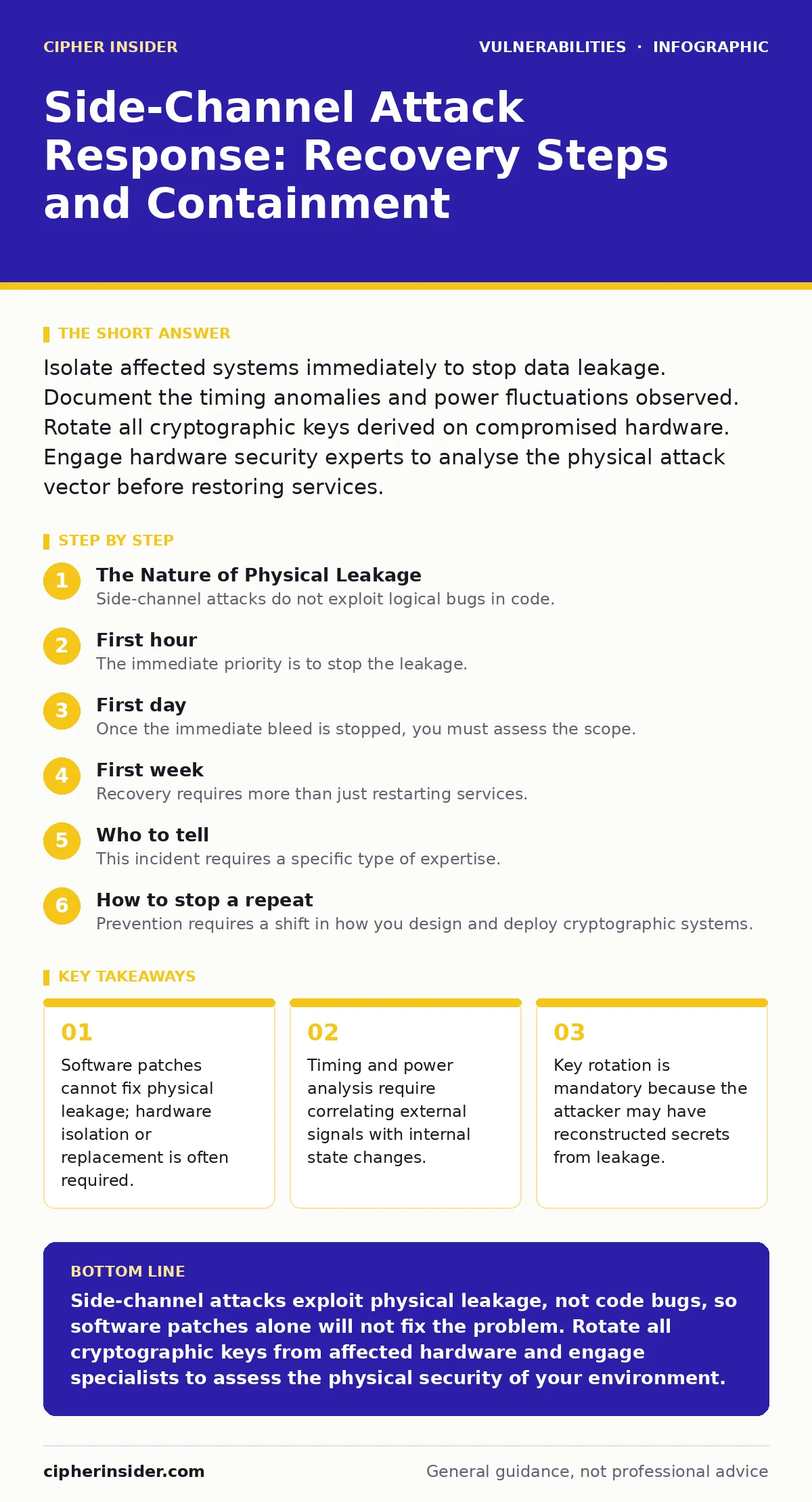
Isolate affected systems immediately to stop data leakage. Document the timing anomalies and power fluctuations observed. Rotate all cryptographic keys derived on compromised hardware. Engage hardware security experts to analyse the physical attack vector before restoring services.
The Nature of Physical Leakage
Side-channel attacks do not exploit logical bugs in code. Instead, they observe the physical implementation of a cryptographic algorithm. When a processor computes a value, it consumes power, emits electromagnetic radiation, and takes a specific amount of time. These physical traits correlate with the data being processed. An attacker measures these variations to deduce secret keys without ever touching the software logic.
This distinction matters because your standard incident response playbook assumes a software vulnerability. You cannot patch a timing leak with a line of code. You must address the physical environment or the hardware design. If you treat this like a standard breach, you will fail to contain the root cause.
First hour
The immediate priority is to stop the leakage. The attacker is likely recording data in real-time or has captured enough samples to begin analysis. You must sever the connection between the cryptographic operation and the observable physical world.
- Isolate the affected hardware from the network to prevent exfiltration of any data already extracted.
- Preserve the current state of the system. Take a memory dump if possible without altering the timing characteristics.
- Identify the specific hardware component under attack. Is it a smart card, a server CPU, or an embedded microcontroller?
- Document the environmental conditions. Note any nearby equipment that could serve as a sensor, such as oscilloscopes or near-field probes.
- Notify the hardware security team. This is not a software issue. Standard IT support cannot resolve physical leakage.
First day
Once the immediate bleed is stopped, you must assess the scope. Side-channel attacks can be passive. The attacker may have been recording data for weeks without triggering any alerts. You need to determine how much data was captured and which keys were exposed.
Imagine a scenario where a server’s power supply noise was monitored from the outside. The attacker correlates power spikes with specific encryption operations. If you only look at software logs, you will see nothing unusual. The logs show successful operations. The truth is in the physics.
You must review your IT asset inventory to identify all devices using the same cryptographic module or hardware design. If one device is vulnerable to timing attacks, others of the same model likely are too. Cross-reference this with your security misconfigurations audit. Did you disable constant-time execution libraries? Did you allow variable-time operations for performance gains? These choices often enable side-channel leakage.
First week
Recovery requires more than just restarting services. You must invalidate the compromised secrets. Every key generated or used on the affected hardware must be considered exposed. This includes session keys, long-term encryption keys, and authentication tokens.
Rotate all affected keys immediately. Do not reuse old keys. Generate new keys on secure, uncompromised hardware. If the hardware itself is fundamentally flawed, you may need to replace it. Software mitigations, such as adding random delays, can reduce the effectiveness of timing attacks but do not eliminate the risk. They add latency and complexity.
Review your development practices. Are your developers aware of CWE weakness categories related to timing and power analysis? Code that runs in variable time is vulnerable. Implement constant-time algorithms where possible. These algorithms take the same amount of time regardless of the input data. This removes the correlation between time and secret data.
Who to tell
This incident requires a specific type of expertise. You need to inform your hardware security engineers and cryptographic specialists. They understand the nuances of electromagnetic shielding and power analysis. Do not rely solely on your software security team. They may look for code bugs that do not exist.
Inform your legal and compliance teams if sensitive data was processed on the affected systems. Side-channel attacks can extract plaintext if the attacker has enough samples and computational power. You must assess the regulatory impact. Transparency with your users may be required if personal data was at risk.
See also: Alert Triage and Reporting is the Responsibility of: Who Owns the Noise? · Watering Hole Attack Response: Containment and Recovery Steps
How to stop a repeat
Prevention requires a shift in how you design and deploy cryptographic systems. You must assume that all physical implementations are leaky. Design your systems to minimise the information available to an attacker. Use hardware security modules that are designed with side-channel resistance in mind. These modules include shielding, noise generators, and constant-time logic.
Regularly audit your cryptographic implementations. Check for variable-time operations. Ensure that automatic software updates include patches for cryptographic libraries that may introduce timing leaks. Keep an eye on unpatched software that might use outdated, vulnerable cryptographic routines.
The Hidden Cost of Mitigation
Adding side-channel countermeasures has a cost. Constant-time algorithms often run slower than optimised, variable-time versions. Adding noise to power consumption reduces efficiency. You must balance security with performance. In some high-performance computing scenarios, this trade-off is difficult.
Do not ignore command injection risks either. An attacker who gains code execution can install a malicious side-channel sensor. They can write software that deliberately leaks data through timing or power channels. Secure the operating system to prevent unauthorised code execution. This limits the attacker’s ability to enhance their side-channel capabilities.
Beyond the Code
Side-channel attacks remind us that security is not just about code. It is about physics. You cannot secure a system by only reviewing its software. You must consider the hardware, the environment, and the physical access an attacker might have.
This perspective changes how you approach insecure direct object references (IDOR). While IDOR is a logical flaw, side-channels are physical flaws. Both require different detection methods. You cannot find a side-channel leak with a standard web application scanner. You need specialised equipment and expertise.
Consider NoSQL injection and other injection flaws as logical entry points. Once an attacker has access, they may use side-channels to extract deeper secrets. Defend at every layer. Logical security protects against direct attacks. Physical security protects against observational attacks. Both are necessary.
Key takeaways
- Software patches cannot fix physical leakage; hardware isolation or replacement is often required.
- Timing and power analysis require correlating external signals with internal state changes.
- Key rotation is mandatory because the attacker may have reconstructed secrets from leakage.
Side-channel attacks exploit physical leakage, not code bugs, so software patches alone will not fix the problem. Rotate all cryptographic keys from affected hardware and engage specialists to assess the physical security of your environment.
Frequently asked questions
Can antivirus software detect a side-channel attack?
No. Antivirus software monitors for malicious code and behaviour. Side-channel attacks are passive observations of physical traits. There is no malicious code to detect.
How do I know if my system is vulnerable to timing attacks?
You need to audit your cryptographic code for variable-time operations. Look for branches or loops that depend on secret data. Specialised tools can measure execution time variations to identify leaks.
Is replacing the hardware always necessary?
Not always. If the vulnerability is in the software implementation, you can fix it by using constant-time algorithms. If the hardware design itself leaks information, such as through power lines, replacement or shielding is required.
Can I prevent side-channel attacks with encryption?
Encryption protects the data, but not the process of encrypting it. Side-channel attacks target the encryption process itself. You need physical and algorithmic countermeasures to protect the operation.
How this guide was produced: written by the Cipher Insider editorial team with AI assistance, checked against the public references listed below, and reviewed when the facts change. See our editorial policy or report an error.