
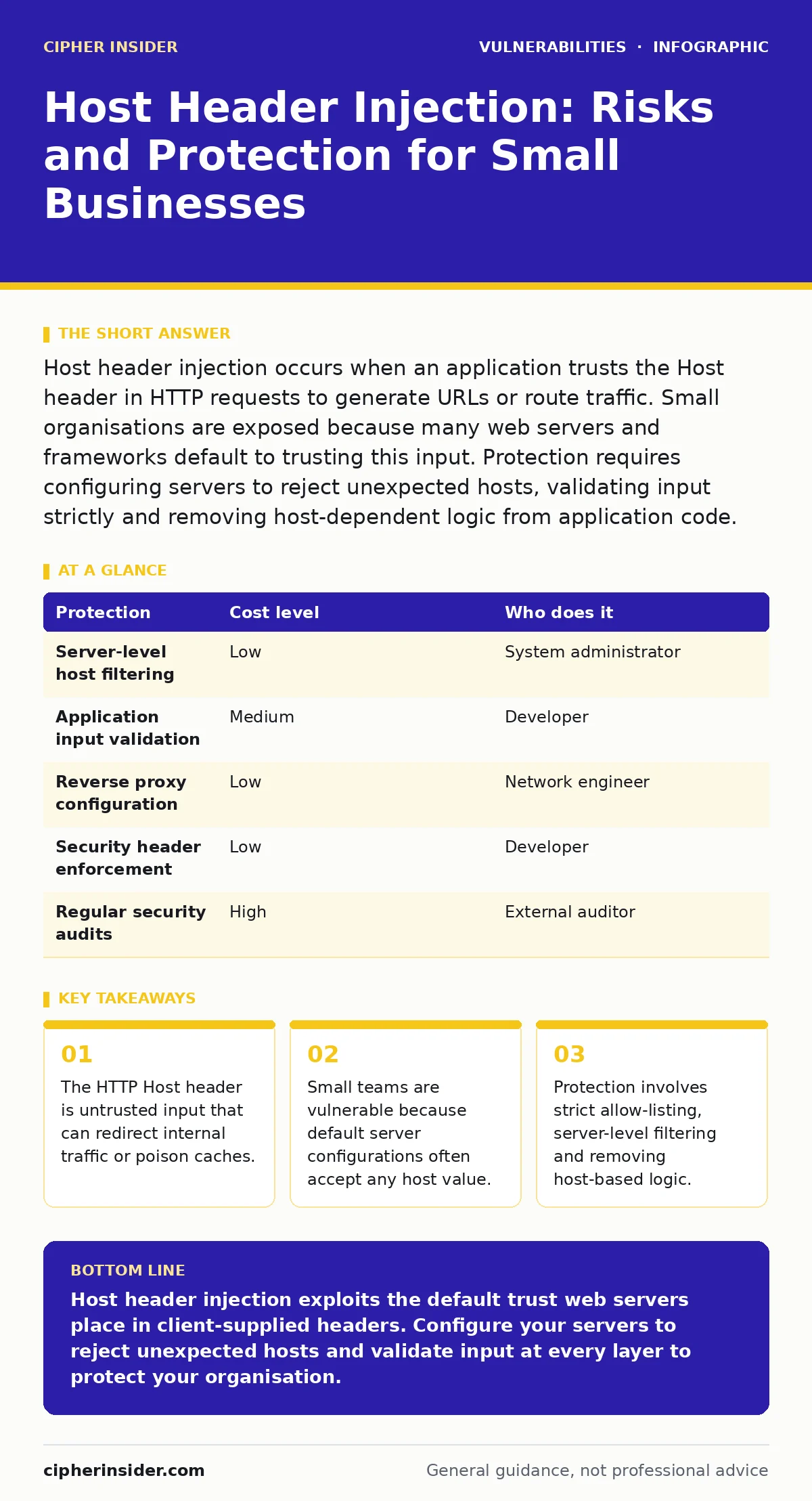
Host header injection occurs when an application trusts the Host header in HTTP requests to generate URLs or route traffic. Small organisations are exposed because many web servers and frameworks default to trusting this input. Protection requires configuring servers to reject unexpected hosts, validating input strictly and removing host-dependent logic from application code.
How Host Header Injection Works
The HTTP Host header tells a web server which domain the client intends to reach. This mechanism allows multiple domains to share one IP address. Applications often read this header to construct absolute URLs for email links, redirects or API calls. When an application uses the Host header without validation, an attacker can substitute a malicious domain.
The server processes the request normally but generates links pointing to the attacker’s infrastructure. This breaks the trust boundary between the client and the server. The application logic remains unchanged, but the output becomes dangerous. This is distinct from command injection, where an attacker executes arbitrary system commands. Here, the attacker manipulates data flow and trust relationships.
Why Small Organisations Are Exposed
Small businesses often rely on default configurations for web servers and application frameworks. These defaults prioritise ease of setup over security. Many frameworks automatically use the Host header for URL generation. Developers may not realise this implicit trust until an incident occurs.
Limited resources mean fewer security audits. Vulnerability scanning tools might miss this issue if they do not specifically test for host header manipulation. The attack surface expands when organisations use complex routing or load balancers. If the infrastructure forwards the original Host header without sanitisation, the application sees the forged value. This creates a chain of trust failures that are hard to detect.
The Hidden Costs of Trusting Input
Trusting the Host header creates subtle risks beyond simple phishing. Cache poisoning is a significant threat. If a server caches responses based on the Host header, an attacker can inject a malicious host value. The server caches the response for that host. Subsequent legitimate users who are routed to that cache entry receive the poisoned content.
This persistence means the attack survives even after the initial request is gone. The attacker controls the content served to victims until the cache expires or is purged. Another risk is server-side request forgery. If the application uses the Host header to make internal API calls, an attacker might redirect internal traffic to external services. This can expose internal metadata or trigger unintended actions.
| Protection | Cost level | Who does it |
|---|---|---|
| Server-level host filtering | Low | System administrator |
| Application input validation | Medium | Developer |
| Reverse proxy configuration | Low | Network engineer |
| Security header enforcement | Low | Developer |
| Regular security audits | High | External auditor |
Low-Cost Protections for Limited Budgets
You can mitigate host header injection without expensive tools. The first step is server-level filtering. Configure your web server to reject requests where the Host header does not match expected domains. This blocks the attack at the entry point. Most standard web servers support this configuration natively.
The second step is application-level validation. Ensure your application code does not use the Host header for security-sensitive operations. Use configuration files or environment variables for domain names. This decouples the application logic from the incoming request. The third step is to implement strict Content-Security-Policy headers. This limits where browsers can load resources, reducing the impact of cache poisoning.
Configuring Servers and Proxies Correctly
Reverse proxies and load balancers play a key role in traffic management. They often forward the Host header to backend servers. If the proxy does not validate the header, the backend receives the forged value. Configure your proxy to inspect and sanitise the Host header before forwarding.
You should define an allow-list of valid hostnames. Any request with a Host header not on this list should be rejected with a 400 Bad Request response. This approach is more secure than a block-list, which attackers can bypass with creative variations. Ensure your configuration applies to all entry points, including internal APIs and management interfaces.
See also: Data Scraping Myths: What Automated Collection Really Reveals · How Token Theft Works: The Mechanics of Session Hijacking
What to Ask an IT Provider
When outsourcing infrastructure management, you must verify how host headers are handled. Ask your provider specific questions about their security posture. These questions help you understand their depth of knowledge and their commitment to secure configurations.
- How do you validate the HTTP Host header at the network edge?
- Do you use allow-lists for permitted hostnames on all public-facing services?
- How do you handle host headers in internal API communications?
- What is your process for updating server configurations after a vulnerability is disclosed?
These questions reveal whether the provider understands the nuances of HTTP security. A vague answer indicates a lack of specific expertise. You need a provider who treats input validation as a core security requirement, not an afterthought.
Integrating with Broader Security Practices
Host header injection rarely occurs in isolation. Attackers often combine it with other vulnerabilities to increase impact. This is known as vulnerability chaining. For example, an attacker might use host header injection to bypass a web application firewall, then exploit an unpatched software flaw in the backend.
Understanding this interplay is vital for comprehensive defence. You should assess your systems for related risks. For instance, vulnerabilities in VPN gateways and application delivery controllers can expose internal services to similar header manipulation attacks. Similarly, IoT device vulnerabilities might allow an attacker to inject headers from within the network, bypassing perimeter controls.
Maintaining Long-Term Defences
Security is not a one-time configuration. You must maintain these protections over time. When you add new domains or services, update your allow-lists immediately. Neglecting this step creates gaps that attackers can exploit. Regularly review your server configurations to ensure they align with current best practices.
Automate where possible. Use infrastructure-as-code tools to manage server settings. This ensures consistency and reduces human error. Monitor logs for rejected requests with invalid Host headers. A spike in such rejections might indicate an active attack attempt. This visibility helps you respond quickly to emerging threats.
Key takeaways
- The HTTP Host header is untrusted input that can redirect internal traffic or poison caches.
- Small teams are vulnerable because default server configurations often accept any host value.
- Protection involves strict allow-listing, server-level filtering and removing host-based logic.
Host header injection exploits the default trust web servers place in client-supplied headers. Configure your servers to reject unexpected hosts and validate input at every layer to protect your organisation.
Frequently asked questions
Does using HTTPS prevent host header injection?
No, HTTPS encrypts the traffic but does not validate the content of the Host header. The server still trusts the header value unless explicitly configured otherwise.
Can I fix this if I use a managed hosting service?
Yes, you can request that the provider configure host header filtering. If they cannot, you may need to implement application-level validation or switch providers.
Is this the same as DNS hijacking?
No, DNS hijacking redirects domain lookups. Host header injection manipulates the HTTP request itself, allowing attackers to spoof the destination within the application logic.
How do I test for this vulnerability?
You can use dynamic application security testing (DAST) tools that specifically check for host header manipulation. Manual testing involves sending requests with forged Host headers and observing the response.
How this guide was produced: written by the Cipher Insider editorial team with AI assistance, checked against the public references listed below, and reviewed when the facts change. See our editorial policy or report an error.