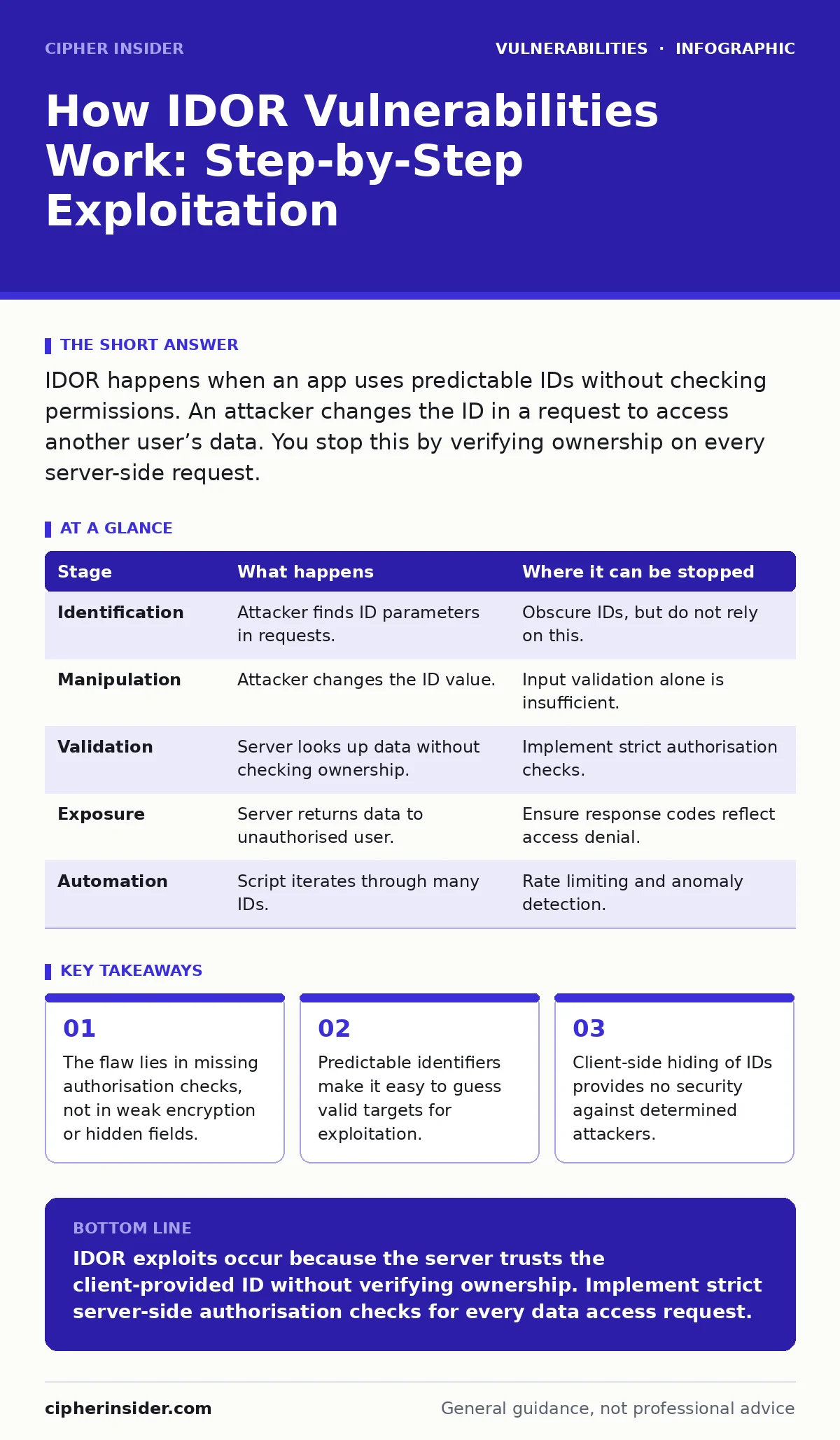
IDOR happens when an app uses predictable IDs without checking permissions. An attacker changes the ID in a request to access another user’s data. You stop this by verifying ownership on every server-side request.
The Architecture of Trust Failure
Insecure Direct Object References (IDOR) occur when an application exposes internal object references directly to the user. These references often take the form of database keys, file names, or sequence numbers. The application assumes that because the user triggered the request, they are entitled to the data returned. This assumption is the root of the vulnerability.
You might assume that keeping IDs hidden from the URL bar prevents abuse. This is a false sense of security. Modern browsers and developer tools reveal all network traffic. If the server does not verify ownership, the location of the ID is irrelevant. The server must validate that the session owner matches the resource owner.
### Stage 1: Identification of the Target
The process begins with the attacker observing how the application handles data references. They look for parameters in HTTP requests that point to specific records. These parameters might appear in the URL path, query strings, or the body of a POST request. The attacker notes the format of these identifiers.
If the IDs are sequential integers, such as 101, 102, and 103, the attack surface is predictable. Even if IDs are random strings, the attacker only needs one valid ID to begin. They do not need to know the structure of the database. They only need to know that changing the value changes the target.
### Stage 2: Manipulation of the Reference
Once a parameter is identified, the attacker modifies its value. Suppose you are viewing your own profile with the ID user=45. You change this to user=46 and resend the request. The application processes the new request without questioning why you want to see record 46.
This step relies on the principle of direct mapping. The application maps the input directly to a data store lookup. It skips the intermediate step of checking permissions. The attacker treats the application interface as a direct window into the database, bypassing the intended access controls.
### Stage 3: Server-Side Validation Failure
The server receives the modified request. It queries the database for the record matching the new ID. Here is where the flaw manifests. The application retrieves the data but fails to check if the authenticated user has the right to view it.
Many developers confuse authentication with authorisation. Authentication confirms who the user is. Authorisation confirms what the user can do. IDOR exists because the authorisation step is missing or incomplete. The server answers the question "what data is at this ID?" instead of "is this user allowed to see this data?"
### Stage 4: Data Exposure or Modification
If the ID exists and the user is not the owner, the application returns the data. This could be personal information, financial records, or administrative settings. In some cases, the attacker can also modify or delete the resource if the HTTP method allows it.
The impact depends on the sensitivity of the data. Access to another user’s email address is a privacy violation. Access to an admin panel is a critical security breach. The severity is determined by the principle of least privilege. The application granted more access than necessary.
See also: Host Header Injection: Risks and Protection for Small Businesses · Apache Struts Vulnerabilities: Debunking 6 Common Security Myths
### Stage 5: Automation and Scaling
Manual testing is slow. Attackers use scripts to automate the process. They iterate through a range of IDs, collecting responses for each. Successful requests return valid data. Failed requests return errors or empty pages.
This automation turns a single flaw into a mass data extraction tool. The attacker can harvest thousands of records in minutes. The application logs may show many requests from one IP, but without proper monitoring, this activity blends in with normal traffic. The lack of rate limiting or anomaly detection aids this phase.
Mitigation Strategies and Controls
Preventing IDOR requires a shift in how you handle data access. You must never trust the client to provide the correct ID. Instead, use indirect references. Map the user’s session to a list of allowed resource IDs server-side. When a request comes in, check if the requested ID is in that allowed list.
| Stage | What happens | Where it can be stopped |
|---|---|---|
| Identification | Attacker finds ID parameters in requests. | Obscure IDs, but do not rely on this. |
| Manipulation | Attacker changes the ID value. | Input validation alone is insufficient. |
| Validation | Server looks up data without checking ownership. | Implement strict authorisation checks. |
| Exposure | Server returns data to unauthorised user. | Ensure response codes reflect access denial. |
| Automation | Script iterates through many IDs. | Rate limiting and anomaly detection. |
You should also consider security misconfigurations that might expose default endpoints. These endpoints often lack proper access controls. Regular reviews of your IT asset inventory help identify all potential entry points. Each asset must be checked for direct object reference flaws.
The Hidden Cost of Indirect Mapping
Using indirect references adds complexity. You must maintain a mapping table between public tokens and private IDs. This introduces a slight performance overhead. However, the cost of a breach far exceeds the computational cost of a lookup.
Another hidden cost is the maintenance burden. If you change your data model, you must update the mapping logic. This requires careful testing. Dynamic application security testing (DAST) tools can help find these flaws, but they may miss logic errors. Manual review of critical flows is still necessary.
Related Vulnerability Context
IDOR is often grouped with CWE weakness categories related to access control. Understanding these categories helps you structure your defence. It is not just about fixing one bug; it is about enforcing a policy.
Be aware that NoSQL injection can sometimes be used to bypass filters, but IDOR is a logic flaw, not an injection flaw. They require different mitigations. Command injection targets system commands, while IDOR targets data access. Do not confuse them.
Side-channel attacks might reveal information about valid IDs through timing differences. If your application takes longer to process valid IDs than invalid ones, an attacker can infer existence. Ensure consistent response times.
Automatic software updates can patch libraries, but they cannot fix logical flaws in your code. You must write the checks yourself. Security misconfigurations in your framework might default to permissive access. Always verify the default settings.
Key takeaways
- The flaw lies in missing authorisation checks, not in weak encryption or hidden fields.
- Predictable identifiers make it easy to guess valid targets for exploitation.
- Client-side hiding of IDs provides no security against determined attackers.
IDOR exploits occur because the server trusts the client-provided ID without verifying ownership. Implement strict server-side authorisation checks for every data access request.
Frequently asked questions
Does using UUIDs prevent IDOR?
No. UUIDs make guessing harder, but if an attacker obtains one valid ID, they can still access that resource if authorisation is missing.
Is IDOR the same as broken access control?
IDOR is a specific type of broken access control. It involves direct references to objects. Other types involve role-based or function-level access failures.
How do I test for IDOR manually?
Log in as a standard user, find a request that accesses your data, change the ID to another user’s ID, and see if the server returns the other user’s data.
Can client-side validation stop IDOR?
No. Client-side validation can be bypassed easily. All authorisation checks must happen on the server, where the attacker cannot alter the code.
How this guide was produced: written by the Cipher Insider editorial team with AI assistance, checked against the public references listed below, and reviewed when the facts change. See our editorial policy or report an error.