
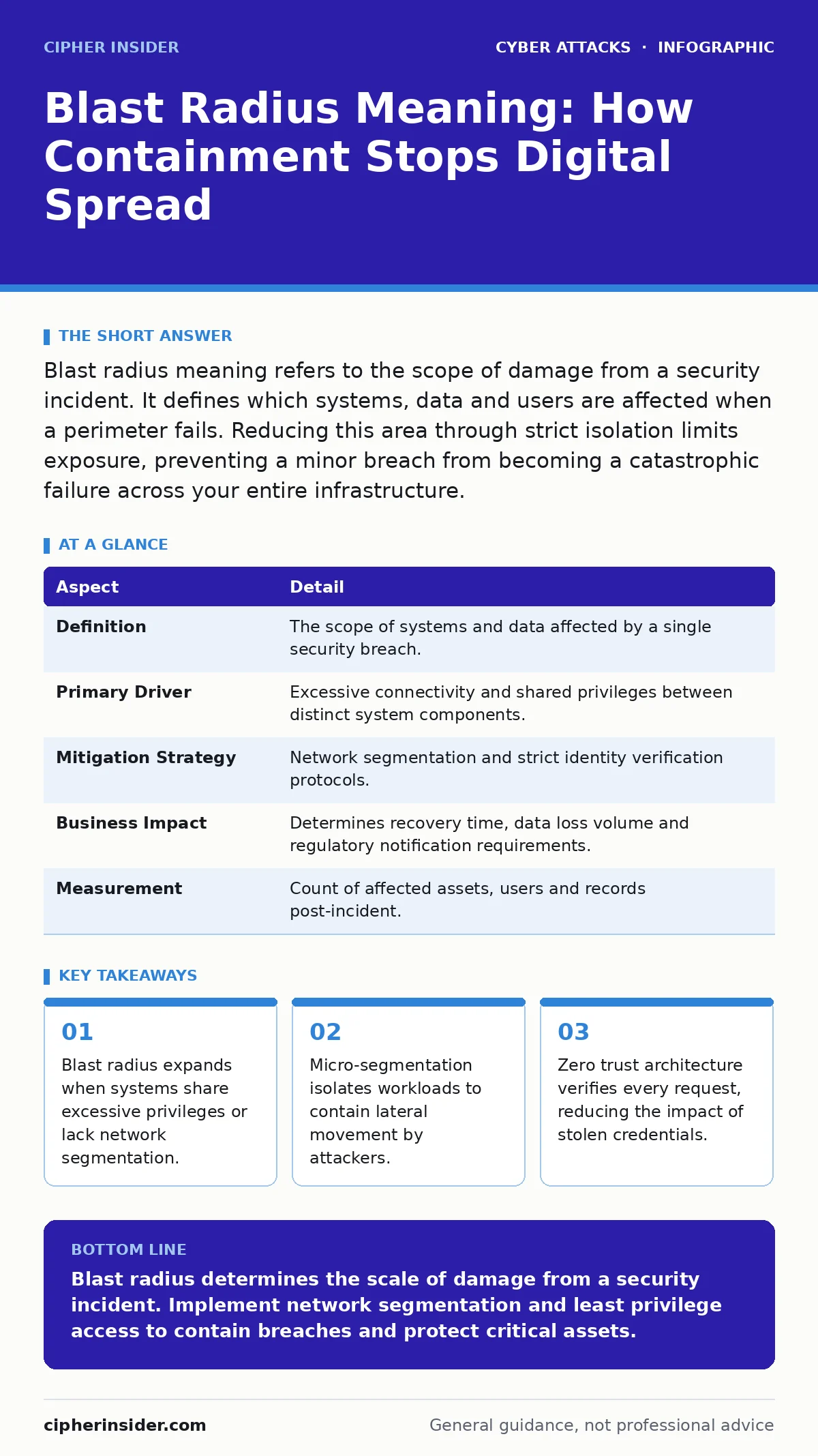
Blast radius meaning refers to the scope of damage from a security incident. It defines which systems, data and users are affected when a perimeter fails. Reducing this area through strict isolation limits exposure, preventing a minor breach from becoming a catastrophic failure across your entire infrastructure.
Blast Radius Meaning Explained
Blast radius meaning describes the extent of damage caused by a security incident within an organisation. It measures how far a breach spreads from the initial point of entry before containment stops it. A small blast radius affects only the compromised component, while a large one impacts entire networks, databases and user accounts. Understanding this concept helps you design systems that fail safely rather than catastrophically.
The term originates from explosives engineering, where it denotes the area affected by a detonation. In cybersecurity, it applies to digital assets. When an attacker gains access to one server, the blast radius determines whether they can reach adjacent servers, central databases or external customer portals. Limiting this radius is the primary goal of defensive architecture.
| Aspect | Detail |
|---|---|
| Definition | The scope of systems and data affected by a single security breach. |
| Primary Driver | Excessive connectivity and shared privileges between distinct system components. |
| Mitigation Strategy | Network segmentation and strict identity verification protocols. |
| Business Impact | Determines recovery time, data loss volume and regulatory notification requirements. |
| Measurement | Count of affected assets, users and records post-incident. |
How Blast Radius Expands
The blast radius grows when an attacker moves laterally across your network. Lateral movement occurs when a threat actor uses compromised credentials or vulnerabilities to access other systems. This movement is possible when systems trust each other implicitly. If one workstation is infected, it may automatically access shared drives, databases or management consoles because the network assumes internal traffic is safe.
Shared administrative accounts accelerate this spread. When multiple servers use the same root or administrator password, compromising one system grants immediate access to all others. Similarly, flat network architectures without segmentation allow unrestricted communication between devices. An attacker on a guest Wi-Fi network could potentially scan and attack internal servers if no firewall rules block that traffic.
Who Is Affected by the Spread
The blast radius affects more than just the directly compromised machine. Users whose accounts are linked to the breached system lose access to services. Their credentials may be stolen, forcing a widespread password reset. Customers whose data resides on the affected servers face privacy violations. Their personal information may be exposed, leading to identity theft risks and legal liabilities for the organisation.
Internal teams also suffer operational disruption. Security operations centers must divert resources to investigate and contain the spread. Developers may freeze deployments to prevent further damage. The longer the blast radius remains uncontrolled, the more personnel are impacted by lockdowns and access restrictions. Third-party vendors connected to the breached system may also face collateral damage if they share integration points.
Common Misconceptions About Containment
Many organisations believe that a strong perimeter firewall eliminates blast radius risks. This is incorrect. Firewalls protect the boundary but do nothing to stop movement inside the network. Once an attacker bypasses the perimeter, they operate within an unmonitored environment. Internal segmentation is required to limit damage after the initial breach.
Another common mistake is assuming that removing external access reduces risk. Insider threats can cause significant damage without external involvement. A disgruntled employee with broad privileges can delete critical files or exfiltrate data. The blast radius here is determined by the employee’s access level, not by network connectivity. Restricting privileges is more effective than relying on physical security alone.
Reducing the Blast Radius
Reducing the blast radius requires implementing zero trust principles. Zero trust assumes no user or device is trustworthy by default. Every access request must be verified, regardless of its origin. This approach limits the damage of stolen credentials because an attacker cannot simply hop between systems without re-authenticating.
Network segmentation divides your infrastructure into smaller, isolated zones. Each zone has strict access controls. If one zone is compromised, the attacker cannot easily move to another. For instance, separating development, testing and production environments ensures that a bug in development does not crash production services. This isolation contains the blast radius to a single segment.
Practical Steps for Isolation
You can implement several measures to shrink the blast radius. Start by auditing user permissions. Remove unnecessary access rights. Apply the principle of least privilege, which grants users only the access they need to perform their jobs. This limits the damage if an account is compromised.
Next, review your network architecture. Identify unnecessary connections between systems. Block traffic that is not explicitly required for business operations. Use virtual local area networks to separate sensitive workloads. Monitor internal traffic for unusual patterns. Detecting lateral movement early allows you to isolate affected systems before the blast radius expands.
Integrating Awareness and Tools
Technical controls must be supported by human behaviour. Security awareness training helps employees recognise phishing attempts and social engineering. If staff report suspicious emails quickly, you can isolate the threat before it spreads. However, training alone is insufficient. It must be combined with automated detection systems.
Tools like DNS filtering can block connections to known malicious domains. This prevents compromised systems from communicating with command and control servers. Similarly, monitoring for session hijacking attempts helps detect when an attacker steals active user sessions. These tools provide visibility into internal traffic, allowing you to identify and contain breaches faster.
The Hidden Cost of Over-Connectivity
A hidden cost of large blast radii is the complexity of recovery. When many systems are affected, restoring services becomes difficult. You must verify the integrity of each component before bringing it back online. This process takes time and resources. In contrast, a small blast radius allows for rapid restoration of unaffected systems.
Over-connectivity also increases the attack surface. Every connection point is a potential entry vector. Reducing connections reduces the number of ways an attacker can enter your network. This simplifies security monitoring and reduces the likelihood of undetected breaches. The trade-off is slightly reduced convenience, but the security benefit is significant.
Key takeaways
- Blast radius expands when systems share excessive privileges or lack network segmentation.
- Micro-segmentation isolates workloads to contain lateral movement by attackers.
- Zero trust architecture verifies every request, reducing the impact of stolen credentials.
Blast radius determines the scale of damage from a security incident. Implement network segmentation and least privilege access to contain breaches and protect critical assets.
Frequently asked questions
How do I calculate my blast radius?
Map your network connections and user permissions. Identify which systems can communicate with each other and what data they access. Simulate a breach to see how far an attacker could move.
What is the difference between blast radius and attack surface?
Attack surface is the total number of entry points an attacker can use. Blast radius is the damage caused after an entry point is exploited. Reducing attack surface prevents entry; reducing blast radius limits damage.
How this guide was produced: written by the Cipher Insider editorial team with AI assistance, checked against the public references listed below, and reviewed when the facts change. See our editorial policy or report an error.