Token theft occurs when an adversary extracts valid authentication credentials from memory or network traffic. This process bypasses login screens and multi-factor authentication. You can interrupt it by enforcing short token lifespans, binding sessions to device characteristics, and monitoring for anomalous token usage patterns.
The Architecture of Trust
Modern web applications rely on tokens to maintain state. When you log in, the server issues a token, often a JSON Web Token or a session ID, which proves your identity for subsequent requests. The server trusts this token without re-verifying your password. This design reduces server load and improves user experience. However, it creates a high-value target. If an attacker obtains the token, they possess the same rights as the legitimate user. The system cannot distinguish between the owner and the thief.
This trust model assumes the token remains secret. In practice, tokens reside in browser storage, cookies, or application memory. These locations are accessible to malicious scripts, other processes on the same machine, or network eavesdroppers. The security of the account depends entirely on the secrecy of this string of characters.
Stage 1: Initial Access and Persistence
The attacker first needs a foothold in the environment. This usually happens through phishing, malware, or exploiting a software vulnerability. Once inside, the goal is not immediate data exfiltration but establishing a presence. Without persistence, the theft is a one-time event. With persistence, the attacker returns to harvest tokens as they are generated.
Imagine a user clicks a link that installs a remote access tool. The tool runs silently in the background. It waits for the user to log into critical applications. This stage relies on the victim’s routine behaviour. The attacker does not need to force a login; they simply wait for the natural occurrence of authentication.
Stage 1: Establishing Presence
- The malicious code executes on the victim's device.
- It hides its processes to avoid detection by standard security tools.
- It establishes a communication channel back to the attacker's command server.
Stage 2: Locating the Credentials
With access established, the attacker searches for tokens. In web applications, tokens are often stored in localStorage, sessionStorage, or cookies. In enterprise environments, tokens may reside in memory structures associated with the operating system's security subsystem. For example, Windows stores authentication data in the Local Security Authority Subsystem Service.
The attacker scans these locations for known patterns. Tokens often have distinct structures, such as a header, payload, and signature. Malware can search for these byte sequences in memory. It can also hook into browser APIs to read cookies directly. This stage is passive and quiet. It generates little to no network traffic, making it difficult to detect with traditional network monitoring.
Stage 2: Scanning for Value
- The malware enumerates running processes to find browsers or credential managers.
- It reads the memory of these processes to locate token strings.
- It checks browser storage for cookies marked as accessible to scripts.
Stage 3: Extraction and Exfiltration
Once located, the token must be extracted. This involves copying the data from the victim's memory or storage to a buffer controlled by the malware. The extraction method depends on the location of the token. If it is in a cookie, the malware reads the cookie file or intercepts the HTTP request. If it is in memory, the malware reads the process memory space.
Exfiltration is the transfer of this data to the attacker. This often happens over encrypted channels to avoid detection by network security tools. The payload is small, often just a few kilobytes. It blends in with normal web traffic. The attacker may wait for a specific trigger, such as the user logging into a high-value account, before sending the data.
Stage 3: Moving the Data
- The token is copied to the malware's internal storage.
- The data is encoded to avoid signature detection.
- It is sent to the attacker's server via HTTPS or DNS tunneling.
Stage 4: Replay and Access
The attacker now possesses a valid token. They use it to make requests to the target service. The server receives the request and validates the token. If the token is valid and not expired, the server grants access. The attacker can now view data, change settings, or perform actions. This is a replay attack. The attacker is not impersonating the user in the sense of guessing a password; they are acting as the user because they hold the valid credential.
This stage bypasses multi-factor authentication. MFA protects the login process, not the session. Once the session is established, MFA is irrelevant. The attacker inherits the user's privileges. If the user has administrative rights, the attacker gains administrative access. This is why token theft is particularly dangerous in privileged environments.
Stage 4: Using the Stolen Credential
- The attacker injects the token into a browser or script.
- They access the target application using the stolen session.
- They perform actions such as data download or configuration changes.
See also: Host Header Injection: Risks and Protection for Small Businesses · Apache Struts Vulnerabilities: Debunking 6 Common Security Myths
Interrupting the Chain
You can interrupt token theft at multiple stages. The most effective defence is reducing the window of opportunity. Short-lived tokens expire quickly, limiting the time an attacker has to use them. Token binding ties the token to specific device characteristics, such as the TLS certificate or CPU serial number. If the token is moved to a different machine, it becomes invalid.
Detection is also possible. Monitor for multiple simultaneous sessions from different geographic locations. Look for tokens being used from new devices or IP addresses. Implement strict Content Security Policies to prevent malicious scripts from accessing browser storage. These measures add friction to the attacker's process. They do not stop the initial compromise, but they limit the impact.
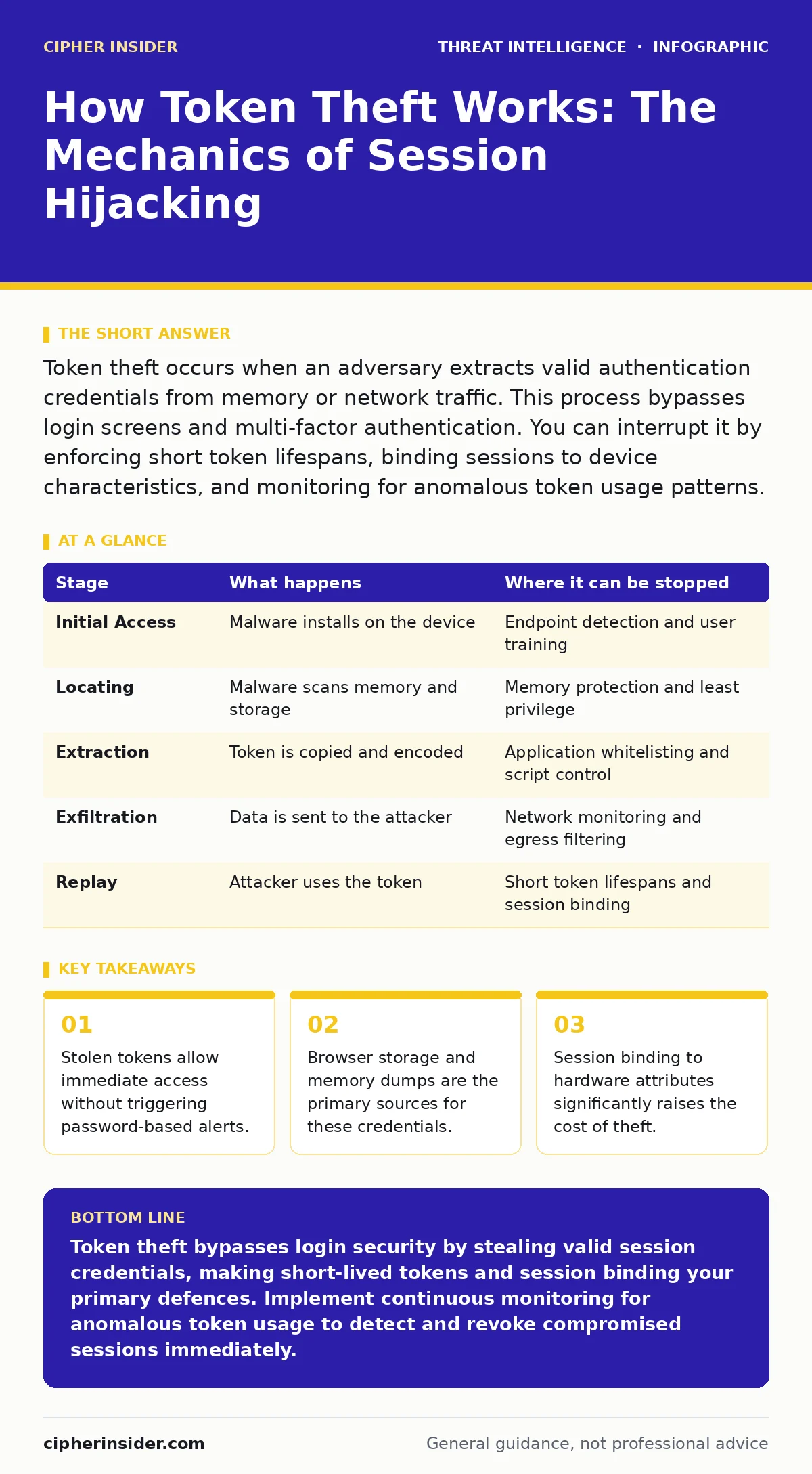
| Stage | What happens | Where it can be stopped |
|---|---|---|
| Initial Access | Malware installs on the device | Endpoint detection and user training |
| Locating | Malware scans memory and storage | Memory protection and least privilege |
| Extraction | Token is copied and encoded | Application whitelisting and script control |
| Exfiltration | Data is sent to the attacker | Network monitoring and egress filtering |
| Replay | Attacker uses the token | Short token lifespans and session binding |
The Hidden Cost of Convenience
The convenience of persistent login sessions is the root cause of token theft. Users expect to stay logged in. Developers implement this to improve retention. Security teams must balance this expectation with risk. Disabling persistent sessions frustrates users. Enabling them increases the value of every compromised device.
Consider the trade-off. A stolen password requires the attacker to bypass MFA. A stolen token does not. The cost of defending against token theft is higher. It requires deeper visibility into memory and network traffic. It requires architectural changes to how sessions are managed. You cannot rely on perimeter defences alone. The threat is inside the session itself.
Beyond the Basic Attack
Token theft is often a precursor to further actions. Once inside, the attacker may look for other credentials. They might use the stolen access to escalate privileges. This moves the attack from a single account to broader system compromise. Understanding this progression is vital for defence.
You should integrate token theft detection into your broader threat model. Look for indicators of privilege escalation attacks following unusual session activity. Use detection engineering to create rules that flag token reuse from anomalous locations. Consider deploying canary tokens in sensitive applications. These are fake tokens that trigger an alert when used. They provide early warning of compromise.
The Role of Observation
Prevention is not enough. You must assume tokens will be stolen. Your goal is to detect it quickly. This requires continuous monitoring of session behaviour. Look for impossible travel, where a user logs in from two distant locations in a short time. Monitor for sessions that remain active far beyond the expected lifespan.
Threat intelligence helps here. Understanding how attackers operate allows you to tune your alerts. You can reduce noise by focusing on high-value accounts. You can improve response by automating token revocation. When a token is suspected stolen, revoke it immediately. Force the user to re-authenticate. This stops the attacker in their tracks.
Final Considerations
Token theft exploits the trust inherent in stateful applications. It is a direct consequence of how modern web services operate. You cannot eliminate the risk, but you can manage it. By shortening token lifespans, binding sessions to devices, and monitoring for anomalous usage, you raise the cost of the attack.
Remember that security is a balance. Perfect security is impossible. Your aim is to make token theft difficult, noisy, and short-lived. This requires a combination of technical controls and behavioural monitoring. Stay alert to new techniques and adjust your defences accordingly.
Key takeaways
- Stolen tokens allow immediate access without triggering password-based alerts.
- Browser storage and memory dumps are the primary sources for these credentials.
- Session binding to hardware attributes significantly raises the cost of theft.
Token theft bypasses login security by stealing valid session credentials, making short-lived tokens and session binding your primary defences. Implement continuous monitoring for anomalous token usage to detect and revoke compromised sessions immediately.
Frequently asked questions
Does Multi-Factor Authentication stop token theft?
No, MFA protects the initial login process. Once a session is established, the token alone grants access, rendering MFA irrelevant for that session.
How can I tell if my token has been stolen?
Look for alerts about concurrent sessions from different locations or devices. Unexpected logouts or security warnings from the service provider may also indicate compromise.
What is the difference between a session cookie and a JWT?
A session cookie is a reference to data stored on the server. A JSON Web Token contains the data itself, signed by the server, and is stateless.
Can antivirus software detect token theft?
Antivirus may detect the malware used to steal tokens, but it often misses the theft itself. Endpoint Detection and Response tools are better suited for monitoring memory access.
How this guide was produced: written by the Cipher Insider editorial team with AI assistance, checked against the public references listed below, and reviewed when the facts change. See our editorial policy or report an error.