
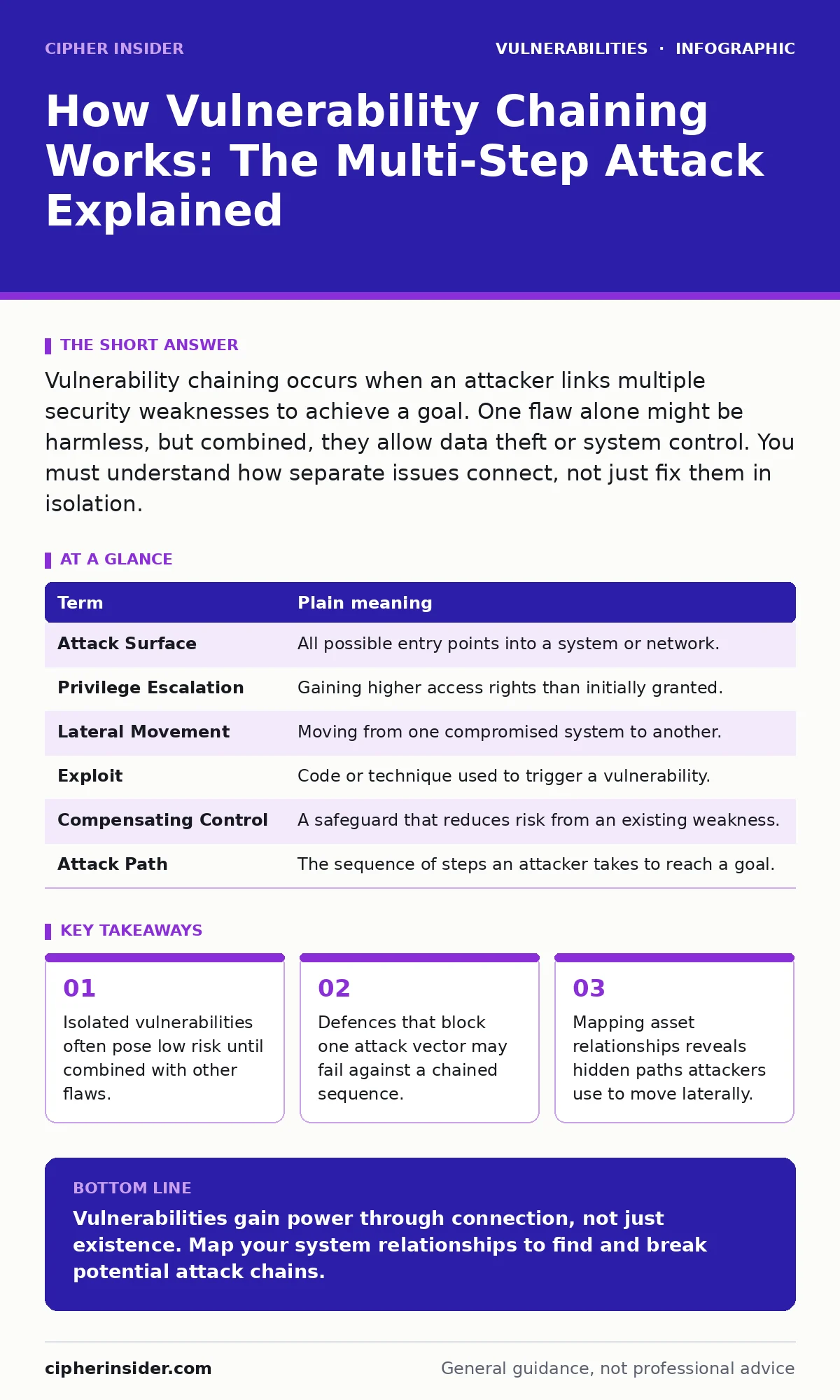
Vulnerability chaining occurs when an attacker links multiple security weaknesses to achieve a goal. One flaw alone might be harmless, but combined, they allow data theft or system control. You must understand how separate issues connect, not just fix them in isolation.
The Broken Fence Analogy
Imagine a garden protected by a tall fence. The fence has a small gap at the bottom, but it is too narrow for a person to crawl through. Separately, this gap is harmless. Now imagine a shed inside the garden with a broken lock. The shed contains a ladder. An attacker cannot enter through the gap, nor can they climb the fence. However, they can reach through the gap, unlock the shed, retrieve the ladder, and climb over the fence. The breach succeeds only because two weak points are linked.
Key Terms in Chaining
Understanding the mechanics requires precise terminology. Each term describes a specific part of the attack path or defence strategy. These definitions help you recognise when separate issues might combine.
| Term | Plain meaning |
|---|---|
| Attack Surface | All possible entry points into a system or network. |
| Privilege Escalation | Gaining higher access rights than initially granted. |
| Lateral Movement | Moving from one compromised system to another. |
| Exploit | Code or technique used to trigger a vulnerability. |
| Compensating Control | A safeguard that reduces risk from an existing weakness. |
| Attack Path | The sequence of steps an attacker takes to reach a goal. |
Why Single Fixes Fail
Many teams believe that patching a known vulnerability eliminates the risk. This assumption ignores the possibility of chaining. Suppose you fix the broken lock on the shed. The attacker still has the gap in the fence. They might now use the gap to plant a device that waits for a maintenance window. Or they might find another way into the shed. Fixing one component does not secure the whole system. You must evaluate how flaws interact.
Common Points of Confusion
Readers often confuse vulnerability chaining with related concepts. Clarifying these distinctions prevents misdiagnosis of security incidents.
- Vulnerability vs. Exploit: A vulnerability is a weakness in design or code. An exploit is the method used to take advantage of that weakness. Chaining involves multiple exploits.
- Chain vs. Cascade: A chain is a deliberate sequence of attacks. A cascade is a unintended failure where one bug triggers another, often causing system crashes rather than a breach.
- Chaining vs. Compounding: Compounding risks increase the likelihood of an event. Chaining risks increase the impact by enabling access that was previously impossible.
Real-World Attack Patterns
Attackers typically follow a predictable pattern when chaining vulnerabilities. They start with low-privilege access and move toward high-value targets. This progression relies on finding connections between seemingly unrelated systems.
- Initial Access: The attacker enters through a weak point, such as an unpatched software component or a misconfigured service.
- Persistence: They establish a foothold, ensuring they can return even if the initial entry point is closed.
- Privilege Escalation: They exploit a second flaw to gain higher permissions, allowing access to sensitive data or administrative controls.
This pattern mirrors the garden analogy. The gap provides initial access. The shed provides persistence. The ladder allows escalation to the top of the fence.
See also: Secure Configuration Baselines for Small Businesses · Host Header Injection: Risks and Protection for Small Businesses
The Hidden Cost of Isolation
Treating vulnerabilities as independent items creates a false sense of security. When you assess risk in isolation, you miss the synergistic effect of combined flaws. A low-risk issue in one system might become critical when linked to a medium-risk issue in another. This hidden cost leads to underinvestment in security measures that address connectivity and interaction between components.
Try This Now
You can assess your own environment for chaining risks using these three steps. This exercise highlights how separate weaknesses might combine.
- List Critical Assets: Identify the data or systems you must protect. Define what success looks like for an attacker.
- Map Entry Points: Document all external and internal interfaces. Note any known vulnerabilities, even low-severity ones.
- Trace Paths: Draw lines between entry points and critical assets. Ask how an attacker could move from one point to another. Look for gaps in monitoring or access controls.
This simple mapping reveals paths that automated scanners might miss. It forces you to think like an attacker, connecting dots that appear separate in isolation.
Breaking the Chain
Preventing vulnerability chaining requires a shift in perspective. Instead of focusing on individual flaws, focus on the paths between them. Implement strict access controls to limit lateral movement. Use network segmentation to isolate critical assets. Regularly review configurations to ensure that fixing one issue does not create new connections for attackers.
Key takeaways
- Isolated vulnerabilities often pose low risk until combined with other flaws.
- Defences that block one attack vector may fail against a chained sequence.
- Mapping asset relationships reveals hidden paths attackers use to move laterally.
Vulnerabilities gain power through connection, not just existence. Map your system relationships to find and break potential attack chains.
Frequently asked questions
Does vulnerability chaining only apply to network security?
No, it applies to any system with multiple components. Physical security, application logic, and human processes can all be chained.
How do I know if my team is vulnerable to chaining?
If you fix bugs in isolation without reviewing system interactions, you are likely vulnerable. Check for unmonitored lateral movement paths.
Can automated tools detect vulnerability chaining?
Standard scanners find individual flaws. Specialised attack path analysis tools can simulate chains, but they require accurate asset mapping.
Is vulnerability chaining legal to test?
Only with explicit written permission from the system owner. Unauthorised testing is illegal and unethical.
How this guide was produced: written by the Cipher Insider editorial team with AI assistance, checked against the public references listed below, and reviewed when the facts change. See our editorial policy or report an error.