
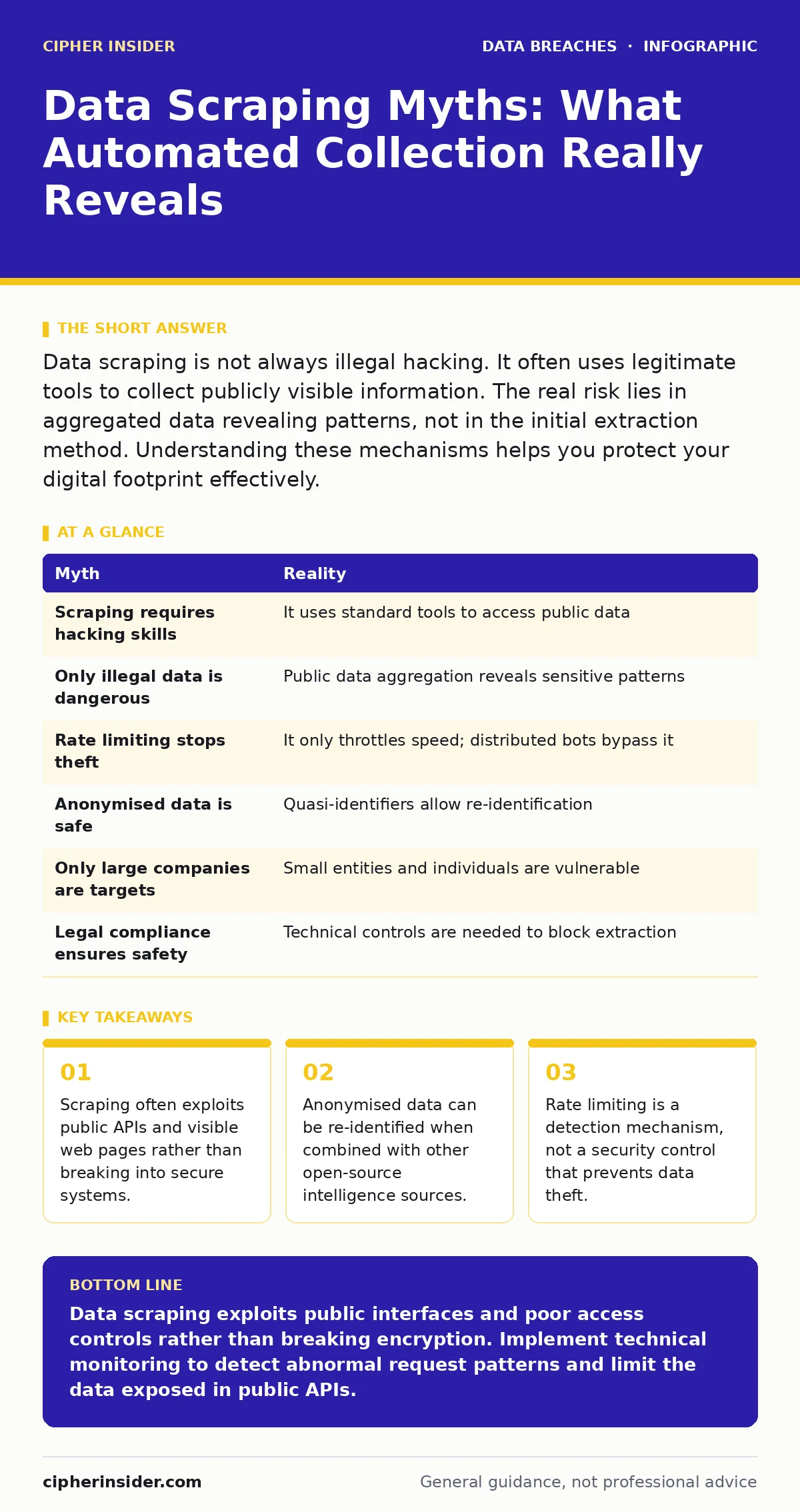
Data scraping is not always illegal hacking. It often uses legitimate tools to collect publicly visible information. The real risk lies in aggregated data revealing patterns, not in the initial extraction method. Understanding these mechanisms helps you protect your digital footprint effectively.
Myth: Scraping Requires Advanced Hacking Skills
Reality: Most large-scale data collection relies on standard, publicly available tools rather than custom exploits. Automated scripts, often called bots, simply visit web pages or query application programming interfaces (APIs) at high speed. These tools mimic normal user behaviour to retrieve information that is already rendered in a browser. The technical barrier to entry is low, which means anyone with basic programming knowledge can harvest significant datasets. This misconception leads organisations to focus on perimeter defence while ignoring the data they have already made visible.
Imagine a researcher writing a simple script to download product listings from an e-commerce site. The script does not bypass authentication or crack encryption. It simply requests the same page a human would view, but thousands of times per minute. The server processes these requests as legitimate traffic because the data is public. The harm occurs when the aggregated data reveals pricing strategies or inventory levels that were never intended to be analysed in bulk.
Myth: Only Illegally Obtained Data Is Dangerous
Reality: Information harvested from public sources can be just as damaging as data stolen from a private database. When disparate public records are combined, they create a detailed profile of an individual or organisation. This process, known as correlation, links seemingly harmless data points to reveal sensitive insights. Open-source intelligence (OSINT) techniques allow attackers to map relationships, physical locations, and financial habits without ever touching a secure system. The danger lies in the aggregation, not the origin of the raw data.
Consider a scenario where an attacker combines public property records, social media photos, and business registration documents. Individually, these sources reveal little. Together, they can identify home addresses, daily routines, and asset values. This aggregated intelligence enables targeted physical theft or sophisticated social engineering attacks. The data was never "stolen" in the traditional sense, yet the resulting exposure is severe.
Myth: Rate Limiting Prevents Data Theft
Reality: Rate limiting controls the speed of requests to protect server performance, not to secure data. It is a throttling mechanism, not an access control. An attacker can distribute requests across thousands of IP addresses, a technique known as proxy rotation, to bypass these limits. The server sees many slow, legitimate-looking requests rather than one fast, malicious one. This allows the scraper to harvest the entire dataset over a longer period without triggering immediate blocks.
Organisations often monitor for sudden spikes in traffic, assuming a flat, steady stream of requests is safe. However, a distributed scraping campaign can maintain a low, steady pace that blends in with normal user behaviour. By the time the volume becomes noticeable, the attacker may have already collected the critical information. Defending against this requires detecting anomalies in request patterns, not just volume.
Myth: Anonymised Data Cannot Be Traced Back
Reality: Removing direct identifiers like names or email addresses does not make data anonymous. Quasi-identifiers, such as birth dates, zip codes, and job titles, can be used to re-identify individuals. When scraped data is cross-referenced with other public datasets, unique combinations of these attributes often point to a single person. This re-identification risk persists even after rigorous sanitisation processes. The assumption of anonymity is false when the data exists in a larger ecosystem of open information.
Suppose a health organisation publishes anonymised patient records. An attacker scrapes this data and combines it with public voter registration lists. By matching age, gender, and location, the attacker can link the medical records back to specific individuals. This reveals private health conditions that were never meant to be public. This vulnerability is relevant to those concerned with credential leaks, as exposed identity fragments often serve as the keys to re-identification.
Myth: Scraping Is Only a Threat to Large Corporations
Reality: Small businesses and individuals are frequent targets because their digital hygiene is often less rigorous. Automated scanners do not distinguish between a multinational enterprise and a small online store. They harvest data from any source that provides value, such as contact details, customer reviews, or product specifications. Smaller entities often lack the resources to monitor for scraping activity or to implement advanced bot management. This makes them easier targets for competitors or malicious actors seeking intelligence.
Individuals who overshare on social media provide a rich source of data for scrapers. Automated tools can harvest profile information, connection lists, and posted content to build detailed personal profiles. This data can be used for identity fraud or targeted harassment. The scale of the target does not determine the value of the data; the richness and accessibility of the information do.
See also: Apache Struts Vulnerabilities: Debunking 6 Common Security Myths · How IDOR Vulnerabilities Work: Step-by-Step Exploitation
Myth: Legal Compliance Guarantees Data Safety
Reality: Adhering to terms of service or data protection laws does not stop automated extraction. Many scraping activities operate in legal grey areas or exploit loopholes in existing regulations. Even if the data is public, the method of collection may violate a website’s terms of use, but this is a civil matter, not a criminal one. Attackers do not care about legal standing; they care about access. Relying on legal frameworks for technical security is a fundamental error.
Organisations must implement technical controls to protect data, regardless of its legal status. This includes monitoring for unusual access patterns and limiting the amount of data exposed in API responses. Legal compliance is a separate concern from technical security. Understanding the difference helps you prioritise defensive measures that actually stop data loss. This is particularly relevant when conducting third-party risk assessments, as vendors may expose your data through their own public interfaces.
| Myth | Reality |
|---|---|
| Scraping requires hacking skills | It uses standard tools to access public data |
| Only illegal data is dangerous | Public data aggregation reveals sensitive patterns |
| Rate limiting stops theft | It only throttles speed; distributed bots bypass it |
| Anonymised data is safe | Quasi-identifiers allow re-identification |
| Only large companies are targets | Small entities and individuals are vulnerable |
| Legal compliance ensures safety | Technical controls are needed to block extraction |
Key takeaways
- Scraping often exploits public APIs and visible web pages rather than breaking into secure systems.
- Anonymised data can be re-identified when combined with other open-source intelligence sources.
- Rate limiting is a detection mechanism, not a security control that prevents data theft.
Data scraping exploits public interfaces and poor access controls rather than breaking encryption. Implement technical monitoring to detect abnormal request patterns and limit the data exposed in public APIs.
Frequently asked questions
How can I tell if my website is being scraped?
Look for high volumes of requests from a single IP address or unusual user-agent strings. Monitor for access to pages that normal users rarely visit.
Is scraping always illegal?
No, scraping public data is often legal. It becomes problematic when it violates terms of service, copyright, or privacy laws, or when it causes server overload.
Can I block all scrapers?
No, blocking all automated access may also block legitimate users and search engines. Use selective controls based on behaviour and request patterns.
What is the difference between scraping and crawling?
Crawling is the automated discovery of links, typically used by search engines. Scraping is the extraction of specific data from those pages for analysis or storage.
How this guide was produced: written by the Cipher Insider editorial team with AI assistance, checked against the public references listed below, and reviewed when the facts change. See our editorial policy or report an error.