
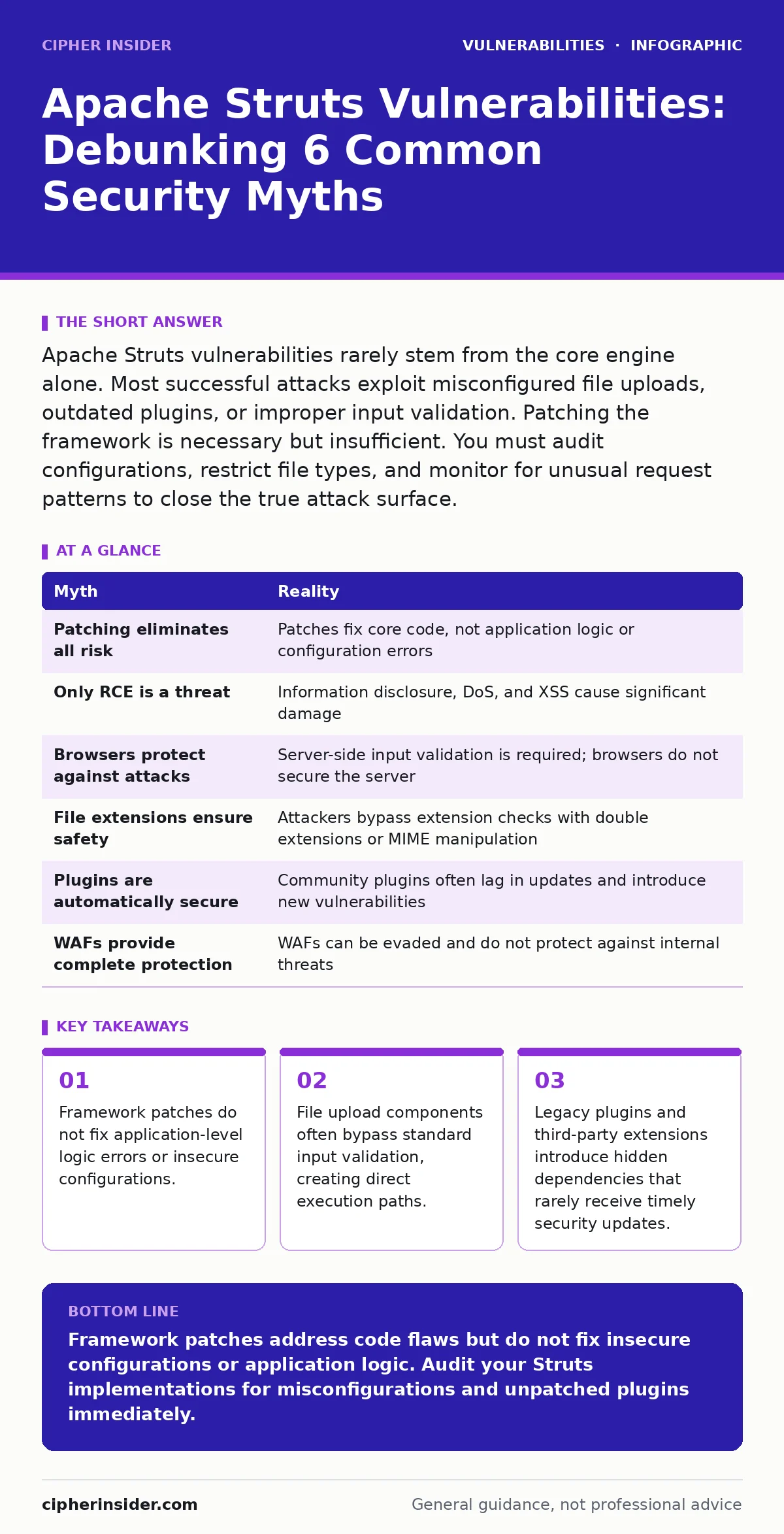
Apache Struts vulnerabilities rarely stem from the core engine alone. Most successful attacks exploit misconfigured file uploads, outdated plugins, or improper input validation. Patching the framework is necessary but insufficient. You must audit configurations, restrict file types, and monitor for unusual request patterns to close the true attack surface.
Myth: Patching the Framework Eliminates All Risk
Reality: Updating the Apache Struts library addresses known code flaws within the core engine, but it does not remediate vulnerabilities introduced by how the application uses that engine. Many web applications rely on custom interceptors, action classes, or result types that process user input before the framework’s security checks apply. If your application logic permits arbitrary file names or unvalidated parameters, an attacker can exploit those paths even with the latest framework version installed.
The framework provides the structure, but your code defines the behaviour. A patched server can still execute malicious commands if the application layer fails to sanitise inputs correctly. This distinction is critical for teams relying solely on vendor updates. You must treat the framework as a tool, not a shield.
Myth: Only Remote Code Execution (RCE) Is a Threat
Reality: While Remote Code Execution allows an attacker to run commands on your server, other vulnerability classes cause significant damage without direct shell access. Information disclosure can leak internal network topology or sensitive data. Denial of Service attacks can crash the application by exploiting resource-intensive parsing functions. Cross-Site Scripting can steal session tokens from privileged users. Focusing exclusively on RCE blinds you to these secondary vectors that often serve as the first step in a broader compromise.
Suppose an attacker cannot execute code but can read directory listings. They might identify backup files or configuration templates containing database credentials. This information enables further attacks that bypass authentication entirely. You must evaluate the impact of every vulnerability class, not just the most dramatic ones.
Myth: Modern Browsers Protect Against Struts Attacks
Reality: Web browsers enforce security policies such as Same-Origin Policy and Content Security Headers, but these mechanisms do not validate server-side input processing. Apache Struts vulnerabilities typically reside in the server’s handling of HTTP requests, not in how the browser renders pages. When a user submits a form, the browser sends the data to the server. The server must then parse and validate that data. If the server uses a vulnerable version of Struts, it will process malformed requests incorrectly, regardless of which browser initiated the request.
Relying on browser security creates a false sense of safety. Attackers use automated tools or crafted HTTP requests that bypass browser protections entirely. You must ensure your server-side logic rejects invalid inputs before they reach the framework’s parsing engine.
Myth: File Uploads Are Safe If You Check Extensions
Reality: Checking file extensions is a weak control because attackers can easily bypass it. Many web servers and frameworks, including Apache Struts, can be tricked into processing files with double extensions or null bytes. An attacker might upload a file named image.jpg.php or script.php%00.jpg. Depending on the server configuration, the server might interpret this as a PHP script rather than an image. Furthermore, MIME type sniffing can be manipulated by altering the file header bytes while keeping the extension benign.
You must implement strict file validation that checks both the extension and the actual file content. Restricting uploads to a specific set of safe types is not enough. You should also store uploaded files outside the web root and serve them through a controlled mechanism. This prevents direct execution of uploaded scripts.
Myth: Third-Party Plugins Are Automatically Secure
Reality: The Apache Struts ecosystem includes numerous plugins and extensions developed by the community. These components often lag behind the core framework in terms of security updates. A plugin might introduce its own parsing logic or interceptors that contain vulnerabilities. Even if the core Struts library is patched, a vulnerable plugin can provide an entry point for attackers. Many organisations overlook these dependencies during their patch management process, assuming that updating the main library covers all associated code.
You must treat every plugin as a potential risk. Review the maintenance status of each extension you use. Consider whether the functionality provided by a plugin can be implemented using standard framework features. Reducing your dependency on external code reduces your attack surface.
See also: Data Scraping Myths: What Automated Collection Really Reveals · How Token Theft Works: The Mechanics of Session Hijacking
Myth: WAFs Provide Complete Protection for Struts
Reality: Web Application Firewalls filter traffic based on known signatures and behavioural patterns. They can block many common exploits, but they are not foolproof. Attackers can obfuscate their requests to evade detection. They might split malicious payloads across multiple requests or use encoding techniques that the firewall does not recognise. Additionally, a WAF sits in front of your application, meaning it cannot inspect traffic that originates from within your network. If an internal system sends a malicious request to your Struts application, the WAF will not catch it.
You must view a WAF as a layer of defence, not a replacement for secure coding practices. It buys you time to detect and respond to attacks, but it does not eliminate the underlying vulnerability. Combine WAF rules with input validation and regular security testing.
Myth: Legacy Applications Are Too Hard to Secure
Reality: While modernising legacy applications is ideal, leaving them unpatched is not an acceptable alternative. Many organisations assume that because an old Struts application is difficult to update, they must accept the risk. This is a dangerous misconception. You can mitigate risk through compensating controls. Network segmentation can limit access to the application. Strict input validation can block known exploit patterns. Monitoring for unusual activity can alert you to attacks in progress. These measures do not fix the code, but they reduce the likelihood of a successful breach.
Imagine an old application that cannot be updated. By restricting access to specific IP addresses and disabling unnecessary features, you reduce the attack surface significantly. You must balance the cost of refactoring with the risk of exposure. Do not leave legacy systems exposed to the internet without additional protection.
| Myth | Reality |
|---|---|
| Patching eliminates all risk | Patches fix core code, not application logic or configuration errors |
| Only RCE is a threat | Information disclosure, DoS, and XSS cause significant damage |
| Browsers protect against attacks | Server-side input validation is required; browsers do not secure the server |
| File extensions ensure safety | Attackers bypass extension checks with double extensions or MIME manipulation |
| Plugins are automatically secure | Community plugins often lag in updates and introduce new vulnerabilities |
| WAFs provide complete protection | WAFs can be evaded and do not protect against internal threats |
Key takeaways
- Framework patches do not fix application-level logic errors or insecure configurations.
- File upload components often bypass standard input validation, creating direct execution paths.
- Legacy plugins and third-party extensions introduce hidden dependencies that rarely receive timely security updates.
Framework patches address code flaws but do not fix insecure configurations or application logic. Audit your Struts implementations for misconfigurations and unpatched plugins immediately.
Frequently asked questions
How do I know if my Struts application is vulnerable?
Review your framework version against known vulnerability databases. Check your configuration files for insecure defaults and audit all third-party plugins for outdated versions.
Can I secure Struts without upgrading the framework?
You can reduce risk by implementing strict input validation, restricting file uploads, and using network segmentation. However, upgrading remains the most effective long-term solution.
What is the difference between Struts 1 and Struts 2 vulnerabilities?
Struts 1 and Struts 2 have different architectures and vulnerability profiles. Struts 2 issues often involve OGNL injection, while Struts 1 issues may involve action mapping flaws. You must assess each version specifically.
How often should I review Struts security?
Review your security posture after every major framework update, plugin change, or configuration modification. Regular automated scans can help detect new vulnerabilities promptly.
How this guide was produced: written by the Cipher Insider editorial team with AI assistance, checked against the public references listed below, and reviewed when the facts change. See our editorial policy or report an error.