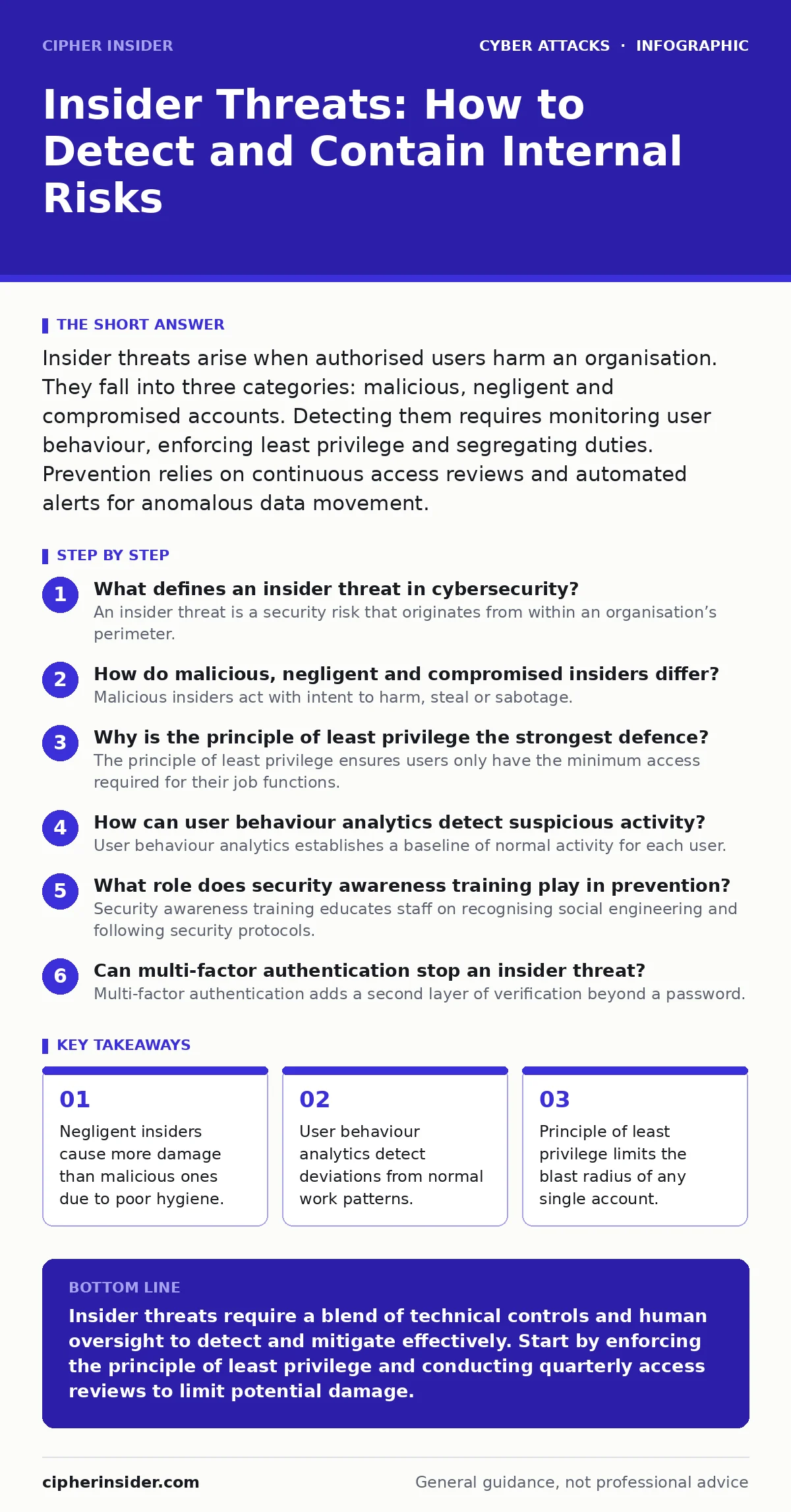
Insider threats arise when authorised users harm an organisation. They fall into three categories: malicious, negligent and compromised accounts. Detecting them requires monitoring user behaviour, enforcing least privilege and segregating duties. Prevention relies on continuous access reviews and automated alerts for anomalous data movement.
What defines an insider threat in cybersecurity?
An insider threat is a security risk that originates from within an organisation’s perimeter. This definition includes employees, contractors and business partners who have legitimate access to systems. The threat manifests when these individuals misuse their privileges, either intentionally to steal data or accidentally through negligence. Unlike external attackers, insiders already possess the credentials and network paths required to reach sensitive assets. This internal position allows them to bypass many perimeter defences that rely on blocking unknown sources.
How do malicious, negligent and compromised insiders differ?
Malicious insiders act with intent to harm, steal or sabotage. They may sell data to competitors or delete critical files out of spite. Negligent insiders cause harm through carelessness, such as clicking a phishing link or misconfiguring a cloud storage bucket. Compromised insiders are victims whose credentials have been stolen by external attackers. The attacker then uses the legitimate account to move laterally. Distinguishing between these types is vital because the response strategies differ significantly. A negligent user needs training, while a malicious one needs legal action.
Why is the principle of least privilege the strongest defence?
The principle of least privilege ensures users only have the minimum access required for their job functions. By restricting permissions, you limit the blast radius if an account is compromised or misused. If a marketing employee only has access to campaign files, they cannot exfiltrate financial records. This approach reduces the attack surface available to both negligent and malicious insiders. It also simplifies auditing because fewer accounts have elevated rights. Implementing this requires regular access reviews to remove permissions that are no longer necessary.
How can user behaviour analytics detect suspicious activity?
User behaviour analytics establishes a baseline of normal activity for each user. The system monitors login times, data access patterns and device usage. When a user deviates from this baseline, the system flags the anomaly. For example, a database administrator downloading large volumes of data at 3 a.m. triggers an alert. This method detects slow, low-and-slow exfiltration that traditional antivirus misses. It relies on machine learning to adapt to changing work habits. False positives can occur, so human investigation remains necessary to confirm threats.
What role does security awareness training play in prevention?
Security awareness training educates staff on recognising social engineering and following security protocols. It reduces the likelihood of negligent insiders falling for phishing attacks. Regular training reinforces the consequences of sharing credentials or ignoring software updates. However, training alone cannot stop a determined malicious insider. It must be combined with technical controls like multi-factor authentication. Training is most effective when it is role-specific and includes practical simulations. Without continuous reinforcement, knowledge decays over time.
| Threat Type | Primary Driver | Detection Method | Mitigation Strategy |
|---|---|---|---|
| Malicious | Intent to harm | User behaviour analytics | Least privilege, termination |
| Negligent | Carelessness | Phishing simulation results | Security awareness training |
| Compromised | Credential theft | Multi-factor authentication logs | Password resets, session termination |
Can multi-factor authentication stop an insider threat?
Multi-factor authentication adds a second layer of verification beyond a password. It prevents attackers from using stolen credentials to access systems remotely. However, it does not stop a malicious insider who already possesses the physical device and active session. If an insider logs in legitimately, MFA provides no further protection against their actions. Therefore, MFA is effective against compromised accounts but insufficient against internal malice. You must combine MFA with endpoint detection and response tools. These tools monitor activity on the device itself, regardless of how the user authenticated.
How do you investigate a suspected insider incident?
Investigation begins by preserving digital evidence without alerting the suspect. You must isolate the account to prevent further data loss or system tampering. Forensic analysts then review logs, email archives and file access records. They look for patterns of data staging, such as copying files to removable media or cloud storage. Legal counsel should guide the process to ensure compliance with employment laws. Involving security operations centers ensures that the incident is correlated with other potential threats. Documentation must be thorough to support potential disciplinary or legal action.
What are the legal and ethical considerations?
Organisations must balance security needs with employee privacy rights. Monitoring employee activity must comply with local labour laws and data protection regulations. Clear policies should inform staff that their work devices and accounts are monitored. Secret surveillance can lead to legal liability and erode trust. Ethical considerations also apply to how data is handled during investigations. Only authorised personnel should access sensitive employee information. Transparency in policy reduces the risk of claims regarding unfair treatment.
How does insider threat management integrate with broader security?
Insider threat management cannot operate in isolation. It must feed data into the broader security operations framework. Alerts from user behaviour analytics should correlate with network intrusion detection systems. This holistic view helps distinguish between a benign anomaly and a coordinated attack. Integrating with incident response plans ensures that insider threats are handled with the same rigour as external breaches. Regular tabletop exercises test the organisation’s ability to respond to internal incidents. This integration closes the gap between people, processes and technology.
Key takeaways
- Negligent insiders cause more damage than malicious ones due to poor hygiene.
- User behaviour analytics detect deviations from normal work patterns.
- Principle of least privilege limits the blast radius of any single account.
Insider threats require a blend of technical controls and human oversight to detect and mitigate effectively. Start by enforcing the principle of least privilege and conducting quarterly access reviews to limit potential damage.
Frequently asked questions
How do I distinguish between a security breach and an insider threat?
A breach often involves external indicators like unknown IP addresses, while insider threats originate from known, authorised accounts. Look for anomalies in user behaviour rather than just network perimeter alerts.
Should I monitor employee emails for insider threats?
Email monitoring can detect data exfiltration but raises significant privacy concerns. Implement clear policies and limit monitoring to work-related accounts and devices to maintain legal compliance.
What is the most common cause of insider data loss?
Negligence is the most common cause, often resulting from lost devices, misconfigured cloud storage or falling for phishing attacks. Proper training and automated security controls reduce this risk significantly.
How often should I review user access permissions?
Review permissions at least quarterly. Annual reviews leave too much time for stale permissions to accumulate, increasing the risk of unauthorised access or accidental data exposure.
How this guide was produced: written by the Cipher Insider editorial team with AI assistance, checked against the public references listed below, and reviewed when the facts change. See our editorial policy or report an error.