CWE categories describe classes of flaws, not specific instances. You must map the abstract category to your code context. Treating the category as a bug list causes false positives. Understand the hierarchy to find real risks.
Misreading: The Identifier Is a Specific Bug
You see a reference to a well-known identifier and assume it points to a single, concrete flaw in your application. This is a fundamental error. The identifier describes a pattern of incorrect behaviour that can manifest in thousands of different ways across different languages and frameworks.
Correct reading: Treat the identifier as a bucket for a class of errors. It is a conceptual container, not a checklist item. When you find a bug, you map it to the category. You do not hunt for the category itself as if it were a hidden object in your codebase. This distinction prevents you from marking clean code as flawed simply because it uses a risky pattern.
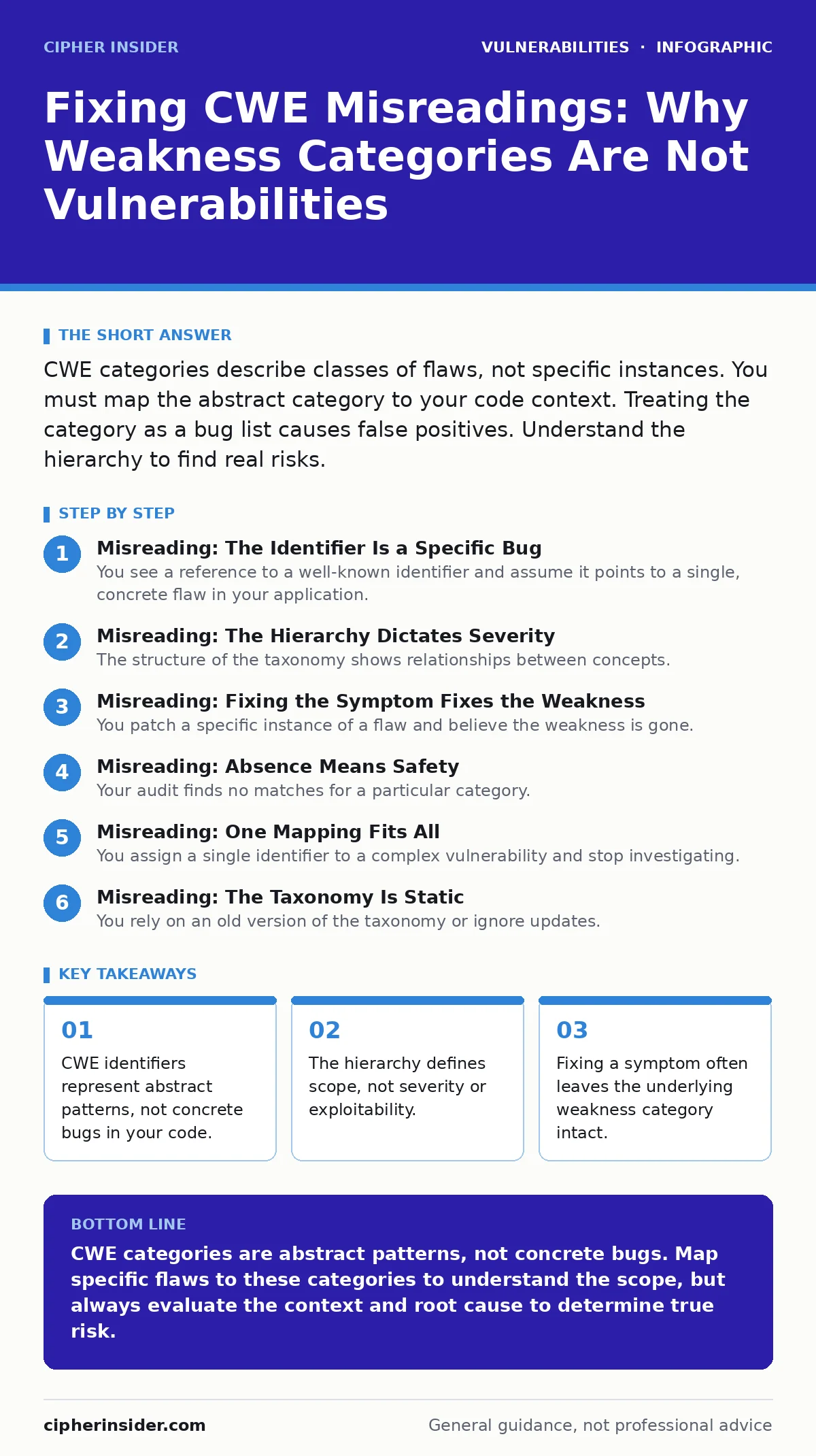
Misreading: The Hierarchy Dictates Severity
The structure of the taxonomy shows relationships between concepts. Many analysts assume that a child node is always more critical or dangerous than its parent. This assumption fails because severity depends entirely on context. A general category might be harmless in one environment and catastrophic in another.
Correct reading: The hierarchy defines scope and specificity. A parent node covers a broad concept. Child nodes narrow that concept into specific mechanisms. Severity is external to the taxonomy. You must evaluate the impact of the specific instance in your environment. Do not let the tree structure dictate your risk ranking.
Misreading: Fixing the Symptom Fixes the Weakness
You patch a specific instance of a flaw and believe the weakness is gone. This is dangerous. You may have addressed the immediate exploit path, but the underlying pattern remains in the codebase. Other developers may introduce the same pattern elsewhere, or the same pattern may exist in a different module.
Correct reading: Remediation requires addressing the root cause of the pattern. If the weakness is related to input validation, you must review all input handling, not just the exploited endpoint. Consider related concepts like command injection or NoSQL injection. These are specific manifestations of broader validation failures. Fixing one instance does not immunise the application against the general category.
Misreading: Absence Means Safety
Your audit finds no matches for a particular category. You declare the application safe from that type of risk. This is a false negative trap. The absence of a known pattern does not prove the absence of risk. Novel attacks or complex interactions can bypass standard checks. New patterns emerge constantly as technology evolves.
Correct reading: Use the categories as a lens for thinking, not a seal of approval. They help you ask better questions about your architecture. For example, consider security misconfigurations. These often do not fit neatly into traditional coding weakness categories. They arise from deployment choices. A clean codebase can still be vulnerable due to incorrect server settings or default credentials.
Misreading: One Mapping Fits All
You assign a single identifier to a complex vulnerability and stop investigating. This oversimplification ignores the layered nature of most flaws. A single exploit often involves multiple weaknesses interacting. Ignoring this complexity leads to incomplete fixes. You might patch the entry point but leave the logic flaw exposed.
Correct reading: Vulnerabilities are often composites. They combine multiple weakness categories. For instance, insecure direct object references (IDOR) often relies on a lack of access control checks combined with predictable resource naming. You must trace the entire attack chain. Identify every weakness category involved in the path from user input to impact. This ensures you address the full scope of the problem.
See also: Remediation Tracking Mistakes That Leave Systems Exposed · Detecting VPN Appliance Vulnerabilities: Signs, Tools and Blind Spots
Misreading: The Taxonomy Is Static
You rely on an old version of the taxonomy or ignore updates. This creates blind spots. The understanding of software weaknesses evolves. New categories are added as new attack vectors are discovered. Old categories are refined or retired. Sticking to an outdated view means you miss emerging risks.
Correct reading: The taxonomy is a living framework. It reflects the current state of knowledge about software flaws. You must stay aware of changes. When new patterns emerge, such as those related to side-channel attacks, the taxonomy adapts. These attacks exploit physical implementations rather than logical bugs. They require different mitigation strategies. Ignoring these updates leaves your assessment incomplete.
Misreading: Context Is Irrelevant
You apply the same risk assessment to every instance of a weakness. This ignores the critical role of context. A weakness in a public-facing web server carries different risk than the same weakness in an internal, air-gapped system. The likelihood of exploitation varies wildly.
Correct reading: Evaluate the exposure of the weakness. Consider who can reach it and what they can do if they do. For example, unpatched software is a common source of weaknesses. However, the risk depends on whether that software is exposed to the internet. An internal tool with limited access is less risky than a public API. Context dictates your priority.
Misreading: The Category Is the Root Cause
You identify a weakness category and assume it is the root cause. This is often incorrect. The category describes the symptom or the mechanism. The root cause might be a process failure. Poor requirements, lack of training, or time pressure can lead to weaknesses. Fixing the code without fixing the process leads to recurrence.
Correct reading: Look beyond the code. Ask why the weakness occurred. Was there a lack of security review? Were the requirements unclear? Addressing these process issues prevents the weakness from reappearing. This is more effective than just patching the code. It builds a stronger foundation for secure development.
Key takeaways
- CWE identifiers represent abstract patterns, not concrete bugs in your code.
- The hierarchy defines scope, not severity or exploitability.
- Fixing a symptom often leaves the underlying weakness category intact.
- Context determines whether a weakness becomes a vulnerability.
CWE categories are abstract patterns, not concrete bugs. Map specific flaws to these categories to understand the scope, but always evaluate the context and root cause to determine true risk.
Frequently asked questions
Is a CWE identifier the same as a CVE?
No. A CWE describes a class of weakness. A CVE identifies a specific vulnerability instance in a product. One CWE can map to many CVEs.
How do I find the right CWE for my bug?
Start with the description of the flaw. Use the search function in the taxonomy. Look for the most specific node that matches your issue. Do not settle for a broad parent node.
Can a single bug have multiple CWEs?
Yes. Complex vulnerabilities often involve multiple weaknesses. You should assign all relevant identifiers to capture the full nature of the flaw.
Does a high CWE number mean it is newer or worse?
No. The number is simply an identifier. It does not indicate age, severity, or importance. Do not use the number to rank risks.
How this guide was produced: written by the Cipher Insider editorial team with AI assistance, checked against the public references listed below, and reviewed when the facts change. See our editorial policy or report an error.