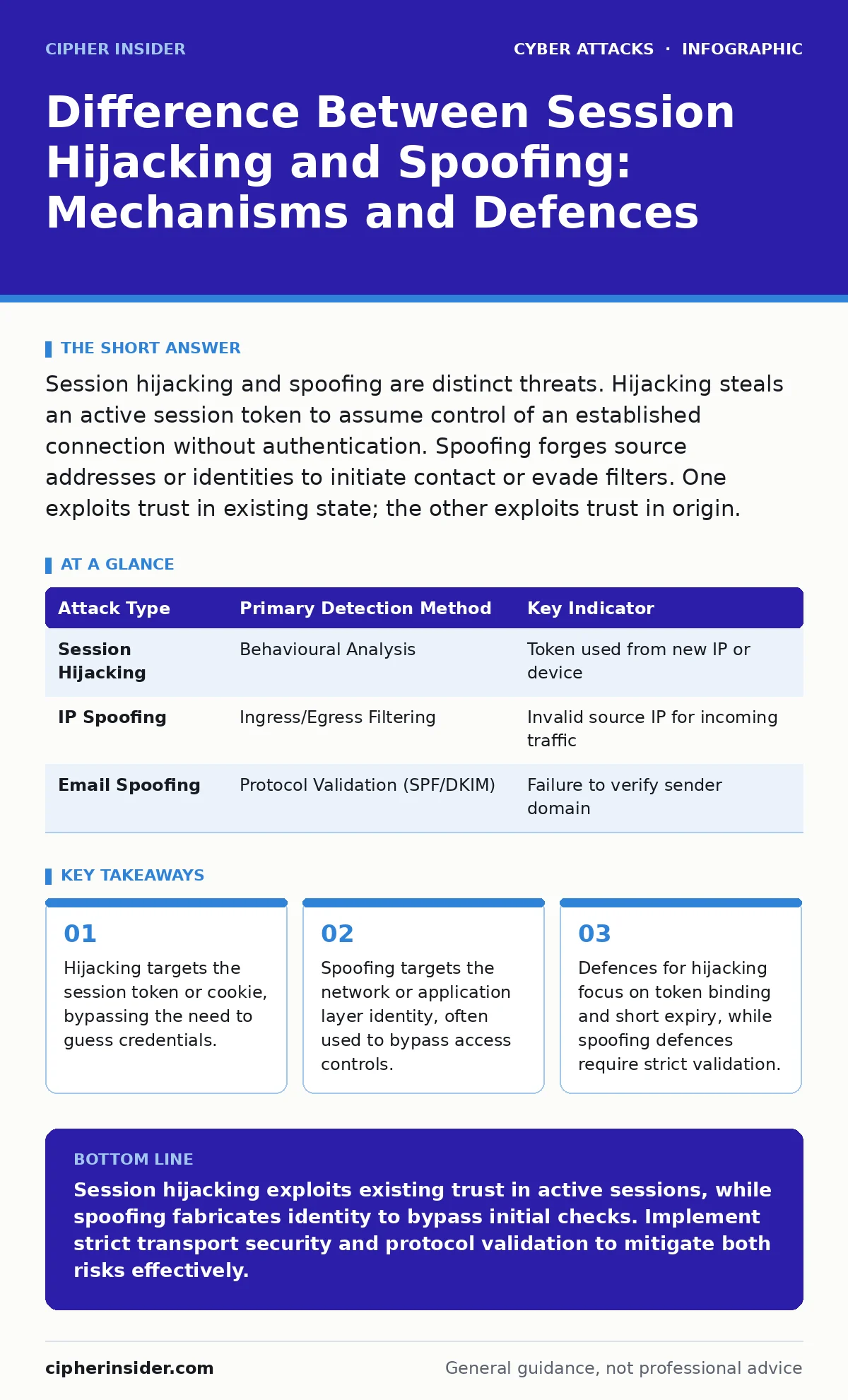
Session hijacking and spoofing are distinct threats. Hijacking steals an active session token to assume control of an established connection without authentication. Spoofing forges source addresses or identities to initiate contact or evade filters. One exploits trust in existing state; the other exploits trust in origin.
What is the difference between session hijacking and spoofing?
Session hijacking and spoofing differ in their target and timing. Hijacking intercepts or predicts an active session identifier, allowing an attacker to take over a connection that has already been authenticated. Spoofing involves fabricating the source address or identity of a packet to make it appear as though it originates from a trusted entity. The core distinction lies in whether the attacker exploits an existing trusted state or creates a false identity from scratch.
Imagine a bank teller who checks your ID. Spoofing is wearing a mask to look like you. Hijacking is stealing your open ledger after you have already been cleared. Both grant access, but the entry point differs. Understanding this separation helps you apply the correct countermeasures. Spoofing defences often fail against hijacking because the connection appears legitimate.
How does session hijacking bypass authentication?
Session hijacking bypasses authentication by stealing the session token rather than the credentials. When you log in, the server issues a unique string, often stored in a cookie, that identifies your session. The server trusts this string for the duration of the session. If an attacker obtains this string, the server treats their requests as yours. No password is required because the trust has already been established.
This mechanism exploits the stateless nature of HTTP. The protocol does not inherently link a request to a specific user beyond the token. Attackers use tools to sniff network traffic or exploit cross-site scripting vulnerabilities to extract these tokens. The attack succeeds because the application relies on possession of the token, not on continuous verification of the user's identity.
What is the primary mechanism of spoofing?
Spoofing primarily works by forging packet headers to disguise the origin of data. In IP spoofing, an attacker modifies the source IP address in the packet header. This makes the traffic appear to come from a trusted internal host. In email spoofing, the attacker alters the envelope sender or header fields to mimic a legitimate domain. The goal is to deceive the receiving system into accepting the data.
This technique exploits the lack of inherent verification in many protocols. TCP/IP was designed for trust, not security. Many firewalls allow traffic from known internal ranges without deep inspection. Spoofing leverages this permissiveness. It is often a precursor to other attacks, such as reflection-based denial of service, where the volume of forged traffic overwhelms a target.
Why do these attacks often get confused?
These attacks are confused because both result in unauthorised access and both involve deception. Users see the outcome—an attacker acting as them—without seeing the technical method. Security reports often group them under "identity theft" or "impersonation". This broad categorisation obscures the specific vulnerabilities each attack exploits. Consequently, organisations may implement defences for one while remaining vulnerable to the other.
The confusion persists because the user experience is identical. If your account is compromised, you see unfamiliar activity. You do not know if the attacker guessed your password, stole your token, or forged an email to reset it. This ambiguity hinders incident response. Precise terminology is necessary for accurate forensic analysis and targeted mitigation.
What are the specific conditions for hijacking to succeed?
Hijacking succeeds when session tokens are transmitted insecurely or are predictable. If a website uses HTTP instead of HTTPS, tokens travel in plain text. Network sniffers can capture them easily. If tokens are generated using weak random number generators, attackers can predict future values. Additionally, if the application does not bind the token to the user's IP address or user-agent string, stolen tokens remain valid on different devices.
Another condition is long-lived sessions. If a token remains valid for days, the window for an attacker to use it widens. Applications that do not invalidate tokens on logout or after suspicious activity leave users exposed. The combination of weak transport security and poor token management creates a high-risk environment for hijacking.
See also: Tor Browser Explained: Routing, Relays, and Real Anonymity · Does Private Browsing Work: The Reality of Local Data Isolation
When is spoofing most effective against defences?
Spoofing is most effective when defences rely solely on source address verification. Many legacy systems trust traffic from specific IP ranges. If an attacker can forge an IP from that range, they bypass perimeter filters. Spoofing also works well against simple email filters that check only the envelope sender. Modern filters check SPF, DKIM, and DMARC records, but misconfigurations remain common.
The attack is particularly potent in distributed denial of service scenarios. By spoofing millions of source addresses, an attacker makes it difficult to block the traffic. The victim cannot blacklist a single attacker. This volume-based approach exploits the scalability limits of network equipment. It forces the target to drop legitimate traffic to survive the assault.
How do detection methods differ for each attack?
Detection for hijacking focuses on anomalies in session behaviour. Sudden changes in IP address, user-agent, or geographic location for the same session token trigger alerts. Real-time monitoring can block requests that deviate from the established baseline. For spoofing, detection relies on validation protocols. Checking SPF records for email or using ingress filtering for IP traffic identifies forged packets before they reach the application.
| Attack Type | Primary Detection Method | Key Indicator |
|---|---|---|
| Session Hijacking | Behavioural Analysis | Token used from new IP or device |
| IP Spoofing | Ingress/Egress Filtering | Invalid source IP for incoming traffic |
| Email Spoofing | Protocol Validation (SPF/DKIM) | Failure to verify sender domain |
Hijacking detection requires stateful inspection. The system must remember the initial conditions of the session. Spoofing detection is often stateless. It checks each packet or email against a rule set. Combining both approaches provides deeper visibility. Relying on one leaves blind spots that sophisticated attackers can exploit.
What are the hidden costs of mitigation?
Mitigation often introduces friction for legitimate users. Binding session tokens to IP addresses can break for users on mobile networks, where IPs change frequently. Strict email validation can cause legitimate messages to be rejected if DNS records are misconfigured. These trade-offs require careful tuning. Overly aggressive defences can lead to service outages or support ticket spikes.
Another hidden cost is the complexity of implementation. Maintaining secure token generation and validation logic requires ongoing expertise. Misconfigurations in DNS or firewall rules can create new vulnerabilities. The effort to defend against one attack vector can inadvertently weaken another. Balancing security with usability is a continuous challenge that demands regular review.
How do related threats compound the risk?
Related threats often serve as entry points for hijacking or spoofing. Phishing emails can deliver malware that steals session cookies. Insider threats may expose internal network maps, aiding spoofing efforts. USB drop attacks can install keyloggers that capture credentials, leading to legitimate sessions that can then be hijacked. Understanding these connections helps you prioritise defences.
Network segmentation limits the blast radius of an insider threat or a compromised device. If an attacker gains access to one segment, they cannot easily reach critical servers. DNS filtering can block connections to known malicious domains used in phishing campaigns. Reducing the attack surface at multiple layers makes it harder for attackers to combine techniques.
What immediate steps reduce exposure to both?
Immediate steps include enforcing strict transport security and validating all inputs. Use HTTPS everywhere to protect tokens in transit. Implement short session timeouts to limit the value of stolen tokens. For email, ensure SPF, DKIM, and DMARC records are correctly configured and monitored. These measures address the primary vectors for both hijacking and spoofing.
Regularly review firewall rules to ensure ingress filtering is active. This blocks packets with forged source addresses from entering your network. Monitor logs for unusual patterns, such as multiple failed login attempts followed by successful sessions from new locations. Early detection minimises damage. Consistent application of these basics significantly lowers the probability of successful attacks.
Key takeaways
- Hijacking targets the session token or cookie, bypassing the need to guess credentials.
- Spoofing targets the network or application layer identity, often used to bypass access controls.
- Defences for hijacking focus on token binding and short expiry, while spoofing defences require strict validation.
Session hijacking exploits existing trust in active sessions, while spoofing fabricates identity to bypass initial checks. Implement strict transport security and protocol validation to mitigate both risks effectively.
Frequently asked questions
Can I prevent session hijacking with a strong password?
No, a strong password only protects the initial login. Hijacking targets the session token generated after login. You must protect the token itself with HTTPS and short expiry times.
Is IP spoofing possible over IPv6?
Yes, IP spoofing is possible in IPv6. However, the larger address space makes random guessing harder. Ingress filtering remains the primary defence against intentional forgery.
Do firewalls stop email spoofing?
Standard firewalls do not inspect email content. You need specific email filtering solutions that validate SPF, DKIM, and DMARC records to detect spoofed senders.
How do I know if my session is hijacked?
You may see unexpected activity in your account history. Log out of all devices immediately. Check for changes in security settings or new linked accounts.
How this guide was produced: written by the Cipher Insider editorial team with AI assistance, checked against the public references listed below, and reviewed when the facts change. See our editorial policy or report an error.