
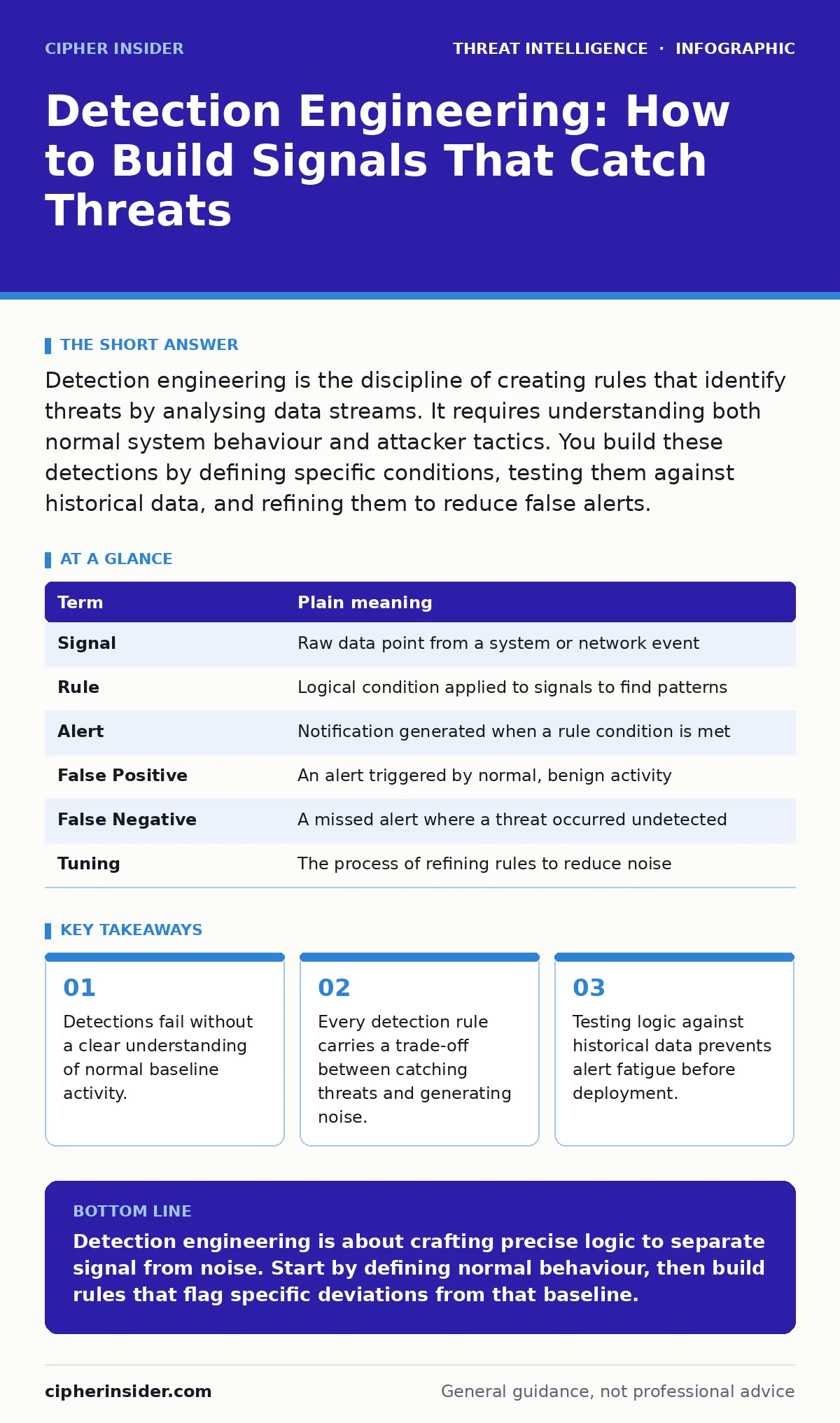
Detection engineering is the discipline of creating rules that identify threats by analysing data streams. It requires understanding both normal system behaviour and attacker tactics. You build these detections by defining specific conditions, testing them against historical data, and refining them to reduce false alerts.
The Library Security Analogy
Imagine a library with thousands of visitors every day. You cannot watch every person simultaneously. Instead, you set up specific conditions that trigger an alert. If a visitor checks out ten books in one minute, the system flags this. This is not necessarily theft, but it is unusual enough to warrant a glance. Detection engineering is the process of defining those specific conditions so they catch real problems without screaming at every cough or sneeze.
The library does not care about the colour of the visitor’s coat. It cares about actions that deviate from the norm. Your detection logic must focus on behaviour, not appearance. If you define "suspicious" as "wearing red", you will miss every threat that wears blue. This specificity is what separates effective security monitoring from random noise.
Core Mechanics and Terminology
To build these conditions, you must understand the building blocks. A signal is a raw piece of data, such as a user logging in. A rule is the logic you apply to that signal, such as "five failed logins in one hour". When the rule matches, it creates an alert. This alert is what a human analyst reviews.
| Term | Plain meaning |
|---|---|
| Signal | Raw data point from a system or network event |
| Rule | Logical condition applied to signals to find patterns |
| Alert | Notification generated when a rule condition is met |
| False Positive | An alert triggered by normal, benign activity |
| False Negative | A missed alert where a threat occurred undetected |
| Tuning | The process of refining rules to reduce noise |
You cannot tune a rule if you do not know what the signal looks like. Poor signal quality leads to broken rules. This is why log management is often a prerequisite for effective detection engineering. If the data is incomplete, your logic will be blind.
The Hidden Cost of Sensitivity
There is a fundamental trade-off in every detection rule: sensitivity versus noise. If you make a rule very sensitive, it catches more threats. However, it also catches more normal activity that looks similar. This creates false positives. Analysts will eventually ignore the alerts if they are constantly wrong. This is known as alert fatigue.
Suppose you create a rule to detect LSASS credential theft. This attack involves accessing memory to steal passwords. However, some legitimate administrative tools also access this memory. If your rule is too broad, it will fire every time an admin runs a diagnostic tool. You must narrow the scope to catch only the malicious pattern. This requires knowing exactly which tools are legitimate in your environment.
Building Your First Detection
You start by choosing a specific tactic. Do not try to detect "malware" generally. Choose a specific action, such as a process spawning another process. For example, a text editor launching a command prompt is unusual. A web browser launching a download manager is normal.
Next, you define the condition. The rule might state: "Alert if a document editor spawns a shell interpreter." You then test this rule against past data. Look at the historical logs. Did any legitimate user do this? If yes, your rule is too broad. You must add exclusions for those specific users or times.
This testing phase is critical. It reveals the edge cases you did not expect. You might find that a specific backup script triggers this pattern. You then modify the rule to exclude that script. This iterative process turns a rough idea into a reliable detection.
Integrating Broader Intelligence
Detections do not exist in a vacuum. They feed into broader security practices. For instance, a detection might reveal initial access, prompting deeper investigation into attacker reconnaissance. If you see scanning activity, you might deploy honeypots to distract the adversary.
Alternatively, a detection might flag unusual privilege usage. This could indicate privilege escalation attacks. By connecting these dots, you move from single events to a narrative of compromise. This is where threat hunting begins. Hunters use these detections as starting points to search for related activities that did not trigger an alert.
See also: Canary Token Mistakes: Why Your Traps Fail and How to Fix Them · Canary Tokens: Benefits, Limitations and When to Deploy Them
Practical Steps for Beginners
You can begin building your intuition for detection logic without complex tools. Follow these steps to practice the mindset.
- Identify a normal baseline: Look at your own computer activity for one hour. Note every program that opens. This is your "normal".
- Define an anomaly: Imagine an attacker wants to hide. How would they make their activity look like your baseline? Perhaps they rename their tool to match a legitimate system process.
- Draft a rule: Write a sentence that would catch this renamed tool. For example, "Alert if a process named 'svchost' runs from the downloads folder."
This exercise teaches you to think like the adversary while maintaining the perspective of the defender. It highlights the importance of context. The same action is benign in one context and malicious in another.
Avoiding Common Pitfalls
A common mistake is relying on single events. A single failed login is rarely an attack. It is often a user forgetting their password. You must look for sequences. Five failed logins followed by a successful one from a new location is a stronger signal.
Another error is ignoring the business context. In a financial system, a large transfer is normal. In a personal banking app, it is not. Your detection rules must align with how the organization actually operates. If you do not understand the business, you cannot build effective rules.
Key takeaways
- Detections fail without a clear understanding of normal baseline activity.
- Every detection rule carries a trade-off between catching threats and generating noise.
- Testing logic against historical data prevents alert fatigue before deployment.
Detection engineering is about crafting precise logic to separate signal from noise. Start by defining normal behaviour, then build rules that flag specific deviations from that baseline.
Frequently asked questions
How is detection engineering different from threat hunting?
Detection engineering builds automated rules to catch known patterns. Threat hunting is a manual, proactive search for threats that may not have triggered any alerts.
Can I use open-source tools for detection engineering?
Yes. Many open-source platforms support creating custom rules and analysing logs. The value lies in the logic of the rule, not the software that hosts it.
How do I know if my detection rule is good?
A good rule has a low false positive rate and catches relevant threats. Test it against historical data to see how often it triggers incorrectly.
Do I need to be a coder to do detection engineering?
Basic logic and understanding of systems are more important than advanced coding. Many rules use simple queries or natural language-like syntax.
How this guide was produced: written by the Cipher Insider editorial team with AI assistance, checked against the public references listed below, and reviewed when the facts change. See our editorial policy or report an error.