
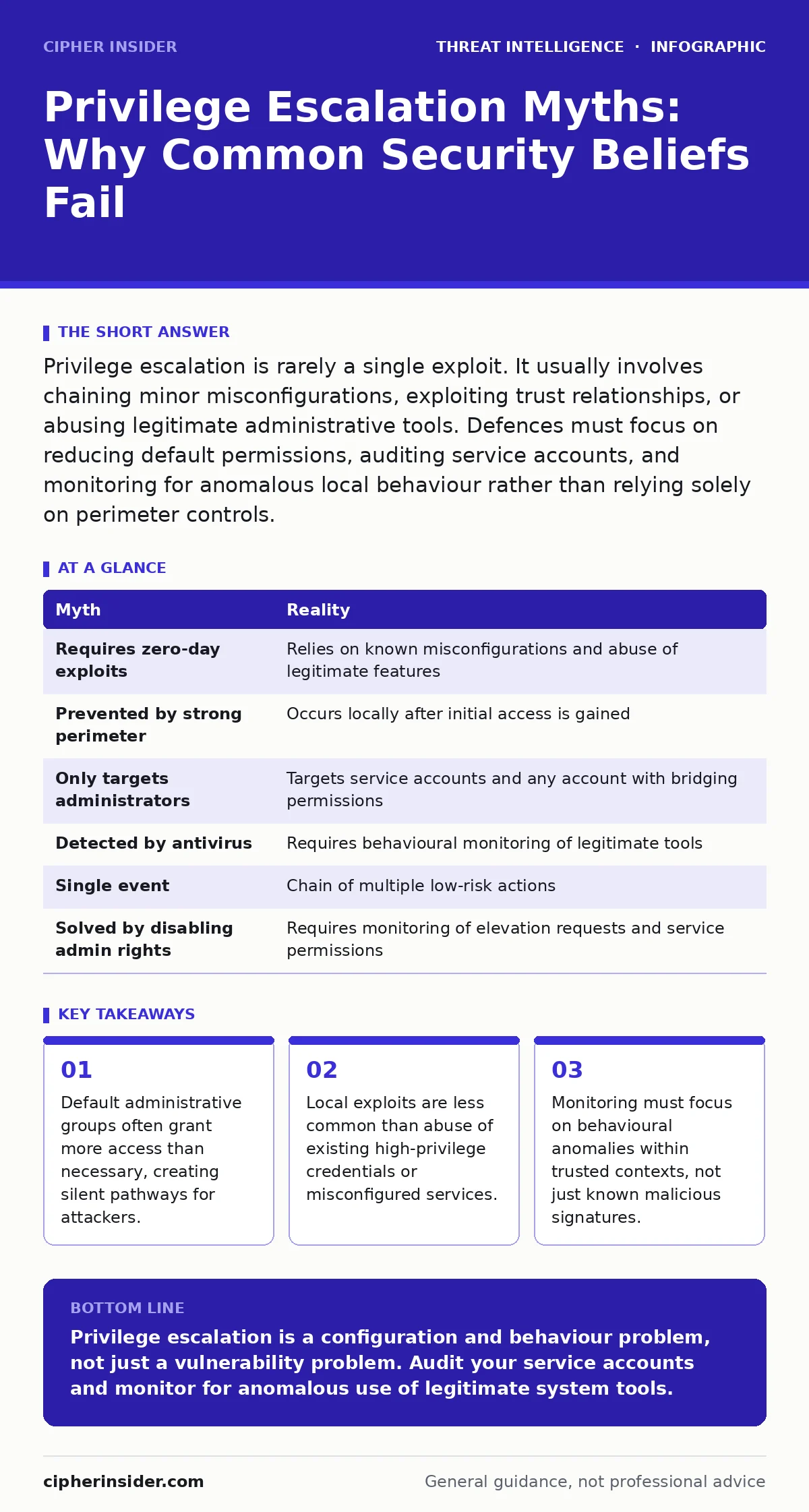
Privilege escalation is rarely a single exploit. It usually involves chaining minor misconfigurations, exploiting trust relationships, or abusing legitimate administrative tools. Defences must focus on reducing default permissions, auditing service accounts, and monitoring for anomalous local behaviour rather than relying solely on perimeter controls.
Myth: Privilege Escalation Requires Zero-Day Exploits
Reality: The vast majority of successful privilege escalation attacks rely on known vulnerabilities, misconfigurations, or abuse of legitimate features. Attackers rarely need unknown code to gain higher privileges. They exploit gaps in how systems are configured by default.
Many defenders assume that if their systems are patched, they are safe from local privilege escalation. This belief ignores the reality of configuration drift. A server may be fully patched, yet still run a service as a system account when it only needs user-level permissions. This unnecessary elevation provides an attacker with a foothold that requires no new exploit.
The mechanism here is simple: if a process runs with high privileges, any vulnerability in that process grants those same high privileges to the attacker. You do not need a zero-day in the operating system kernel. You only need a bug in the application running as root or system. This shifts the defence burden from patching alone to rigorous permission auditing.
Myth: If the Perimeter is Secure, Local Escalation Cannot Occur
Reality: Privilege escalation is a local problem that occurs after an attacker has already gained initial access. Perimeter defences stop external intrusion but do not restrict what an attacker can do once inside.
Imagine an attacker gains access through a phishing email that compromises a standard user account. The perimeter firewall did not fail. The email filter did not fail. The attacker is now inside. The next step is not to break out, but to move up.
This is where the concept of lateral movement and privilege escalation intersects. Attackers often spend more time enumerating the internal environment than trying to break new ground. They look for writable directories, misconfigured scheduled tasks, or services running under privileged accounts. The perimeter is irrelevant at this stage. Your defence must assume breach and focus on limiting the damage a low-privileged account can cause.
Myth: Only Administrators Are Targets for Escalation
Reality: Service accounts and standard users with specific application rights are frequent targets. Attackers look for any account that can bridge the gap between low and high privilege.
Service accounts are often created with broad permissions to ensure applications function correctly across different systems. These accounts are rarely monitored as closely as human user accounts. An attacker who compromises a standard user may look for credentials stored in scripts or configuration files associated with these service accounts.
This is where token theft becomes a critical vector. An attacker may not need to crack a password. They may simply steal the security token of a high-privilege process that is already running. This technique allows them to impersonate the service account without knowing its password. Defending against this requires understanding which processes run with elevated rights and ensuring they are minimal.
Myth: Anti-Virus Software Detects Privilege Escalation Attempts
Reality: Traditional antivirus solutions are poor at detecting privilege escalation because these attacks often use legitimate system tools. The behaviour is technically valid, even if the intent is malicious.
Attackers frequently use "living off the land" techniques. They run PowerShell commands, execute C++ scripts, or modify registry keys using built-in Windows utilities. These tools are signed by Microsoft and trusted by the system. An antivirus engine sees a legitimate binary executing a command. It does not see malware.
This is why detection engineering focuses on behavioural analytics rather than signature matching. You must look for unusual sequences of actions. For example, a standard user account suddenly modifying system-level registry keys or accessing sensitive directories is anomalous. The tool itself is not malicious, but the context of its use is. Defences must adapt to monitor the who, what, and when of command execution, not just the which.
Myth: Disabling Admin Rights for Users Prevents Escalation
Reality: While limiting administrative rights is a best practice, it does not eliminate the risk. Attackers exploit misconfigurations in how applications and services request elevated privileges.
Even if a user has no administrative rights, an application they run might request elevation through User Account Control (UAC). If the application is poorly designed or if the UAC settings are too permissive, an attacker can trick the system into granting higher privileges.
Furthermore, many organisations create "local admin" groups on workstations to allow users to install software. This creates a large attack surface. If one workstation is compromised, the attacker has local administrative rights. They can then install persistence mechanisms or capture credentials. The defence here is not just disabling admin rights, but ensuring that even when elevation is requested, it is logged and monitored for anomalies.
See also: Port Scanning Myths: What Attackers Actually Reveal
Myth: Privilege Escalation is a Single Event
Reality: Privilege escalation is often a chain of small, seemingly harmless actions. Attackers combine multiple low-risk findings to achieve a high-risk outcome.
An attacker might find a writable directory, a misconfigured scheduled task, and a weakly secured service. Individually, none of these allow full system control. Together, they form a path. This chaining makes detection difficult because each step appears benign.
This is where threat hunting becomes valuable. You must look for the correlation between events. Did a low-privileged user modify a file in a system directory? Did that file get executed by a scheduled task? Did that task run a process that interacted with a high-privilege service? The pattern is the indicator, not the individual action.
| Myth | Reality |
|---|---|
| Requires zero-day exploits | Relies on known misconfigurations and abuse of legitimate features |
| Prevented by strong perimeter | Occurs locally after initial access is gained |
| Only targets administrators | Targets service accounts and any account with bridging permissions |
| Detected by antivirus | Requires behavioural monitoring of legitimate tools |
| Single event | Chain of multiple low-risk actions |
| Solved by disabling admin rights | Requires monitoring of elevation requests and service permissions |
Key takeaways
- Default administrative groups often grant more access than necessary, creating silent pathways for attackers.
- Local exploits are less common than abuse of existing high-privilege credentials or misconfigured services.
- Monitoring must focus on behavioural anomalies within trusted contexts, not just known malicious signatures.
Privilege escalation is a configuration and behaviour problem, not just a vulnerability problem. Audit your service accounts and monitor for anomalous use of legitimate system tools.
Frequently asked questions
How do I detect privilege escalation if antivirus doesn't catch it?
Focus on behavioural monitoring. Look for standard users executing administrative commands, accessing sensitive directories, or modifying system files. Use logging to track process creation and file modifications.
What is the difference between vertical and horizontal privilege escalation?
Vertical escalation is gaining higher privileges, such as moving from user to admin. Horizontal escalation is gaining the privileges of another user at the same level, such as stealing another user's session token.
Why are service accounts a high risk for privilege escalation?
Service accounts often have broad permissions to ensure application functionality. They are less monitored than user accounts and may have credentials stored in plaintext or weakly protected locations, making them easy targets for token theft.
Can privilege escalation happen on cloud environments?
Yes. Cloud environments have their own privilege models, such as IAM roles. Attackers exploit misconfigured roles, overly permissive policies, or compromised credentials to gain higher access levels within the cloud infrastructure.
How this guide was produced: written by the Cipher Insider editorial team with AI assistance, checked against the public references listed below, and reviewed when the facts change. See our editorial policy or report an error.