
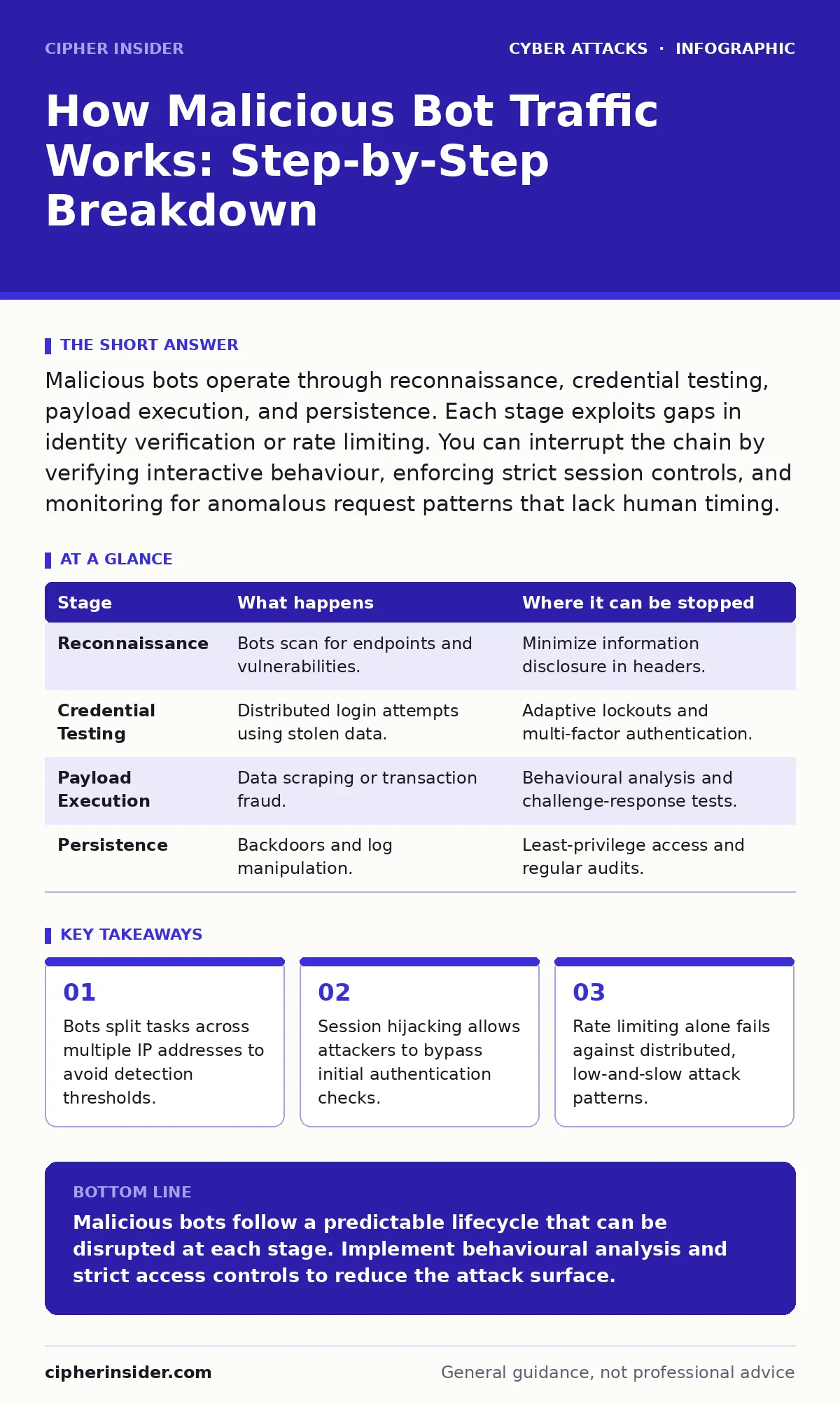
Malicious bots operate through reconnaissance, credential testing, payload execution, and persistence. Each stage exploits gaps in identity verification or rate limiting. You can interrupt the chain by verifying interactive behaviour, enforcing strict session controls, and monitoring for anomalous request patterns that lack human timing.
The Anatomy of Automated Intrusions
Malicious bot traffic does not arrive as a single event. It follows a structured lifecycle designed to maximise data extraction while minimising detection risk. Understanding this lifecycle reveals why simple firewall rules fail and where defensive controls must shift. You will see how attackers move from passive observation to active exploitation, and where you can intervene to break the chain.
Stage 1: Reconnaissance and Fingerprinting
Stage 1: Reconnaissance and Fingerprinting
The attacker begins by mapping the target environment. Bots send lightweight requests to discover entry points, such as login forms, API endpoints, or hidden administrative panels. They analyse server responses to identify software versions and potential vulnerabilities. This phase relies on the target exposing technical details in HTTP headers or error messages.
This stage can be interrupted by minimising information disclosure. Configure servers to suppress version numbers and generic error codes. Imagine a bot scanning for a known vulnerability in a specific web server version. If the server does not advertise that version, the bot cannot confirm the target is vulnerable. This forces the attacker to guess, increasing the noise and reducing the efficiency of the campaign.
Stage 2: Credential Testing and Access
Stage 2: Credential Testing and Access
Once entry points are identified, bots attempt to gain authenticated access. They use stolen credential lists to perform brute-force or dictionary attacks. Modern bots rotate user-agent strings and IP addresses to appear as distinct users. This distribution prevents rate-limiting controls from triggering alerts based on volume alone. The attacker relies on the target not requiring multi-factor authentication or implementing weak lockout policies.
You can stop this by enforcing multi-factor authentication and adaptive lockouts. Standard lockouts after five attempts are insufficient if the attacker uses thousands of different IPs. Instead, monitor for impossible travel or rapid login failures across many accounts. If a single account sees failures from diverse locations, block the session. This requires a security operations center to correlate events that individual systems might miss.
Stage 3: Payload Execution and Data Extraction
Stage 3: Payload Execution and Data Extraction
With valid credentials, the bot executes its primary objective. This may involve scraping sensitive data, submitting fraudulent transactions, or injecting malicious code into the application. The bot mimics human typing speeds and mouse movements to evade behavioural analysis tools. It requests data in small chunks to stay below bandwidth thresholds. The attacker relies on the application trusting authenticated users without further validation of intent.
Interrupt this stage by validating request patterns. Analyse the timing and sequence of API calls. Human users pause to read content; bots often request data sequentially without delay. Implementing challenge-response tests, such as CAPTCHAs, for sensitive actions can disrupt automated flows. However, this must be balanced against user experience. Overusing these challenges frustrates legitimate users and drives them to competitors.
Stage 4: Persistence and Evasion
Stage 4: Persistence and Evasion
The final stage focuses on maintaining access and evading detection. Bots may establish hidden backdoors or modify application settings to allow future entry. They also clear logs or generate noise to obscure their tracks. Some bots remain dormant until triggered by a specific event, such as a new product launch or financial quarter. This persistence relies on the target’s inability to correlate disparate events over time.
You can mitigate persistence by enforcing strict least-privilege access. Ensure that even authenticated users cannot modify critical system configurations without elevated privileges. Regularly audit access logs for changes to user roles or API keys. If a bot gains access, it should not be able to grant itself higher permissions. This limits the damage even if the initial breach is not immediately detected.
See also: Detection Engineering: How to Build Signals That Catch Threats
Attack Surface Mapping
Understanding the full cycle requires visualising where controls intersect. The following table summarises the stages, actions, and intervention points.
| Stage | What happens | Where it can be stopped |
|---|---|---|
| Reconnaissance | Bots scan for endpoints and vulnerabilities. | Minimize information disclosure in headers. |
| Credential Testing | Distributed login attempts using stolen data. | Adaptive lockouts and multi-factor authentication. |
| Payload Execution | Data scraping or transaction fraud. | Behavioural analysis and challenge-response tests. |
| Persistence | Backdoors and log manipulation. | Least-privilege access and regular audits. |
The Hidden Cost of False Positives
Blocking malicious bots is not merely a technical challenge. It involves significant trade-offs. Aggressive blocking rules often catch legitimate users, such as those using corporate proxies or automated testing tools. This friction damages user experience and can lead to revenue loss. You must balance security with accessibility.
Consider the impact on search engine crawlers. These bots are essential for visibility but share some characteristics with malicious bots. If your rules are too strict, search engines may de-index your site. This is a non-obvious consequence of overzealous bot management. You need fine-grained controls that distinguish between helpful and harmful automation. This requires continuous tuning and monitoring, not just a one-time configuration.
Integrating Defence Layers
No single control stops all bot traffic. You must combine network-level filtering with application-level validation. DNS filtering can block known malicious domains before they reach your servers. This reduces the volume of traffic your application must process. However, attackers often use compromised legitimate domains, so DNS filtering alone is insufficient.
Phishing attacks often deliver the initial credentials that bots use. Educating users against phishing reduces the pool of valid credentials available for testing. This upstream defence weakens the bot’s ability to gain access. Similarly, understanding watering hole attacks helps you protect users who visit trusted sites that have been compromised. These sites may serve malicious code that installs bots on user devices, turning them into part of a distributed network.
Operationalising Detection
Detecting bot traffic requires a shift from signature-based to behaviour-based monitoring. Traditional firewalls look for known bad patterns. Behavioural analysis looks for anomalies in user activity. This includes mouse movements, keystroke dynamics, and request timing. Implementing this analysis requires a security operations center to review alerts and refine rules.
You must also consider insider threats. An insider may intentionally disable bot protections or provide credentials to attackers. Monitoring for unusual administrative actions can reveal such compromises. USB drop attacks are another vector, but they are less relevant to remote bot traffic. Focus on network and application controls to address the primary risk.
Key takeaways
- Bots split tasks across multiple IP addresses to avoid detection thresholds.
- Session hijacking allows attackers to bypass initial authentication checks.
- Rate limiting alone fails against distributed, low-and-slow attack patterns.
Malicious bots follow a predictable lifecycle that can be disrupted at each stage. Implement behavioural analysis and strict access controls to reduce the attack surface.
Frequently asked questions
How do I distinguish between search engine bots and malicious bots?
Verify the bot’s identity through known lists of search engine crawlers. Check the IP address against official ranges and ensure the user-agent matches the expected format. Malicious bots often spoof these details but fail deeper validation checks.
Can multi-factor authentication stop credential stuffing attacks?
Yes, multi-factor authentication significantly reduces the success rate of credential stuffing. Even if the bot has valid usernames and passwords, it cannot provide the second factor. This adds a layer of security that is difficult for automated systems to bypass.
What is the role of DNS filtering in bot mitigation?
DNS filtering blocks requests to known malicious domains. This prevents bots from communicating with command-and-control servers or downloading additional payloads. It reduces the volume of malicious traffic reaching your application, making other controls more effective.
How do I handle bot traffic during a product launch?
Expect increased bot activity during high-traffic events. Pre-configure stricter rate limits and behavioural rules before the launch. Monitor traffic closely and adjust thresholds in real-time. This proactive approach helps maintain service availability while filtering out fraudulent requests.
How this guide was produced: written by the Cipher Insider editorial team with AI assistance, checked against the public references listed below, and reviewed when the facts change. See our editorial policy or report an error.