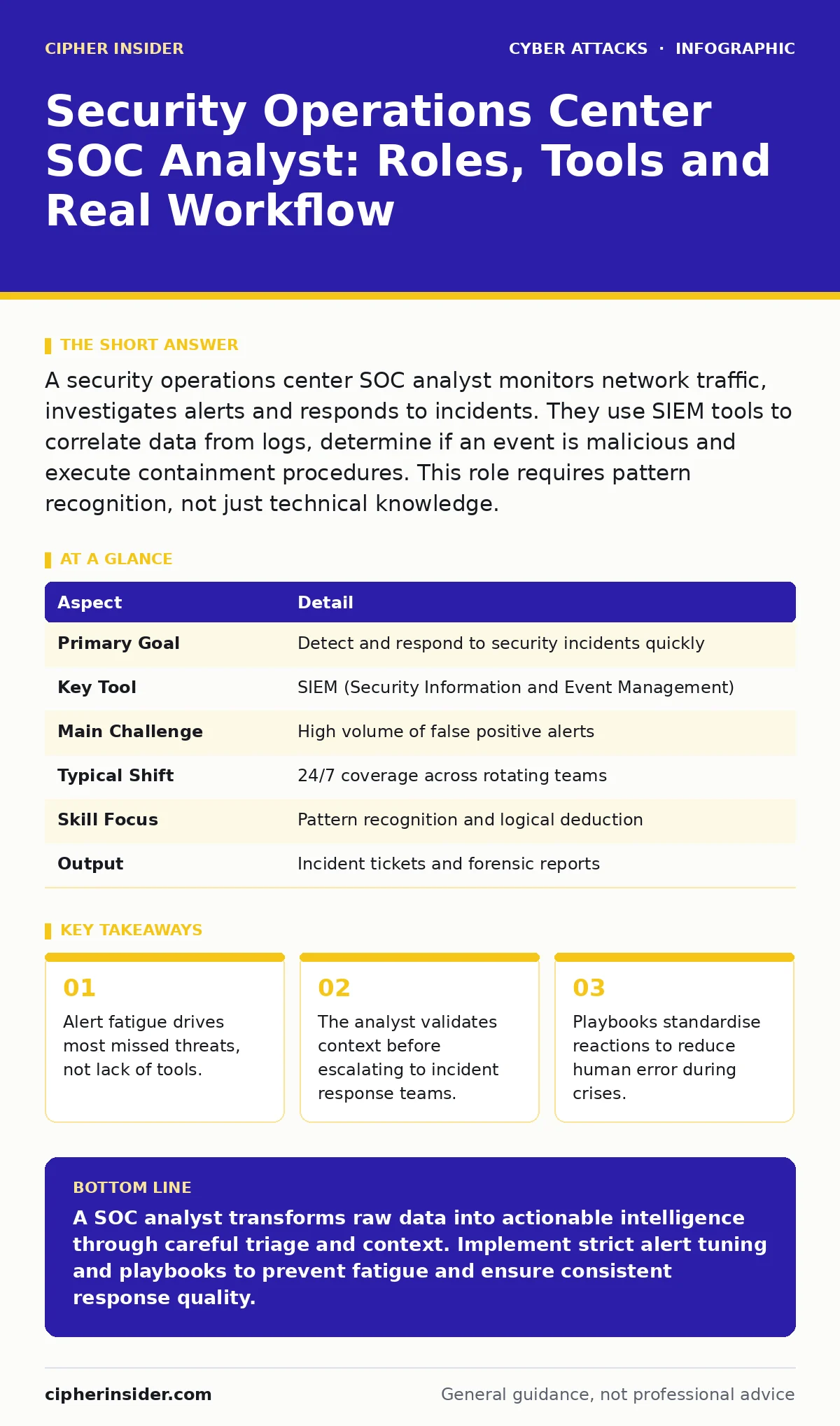
A security operations center SOC analyst monitors network traffic, investigates alerts and responds to incidents. They use SIEM tools to correlate data from logs, determine if an event is malicious and execute containment procedures. This role requires pattern recognition, not just technical knowledge.
Why the Security Operations Center SOC Analyst Matters
Imagine a busy airport security checkpoint. The scanners flag every metal object, from belt buckles to coins. The security officer must decide in seconds which flags require a physical search and which are harmless background noise. A security operations center (SOC) performs this same function for digital infrastructure. It is a dedicated team and suite of tools that monitor, detect and respond to cybersecurity threats.
The SOC analyst is the human element within this system. They sit at the console, watching streams of data that machines cannot fully interpret. Without this human layer, an organisation relies entirely on automated rules, which attackers can easily circumvent. The analyst provides the contextual understanding that distinguishes a system glitch from a coordinated attack.
| Aspect | Detail |
|---|---|
| Primary Goal | Detect and respond to security incidents quickly |
| Key Tool | SIEM (Security Information and Event Management) |
| Main Challenge | High volume of false positive alerts |
| Typical Shift | 24/7 coverage across rotating teams |
| Skill Focus | Pattern recognition and logical deduction |
| Output | Incident tickets and forensic reports |
How the Detection Mechanism Works
The core of the SOC is the SIEM platform. This software collects logs from firewalls, endpoints, servers and applications. It aggregates this data into a single timeline. The SIEM applies correlation rules to identify suspicious patterns, such as multiple failed login attempts from different geographic locations.
The analyst reviews these correlated alerts. They do not look at raw logs alone. They examine the context: is this user known? Is the device managed? Is the time unusual? This triage process determines the severity. Low-severity alerts might be closed automatically. High-severity alerts trigger a deeper investigation. This workflow ensures that resources are spent on real threats rather than administrative errors.
The Analyst’s Daily Investigation Cycle
A typical shift begins with reviewing pending tickets from the previous team. The analyst prioritises based on severity and potential blast radius. They investigate by asking specific questions. Who is the user? What asset is affected? What changed recently? This questioning mirrors a detective’s approach. They gather evidence, not just to prove a breach occurred, but to understand how it happened.
If the analyst confirms malicious activity, they follow a playbook. A playbook is a step-by-step guide for specific scenarios. For example, a ransomware playbook dictates isolating the infected host immediately. This standardisation prevents panic-driven decisions. The analyst documents every step. This documentation becomes part of the forensic record. It helps future analysts understand the attack chain.
What People Usually Get Wrong
Many assume the SOC is a passive monitoring station. In reality, it is an active defence mechanism. Another common misconception is that tools solve all problems. Tools generate noise. Humans make decisions. Without skilled analysts, a SOC is just an expensive data warehouse.
People also underestimate the mental toll of the job. Alert fatigue is a real phenomenon. When analysts see hundreds of false positives daily, their sensitivity to genuine threats decreases. They may start ignoring alerts to cope with the volume. This creates a blind spot. Organisations must tune their SIEM rules carefully. They must reduce noise before adding more data sources. Quality of alerts matters more than quantity.
Furthermore, the role is not static. Attackers change tactics. The analyst must update their knowledge base constantly. They cannot rely on last year’s indicators. This continuous learning curve is steep. It requires curiosity and discipline. The job is not about knowing every tool. It is about knowing how to find answers quickly.
The Human Factor in Defence
The SOC analyst is the first line of defence against insider threats. Malicious insiders often mimic normal behaviour. Automated systems struggle to detect this deviation. An analyst can spot subtle anomalies in user behaviour. They notice when a developer accesses files outside their project scope. They question why a finance employee downloads large datasets at midnight.
This human intuition complements machine learning models. Algorithms identify statistical outliers. Analysts provide business context. Together, they form a stronger defence. However, this synergy requires trust. The analyst must feel empowered to escalate concerns without fear of reprisal. A culture of psychological safety improves detection rates. If analysts hide mistakes, the organisation learns nothing.
Common Errors and How to Avoid Them
One frequent error is jumping to conclusions. An alert indicates a threat, but it does not prove intent. The analyst must verify. They should assume innocence until evidence proves otherwise. This prevents unnecessary disruption to business operations. Blocking a critical server based on a false positive can cause significant downtime.
Another error is poor documentation. Analysts often focus on the immediate fix. They forget to record the reasoning behind their decisions. This lack of context hinders future investigations. New analysts inherit unresolved tickets without understanding the history. They repeat previous mistakes. Good documentation creates institutional memory. It allows the team to build on past work rather than starting from scratch.
Finally, silos create blind spots. The SOC often operates separately from IT operations. This separation delays response times. When the SOC detects an issue, they need IT to execute containment actions. If communication is slow, the attacker gains more time. Integrating SOC and IT workflows reduces this friction. Regular joint exercises improve coordination.
Building a Resilient SOC Workflow
To build an effective SOC, start with clear priorities. Define what assets need protection. Align monitoring with business value. Do not monitor everything equally. Focus on high-value targets. This reduces noise and improves signal quality.
Invest in security awareness training for the wider organisation. The SOC cannot catch everything. Users must report suspicious activity. If a user recognises a phishing attempt and reports it, the SOC can block the campaign before it spreads. This crowdsourced intelligence is invaluable. It extends the SOC’s reach beyond its technical boundaries.
Regularly review and update playbooks. As threats evolve, so must responses. Test playbooks in simulations. Identify gaps in the process. Fix them before a real incident occurs. This proactive approach builds confidence. It ensures the team is ready when the pressure is on.
The Future of the Analyst Role
The role of the SOC analyst will continue to evolve. Automation will handle more routine tasks. This frees analysts to focus on complex investigations. They will spend less time filtering noise and more time hunting for advanced threats. The skill set will shift towards strategic thinking and narrative building.
Analysts will need to explain technical events to non-technical stakeholders. They must translate logs into business risk. This communication skill is as important as technical expertise. The ability to tell the story of an attack helps leadership make informed decisions. It justifies investment in security measures.
The demand for skilled analysts remains high. The gap between available talent and needed roles is significant. This shortage drives innovation in tooling. It also increases the value of experienced professionals. Those who combine technical depth with clear communication will thrive. The role is challenging but rewarding. It sits at the heart of organisational resilience.
Key takeaways
- Alert fatigue drives most missed threats, not lack of tools.
- The analyst validates context before escalating to incident response teams.
- Playbooks standardise reactions to reduce human error during crises.
A SOC analyst transforms raw data into actionable intelligence through careful triage and context. Implement strict alert tuning and playbooks to prevent fatigue and ensure consistent response quality.
Frequently asked questions
What tools does a SOC analyst use?
They primarily use SIEM platforms for log aggregation, endpoint detection and response tools for host-level visibility and threat intelligence feeds for context.
Is a SOC analyst the same as a penetration tester?
No. Penetration testers actively attempt to breach systems to find weaknesses. SOC analysts defend against breaches by monitoring and responding to actual attacks.
How long does it take to become a SOC analyst?
Entry-level roles often require 1-2 years of IT or security experience. Certifications and hands-on lab practice can accelerate this timeline significantly.
Do SOC analysts work only during business hours?
Most organisations require 24/
How this guide was produced: written by the Cipher Insider editorial team with AI assistance, checked against the public references listed below, and reviewed when the facts change. See our editorial policy or report an error.