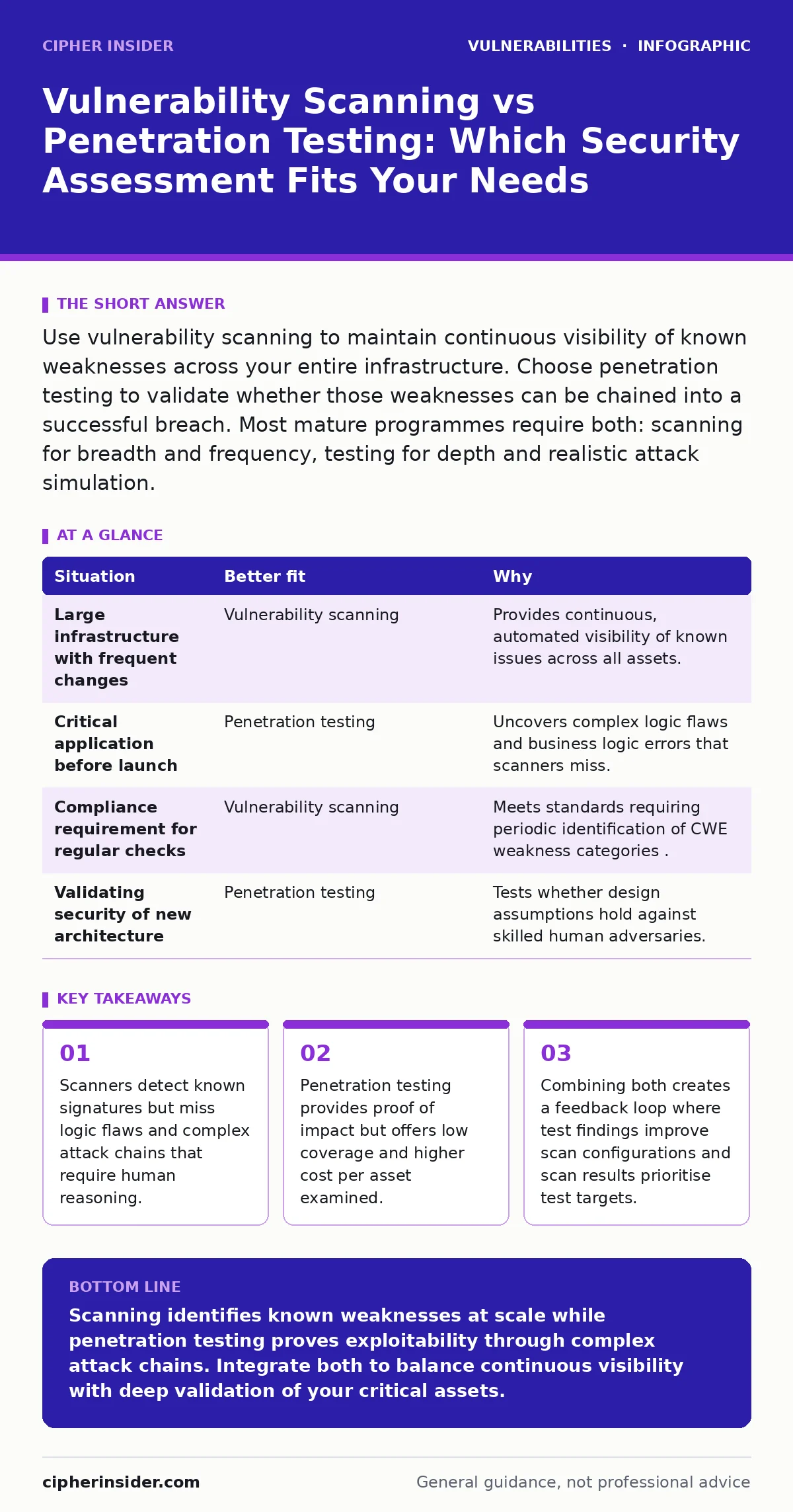
Use vulnerability scanning to maintain continuous visibility of known weaknesses across your entire infrastructure. Choose penetration testing to validate whether those weaknesses can be chained into a successful breach. Most mature programmes require both: scanning for breadth and frequency, testing for depth and realistic attack simulation.
What is the primary goal of your security assessment?
Vulnerability scanning answers the question of what is present, while penetration testing answers the question of what is possible. Scanners operate by comparing system configurations and software versions against databases of known weaknesses. They excel at identifying unpatched software and security misconfigurations across thousands of assets. The output is a list of potential issues ranked by severity. This approach provides breadth but lacks context. A scanner cannot determine if a high-severity finding is actually reachable from the internet or if internal controls mitigate the risk.
Penetration testing simulates an adversary’s actions to exploit those weaknesses. Testers look for ways to bypass controls, escalate privileges, and access sensitive data. This method reveals the actual impact of a vulnerability. It uncovers logic flaws that automated tools cannot see, such as flawed business processes or improper input validation leading to command injection. The goal is not to find every weakness but to demonstrate a successful attack path.
How much coverage and frequency do you require?
Scanning is designed for scale and repetition. You can configure scanners to run daily or weekly across your entire network. This frequency is necessary because new vulnerabilities are published constantly. Automated tools can quickly identify when a server is running an outdated version of a library or when a dynamic application security testing (DAST) tool finds a new entry point. The trade-off is accuracy. Scanners produce false positives, requiring manual verification. They also struggle with authenticated scans, often missing vulnerabilities that only appear to logged-in users.
Penetration testing is resource-intensive and time-consuming. A thorough test of a single application or network segment may take weeks. You cannot run this assessment daily. The coverage is narrow but deep. Testers focus on critical assets, high-value targets, or new features before release. This depth allows them to combine multiple low-severity findings into a single high-impact exploit. For example, a tester might chain a minor information disclosure with a weak authentication mechanism to gain full admin access.
| Situation | Better fit | Why |
|---|---|---|
| Large infrastructure with frequent changes | Vulnerability scanning | Provides continuous, automated visibility of known issues across all assets. |
| Critical application before launch | Penetration testing | Uncovers complex logic flaws and business logic errors that scanners miss. |
| Compliance requirement for regular checks | Vulnerability scanning | Meets standards requiring periodic identification of CWE weakness categories. |
| Validating security of new architecture | Penetration testing | Tests whether design assumptions hold against skilled human adversaries. |
Do you need to validate complex attack chains?
Automated tools operate in isolation. They find a vulnerability and report it. They do not attempt to use that vulnerability to move laterally or access other systems. This limitation means scanners often miss side-channel attacks or race conditions that depend on specific timing or environmental states. They also fail to identify issues where the vulnerability exists but is protected by an unexpected control. For instance, a scanner might flag a database port as open, but a penetration tester would verify if the firewall rules actually block external access.
Penetration testers think like attackers. They look for ways to bypass security controls entirely. They might discover that while a specific patch is missing, the application’s input sanitisation prevents exploitation. Conversely, they might find that a seemingly minor misconfiguration allows them to read sensitive files. This human element is critical for identifying risks that automated tools cannot comprehend. It also helps prioritise remediation efforts by showing which vulnerabilities are actually exploitable in your specific environment.
How do you integrate both approaches for maximum security?
Using both methods creates a resilient security programme. Scanning provides the baseline data. It identifies the large volume of low-hanging fruit that needs patching. Penetration testing validates the effectiveness of your controls and identifies the gaps that scanning misses. The results from testing should inform your scanning configuration. If a tester finds a vulnerability that the scanner missed, you can add that signature or adjust the scan parameters to catch it in the future.
This integration also improves remediation prioritisation. Not all vulnerabilities are equal. A high-severity finding that is unreachable from the internet may be less urgent than a low-severity finding that allows remote code execution. Penetration testing provides the context needed to make these decisions. It helps you focus resources on the risks that matter most. Regular scanning ensures that new vulnerabilities are caught quickly, while periodic testing ensures that your overall security posture remains robust against sophisticated attacks.
See also: Host Header Injection: Risks and Protection for Small Businesses · Remediation Tracking Mistakes That Leave Systems Exposed
When should you choose one over the other?
Choose vulnerability scanning when you need to monitor a large number of assets continuously. It is the correct choice for maintaining compliance, tracking automatic software updates, and identifying widespread configuration errors. It is cost-effective and scalable. Choose penetration testing when you need to understand the real-world impact of vulnerabilities. It is the correct choice for validating new security controls, assessing critical applications, and preparing for incident response. It provides insights that automated tools cannot deliver.
In most cases, you need both. Scanning without testing leaves you blind to complex threats. Testing without scanning leaves you exposed to known, easily exploitable weaknesses. The combination ensures that you address both the volume of known issues and the depth of potential attacks. This balanced approach reduces risk more effectively than either method alone.
Key takeaways
- Scanners detect known signatures but miss logic flaws and complex attack chains that require human reasoning.
- Penetration testing provides proof of impact but offers low coverage and higher cost per asset examined.
- Combining both creates a feedback loop where test findings improve scan configurations and scan results prioritise test targets.
Scanning identifies known weaknesses at scale while penetration testing proves exploitability through complex attack chains. Integrate both to balance continuous visibility with deep validation of your critical assets.
Frequently asked questions
Can vulnerability scanning replace penetration testing?
No. Scanners miss logic flaws and complex attack chains that require human reasoning and context. Testing validates the actual impact of vulnerabilities.
How often should penetration testing be performed?
Perform testing after significant changes to your infrastructure or applications, and at least annually for critical assets to validate security controls.
Do scanners detect NoSQL injection vulnerabilities?
Some advanced scanners may detect basic NoSQL injection patterns, but penetration testing is more reliable for identifying complex injection flaws in modern databases.
Is penetration testing only for external networks?
No. Internal penetration testing is crucial for identifying lateral movement paths and privilege escalation opportunities within your trusted network segments.
How this guide was produced: written by the Cipher Insider editorial team with AI assistance, checked against the public references listed below, and reviewed when the facts change. See our editorial policy or report an error.