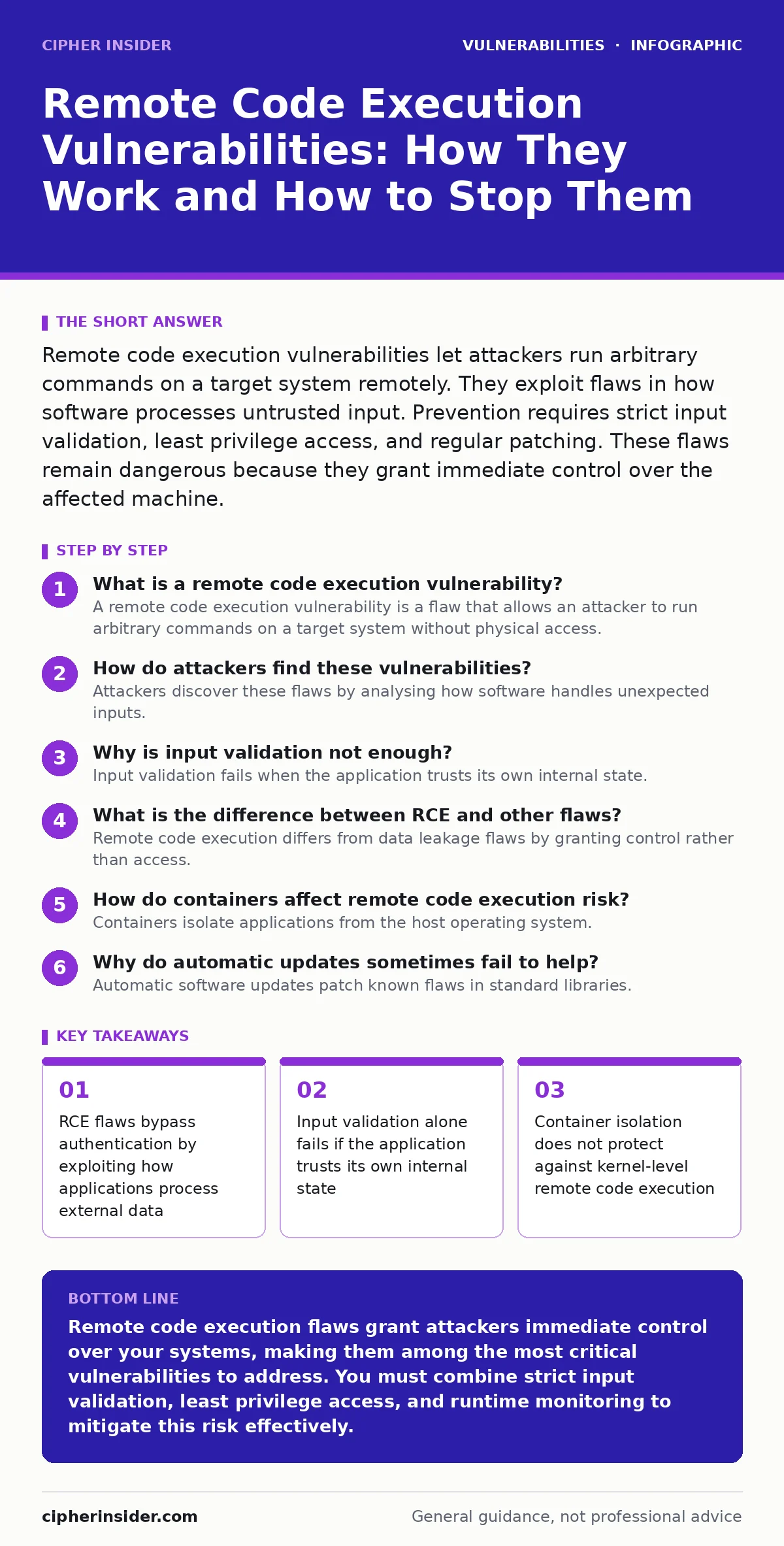
Remote code execution vulnerabilities let attackers run arbitrary commands on a target system remotely. They exploit flaws in how software processes untrusted input. Prevention requires strict input validation, least privilege access, and regular patching. These flaws remain dangerous because they grant immediate control over the affected machine.
What is a remote code execution vulnerability?
A remote code execution vulnerability is a flaw that allows an attacker to run arbitrary commands on a target system without physical access. This occurs when an application processes untrusted input without proper validation. The attacker sends malicious data through network protocols. The application executes this data as code. This grants the attacker control equivalent to the application’s own permissions. The impact depends entirely on those permissions. A service running as root gives full system control. A service with limited rights restricts the damage. Understanding this distinction helps you prioritise remediation efforts. High-privilege services require immediate attention.
How do attackers find these vulnerabilities?
Attackers discover these flaws by analysing how software handles unexpected inputs. They use fuzzing tools that send random data streams to application endpoints. They also review public source code for dangerous functions. Manual code review reveals logic errors that automated tools miss. Attackers look for deserialisation flaws or command injection points. They map the application’s attack surface to find entry points. This process is slow but effective against complex systems. Automated scanners often miss nuanced logic flaws. Human intuition remains necessary for finding sophisticated execution paths. You must assume attackers are actively probing your services.
Why is input validation not enough?
Input validation fails when the application trusts its own internal state. An attacker might bypass validation by manipulating session tokens. They can alter data after it has passed initial checks. This is known as a time-of-check to time-of-use flaw. The application validates data at one moment. It uses that data at a later moment. The data changes between those two moments. You must validate data at every point of use. You must also ensure data cannot be modified in transit. Relying solely on initial checks creates a false sense of security. The validation must be continuous and strict.
What is the difference between RCE and other flaws?
Remote code execution differs from data leakage flaws by granting control rather than access. A SQL injection flaw might reveal database contents. It does not necessarily allow command execution. An insecure direct object references (IDOR) flaw lets users access other users' files. It does not let them run system commands. RCE is distinct because it executes instructions on the host machine. This allows the attacker to install malware or create backdoors. The consequence is total system compromise rather than data theft. You must treat RCE flaws with higher urgency than data exposure flaws. The remediation strategies also differ significantly.
How do containers affect remote code execution risk?
Containers isolate applications from the host operating system. This isolation limits the damage from many software flaws. However, containers do not protect against kernel-level exploits. If the container runtime has an RCE flaw, the attacker escapes the container. They gain access to the host system. This bypasses all application-level controls. You must treat the container runtime as part of your attack surface. Regularly update the container engine and kernel. Assume that container isolation is not absolute. A flaw in the hypervisor or kernel negates container benefits. Security depth requires multiple layers of defence.
| Vulnerability Type | Primary Impact | Typical Attack Vector | Mitigation Strategy |
|---|---|---|---|
| Command Injection | System Control | User Input Fields | Input Sanitisation |
| Deserialisation | Code Execution | API Endpoints | Type Validation |
| Buffer Overflow | Memory Corruption | Network Protocols | Memory Safety |
| XXE Attacks | Data Theft | XML Parsers | Disable External Entities |
Why do automatic updates sometimes fail to help?
Automatic software updates patch known flaws in standard libraries. They do not fix flaws in your custom application code. Your application might use a patched library incorrectly. You might still pass untrusted data to safe functions. The update protects the library, not your usage of it. You must review your code after every major update. You must ensure your application logic remains secure. Relying on automatic updates for application security is insufficient. You need a dedicated review process for your own code. The library is only one part of the security chain.
What is the hidden cost of strict sandboxing?
Sandboxing restricts what an application can do on the system. This limits the impact of a successful remote code execution attack. However, strict sandboxing increases development complexity. Developers must request permissions for every action. This slows down feature development. It also creates configuration overhead. You must balance security with usability. Overly strict sandboxes may break legitimate functionality. You must test thoroughly to ensure the sandbox does not hinder operations. The cost is not just technical but also organisational. Teams must adapt their development workflows to accommodate these restrictions.
How do you detect active exploitation attempts?
You detect active exploitation by monitoring for anomalous system behaviour. Look for unexpected process creation or network connections. Monitor for changes in system files or permissions. Use runtime application self-protection tools to block execution attempts. These tools observe the application’s behaviour in real time. They can stop malicious code before it completes. Static analysis tools find potential flaws in the code. Dynamic application security testing (DAST) finds flaws in running applications. Combining these methods provides better coverage. You must correlate logs from multiple sources to identify true attacks. False positives are common in automated detection.
What is the role of memory safety in prevention?
Memory safety prevents buffer overflows and use-after-free errors. These errors often lead to remote code execution. Languages like Rust enforce memory safety at compile time. They prevent many common execution flaws. Legacy languages like C require careful manual management. You must audit code for memory safety issues. Use static analysis tools to find potential violations. Refactor unsafe code to use safer alternatives. This reduces the attack surface significantly. Memory safety is a foundational defence against execution flaws. It addresses the root cause rather than the symptom. Investing in safer languages pays long-term dividends.
Key takeaways
- RCE flaws bypass authentication by exploiting how applications process external data
- Input validation alone fails if the application trusts its own internal state
- Container isolation does not protect against kernel-level remote code execution
- Automated scanners miss logic-based execution flaws that require human review
Remote code execution flaws grant attackers immediate control over your systems, making them among the most critical vulnerabilities to address. You must combine strict input validation, least privilege access, and runtime monitoring to mitigate this risk effectively.
Frequently asked questions
Can a firewall prevent remote code execution attacks?
A firewall blocks network traffic but cannot inspect the content of allowed connections. It stops unauthorised access but does not prevent exploitation of allowed services. You need application-level security controls to stop execution flaws.
How do I know if my software has an RCE flaw?
You must conduct regular code reviews and penetration testing. Automated scanners can find known patterns but miss logic errors. Manual review by security experts is necessary for comprehensive coverage.
Is encrypting data enough to stop RCE?
Encryption protects data at rest and in transit but does not prevent code execution. An attacker can execute code and decrypt data if they gain access. You must secure the application logic itself.
What is the first step in responding to an RCE incident?
Isolate the affected system from the network immediately. This prevents the attacker from moving laterally or exfiltrating data. Preserve logs and memory dumps for forensic analysis before remediation.
How this guide was produced: written by the Cipher Insider editorial team with AI assistance, checked against the public references listed below, and reviewed when the facts change. See our editorial policy or report an error.