
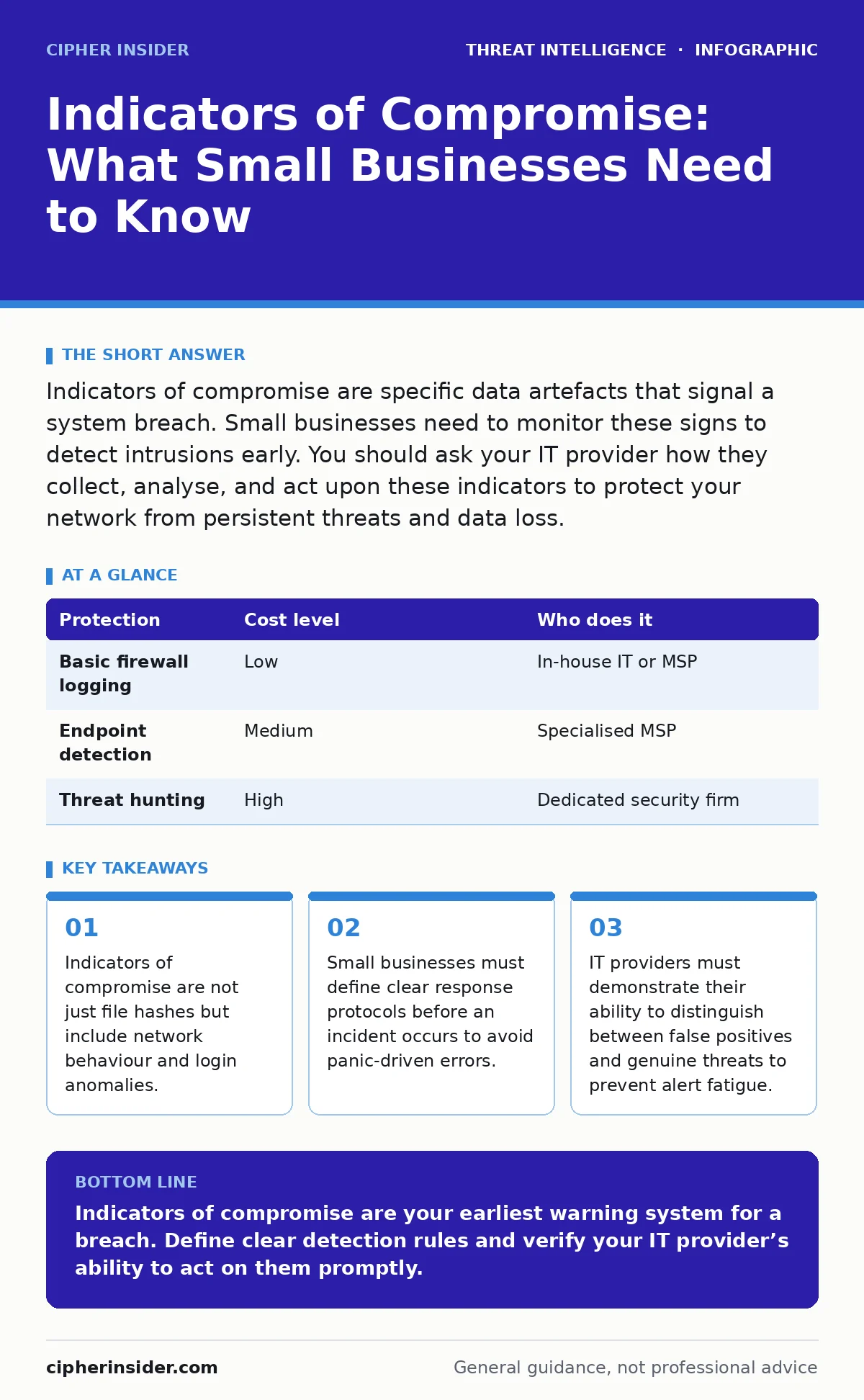
Indicators of compromise are specific data artefacts that signal a system breach. Small businesses need to monitor these signs to detect intrusions early. You should ask your IT provider how they collect, analyse, and act upon these indicators to protect your network from persistent threats and data loss.
Indicators of compromise are digital footprints left by an attacker. These artefacts signal that a breach has occurred or is in progress. They range from simple file changes to complex network patterns. Understanding these signs is critical for any organisation, regardless of size. Small businesses often believe they are too small to be targeted. This assumption is dangerous. Automated bots scan the entire internet for vulnerabilities. They do not discriminate based on company revenue or employee count.
The Nature of Indicators in Small Networks
Indicators fall into three main categories. Host-based indicators live on individual devices. These include unusual file creation times, modified registry keys, or new services running in the background. Network-based indicators appear in traffic logs. They involve connections to known malicious IP addresses or unusual data volumes. User-based indicators relate to behaviour. These include logins from unusual locations or accounts with elevated privileges created unexpectedly.
Small networks often lack the depth of logging required to spot host-based indicators. Without detailed audit logs, a changed file is just a changed file. You need context to know if that change is legitimate or malicious. Network monitoring is often easier to implement at this scale. It requires less storage and provides a broader view of activity. You can see where your data is going, even if you cannot see what is happening inside every device.
Why Scale Changes the Detection Strategy
Large enterprises have dedicated security operations centres. They use threat intelligence platforms to correlate millions of signals. Small businesses cannot match this resource level. You must rely on precision rather than volume. The goal is not to catch every minor anomaly. The goal is to catch the clear signs of intrusion. This requires focusing on high-fidelity indicators. These are signs that rarely occur in normal business operations.
Imagine a server that suddenly begins communicating with a foreign domain it has never contacted. This is a high-fidelity indicator. It is less ambiguous than a user downloading a large file. Large files can be legitimate work. Unusual external connections are rarely necessary. By prioritising high-fidelity signals, you reduce noise. This makes it easier for a small team or an external provider to act quickly. You avoid wasting time on false alarms that distract from real threats.
Practical Implementation Without Heavy Tools
You do not need expensive software to start monitoring. Basic log management can provide valuable insights. Ensure your servers and firewalls record connection attempts. Look for repeated failed login attempts. These often precede successful brute-force attacks. Check for unexpected port scanning activity. Attackers scan ports to find open services they can exploit. Blocking these scans at the firewall is a basic defence. However, the scan itself is an indicator of interest. It shows someone is looking for weaknesses in your defences.
Consider using canary tokens to detect reconnaissance. These are deceptive files or email addresses placed in your network. They look valuable but trigger an alert when accessed. If an attacker touches a canary token, you know they are inside. This is a passive detection method. It costs nothing to set up. It provides immediate confirmation of a breach attempt. This approach complements traditional monitoring by adding a layer of active deception.
Evaluating Your IT Provider’s Capabilities
Many small businesses outsource their IT security. You must ensure your provider understands indicators of compromise. Do not just ask if they monitor your systems. Ask how they distinguish between normal and abnormal behaviour. A provider who only alerts on known viruses is not enough. Modern attacks often use custom malware that signature-based tools miss. You need behavioural analysis.
| Protection | Cost level | Who does it |
|---|---|---|
| Basic firewall logging | Low | In-house IT or MSP |
| Endpoint detection | Medium | Specialised MSP |
| Threat hunting | High | Dedicated security firm |
Ask your provider to demonstrate their detection logic. Request a sample report of recent alerts. Look for details about the source and destination of connections. Check if they investigate lateral movement within your network. If they only look at the perimeter, you are blind to internal threats. An attacker who breaches one machine can move to others. Your provider must track this movement.
Questions to Ask Your IT Provider
Prepare these questions before signing a contract. They reveal the depth of your provider’s expertise.
- How do you detect lateral movement between machines on my network?
- What is your process for investigating a potential false positive?
- Do you monitor for attacker persistence techniques that survive reboots?
- How quickly do you update your detection rules based on new threat intelligence?
- Can you provide examples of indicators you have caught in the last month?
These questions force your provider to explain their methods. Vague answers indicate a lack of depth. Specific answers show they have a structured approach. You want a partner who can explain why an alert was raised. You need to understand the evidence they rely on. This transparency builds trust and ensures you are protected against evolving tactics.
See also: Port Scanning Myths: What Attackers Actually Reveal · Detect DNS Tunneling: Log Analysis and Network Signatures
The Hidden Cost of Alert Fatigue
Monitoring everything creates noise. If your tools generate too many alerts, staff will ignore them. This is alert fatigue. It is a serious risk for small teams. You must tune your detection rules to focus on high-value indicators. Suppress common, benign activities. Keep the alerts meaningful. This requires ongoing adjustment. It is not a set-and-forget process.
Suppose your provider alerts on every failed login. In a busy office, this happens dozens of times a day. You will stop checking the emails. Then, a real brute-force attack occurs. You miss it because the signal is lost in the noise. Tuning is essential. It balances sensitivity with usability. You want to catch the needle without drowning in the haystack. Regular reviews of alert history help identify unnecessary noise.
Integrating Broader Security Practices
Indicators of compromise are part of a larger defence strategy. They work best when combined with other practices. Threat hunting involves proactively searching for hidden threats. It uses indicators as a starting point but looks for subtle anomalies. Log management ensures you have the data needed to detect these indicators. Without good logs, you cannot hunt or detect effectively.
Be aware of specific attack methods that leave unique traces. LSASS credential theft targets the memory of the local security authority. It allows attackers to steal passwords without triggering standard login alerts. DNS tunneling hides malicious traffic inside normal DNS queries. It is difficult to detect without deep packet inspection. Understanding these techniques helps you choose the right indicators. You can tailor your monitoring to catch these specific behaviours.
Building a Resilient Detection Framework
Start with what you can measure. Implement basic logging on all critical systems. Define a shortlist of high-fidelity indicators relevant to your industry. Share this list with your IT provider. Ensure they are monitoring for these specific signs. Conduct regular tests to verify their response. Simulate a breach and see if they detect it. This validates your framework.
Do not rely on any single tool or person. Diversity in detection methods reduces blind spots. Combine network monitoring with host-based checks. Use deception techniques like canary tokens to catch early reconnaissance. Keep your software updated to prevent known exploits. A layered approach ensures that if one indicator is missed, another will catch the intrusion. Consistency and clarity are your best defences.
Key takeaways
- Indicators of compromise are not just file hashes but include network behaviour and login anomalies.
- Small businesses must define clear response protocols before an incident occurs to avoid panic-driven errors.
- IT providers must demonstrate their ability to distinguish between false positives and genuine threats to prevent alert fatigue.
Indicators of compromise are your earliest warning system for a breach. Define clear detection rules and verify your IT provider’s ability to act on them promptly.
Frequently asked questions
What are the most common indicators of compromise for small businesses?
Common indicators include unexpected outbound connections to unknown IPs, new administrator accounts created without authorisation, and unusual file modifications on critical servers.
How often should I review my indicators of compromise?
You should review your indicators quarterly. Attack tactics evolve rapidly, and your business environment changes. Regular reviews ensure your detection rules remain relevant and effective.
Can free tools detect indicators of compromise effectively?
Free tools can detect basic indicators like known malware hashes. They often lack the behavioural analysis needed to catch sophisticated attacks. You may need to combine them with manual log reviews.
What is the difference between an indicator of compromise and an indicator of attack?
Indicators of attack signal active malicious activity in real-time. Indicators of compromise confirm that a breach has already occurred. Both are vital, but they require different response speeds.
How this guide was produced: written by the Cipher Insider editorial team with AI assistance, checked against the public references listed below, and reviewed when the facts change. See our editorial policy or report an error.