
Common beliefs about port scanning are often incorrect. Scanners rarely aim for specific ports blindly, and slow scans are not necessarily stealthy. Detection relies on behavioural patterns rather than simple volume thresholds. Understanding these misconceptions improves your defensive posture significantly.
Myth: Slow scanning is invisible to detection systems
Reality: Reducing scan speed does not make the activity undetectable by modern security infrastructure. Many defenders assume that spacing out connection attempts avoids triggering alarms. This belief ignores how contemporary intrusion detection systems operate. These systems analyse behavioural patterns over time rather than counting packets per second. A slow, methodical scan still generates a distinctive signature. The pattern of sequential or random port probing remains visible to analysts.
Imagine an attacker probing a network at one port per minute. This pace avoids rate-limiting triggers. However, the cumulative data reveals a clear reconnaissance phase. Security tools correlate these low-frequency events across hours or days. The scan becomes obvious when viewed in aggregate. Speed is not the primary factor in detection. Consistency and pattern recognition matter more. Defenders should focus on long-term behavioural analysis.
Myth: Only external attackers perform port scans
Reality: Internal network reconnaissance is a frequent and dangerous activity during breach scenarios. Many organisations focus their monitoring exclusively on perimeter traffic. This creates a blind spot for lateral movement. Once an attacker gains initial access, they map the internal network. They scan for other hosts, services, and administrative interfaces. Internal scans often bypass perimeter firewalls entirely. These activities look like normal network traffic to external monitors.
Internal scanning is harder to detect because baseline noise is higher. Legitimate services communicate frequently across the network. Attackers blend their probes with this legitimate chatter. They may scan for specific database ports or management interfaces. This behaviour supports privilege escalation attacks. The goal is to find high-value targets within the trusted zone. Defenders must monitor internal traffic segments for unusual connection patterns.
Myth: Closed ports provide complete security
Reality: The state of a port does not determine the security of the underlying service. A closed port simply means no application is listening. It does not protect against other attack vectors. Attackers often scan for open ports to identify running services. However, they also scan for filtered ports. Filtered ports indicate the presence of a firewall or security appliance. This information is valuable for mapping the network architecture.
Knowing which ports are filtered helps attackers understand defensive measures. They can adjust their tactics accordingly. They might focus on services that are open but misconfigured. They might also attempt to bypass the firewall entirely. Closed ports offer no protection against social engineering or phishing. They do not stop malware from communicating outbound. Security requires a holistic approach beyond port state management.
Myth: Port scanning always precedes an attack
Reality: Reconnaissance activities do not always lead to immediate exploitation. Many scans are performed by automated bots or curiosity-driven individuals. These actors may not intend to cause harm. They might be mapping the internet for research purposes. Others may be testing their own tools. Assuming every scan is a prelude to an attack leads to alert fatigue. Security teams waste resources investigating benign activities.
This assumption creates noise in security operations. Analysts struggle to distinguish between genuine threats and background noise. Effective alert triage requires context. Not every scan indicates an imminent breach. Some scans are part of legitimate network management. Others are accidental. Understanding the intent behind the scan helps prioritise responses. Focus on scans that target specific, high-value services.
Myth: All port scans look the same
Reality: Different scanning techniques produce distinct network signatures. Attackers use various methods to gather information. Some techniques rely on TCP handshakes. Others use UDP packets or fragment-based approaches. Each method interacts with the target differently. The responses vary based on the operating system and firewall rules. These differences provide clues about the attacker’s tooling.
For example, SYN scanning differs significantly from FIN scanning. The network behaviour is unique to each technique. Analysing these patterns helps identify the specific tools used. This information can be linked to indicators of compromise. It helps build a profile of the threat actor. Understanding these variations improves detection accuracy. Defenders should tune their rules to recognise multiple scan types.
See also: Deploy Honeypots: A Step-by-Step Implementation Plan · Canary Token Mistakes: Why Your Traps Fail and How to Fix Them
Myth: Port scanning reveals only open ports
Reality: Port scanning provides extensive information beyond service availability. The response to a scan probe reveals operating system details. It indicates firewall rules and network topology. The timing of responses can expose network latency. The sequence number behaviour reveals kernel characteristics. Attackers use this data to fingerprint the target. This information helps them select appropriate exploits.
This intelligence gathering is critical for successful attacks. Knowing the operating system allows attackers to choose specific payloads. Understanding firewall rules helps them bypass security controls. Port scanning is not just about finding open doors. It is about understanding the entire building structure. Defenders should monitor for fingerprinting attempts. These activities are often more telling than the scan itself.
Myth: Blocking all port scans is feasible
Reality: Completely preventing port scanning is impractical and often counterproductive. Internet-wide scanning is constant and voluminous. Blocking every probe would require significant resources. It might also block legitimate traffic. Many services rely on connection attempts to function. Overly aggressive blocking can disrupt business operations. The goal should be detection and response, not prevention.
Defenders should focus on identifying malicious intent. Not all scans are harmful. Some are part of normal internet background noise. Blocking all scans creates a false sense of security. It does not stop determined attackers. They will adapt their techniques. They may use slower rates or different protocols. A better approach is to monitor for suspicious patterns. Respond to scans that target critical infrastructure.
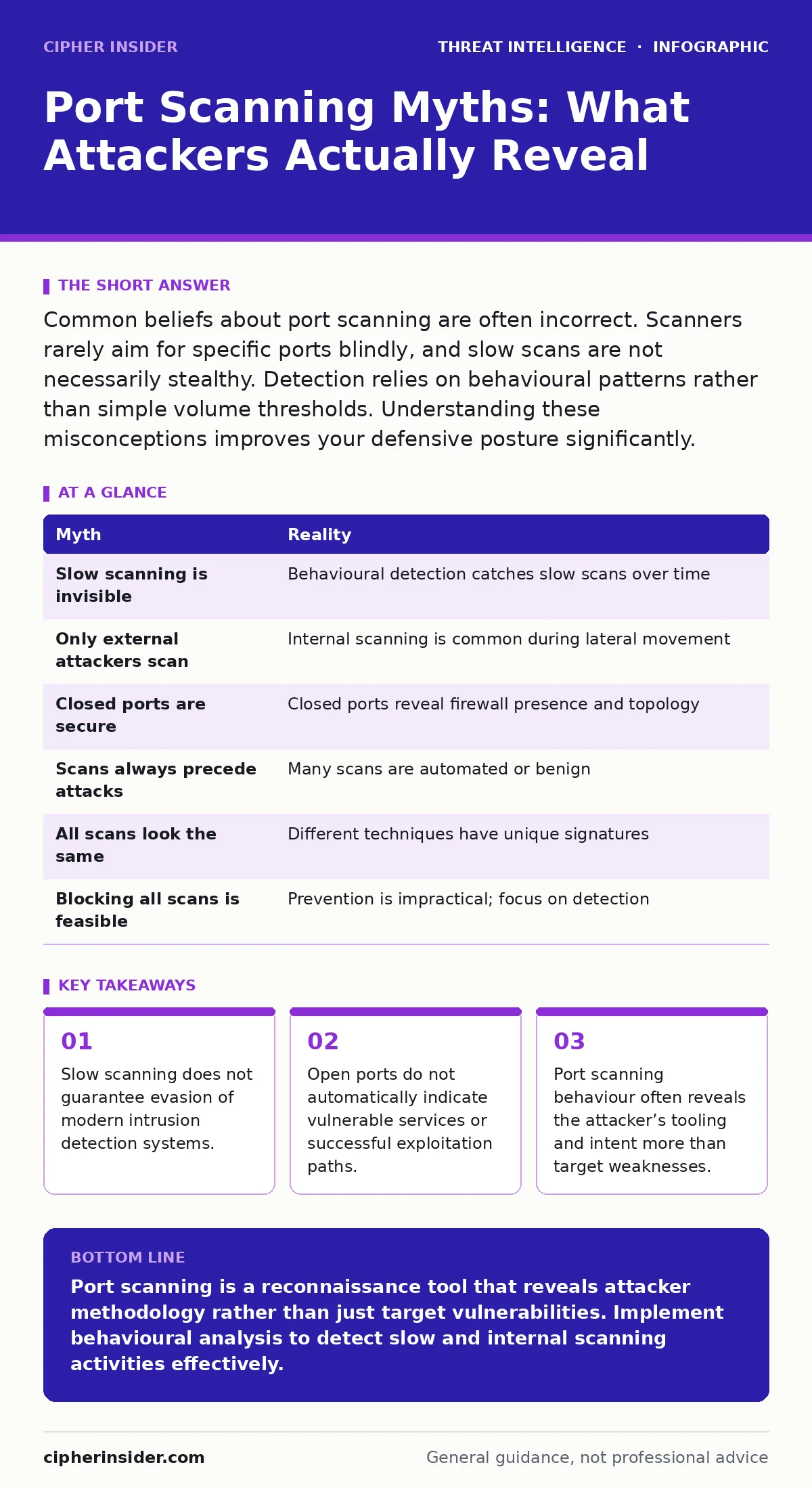
| Myth | Reality |
|---|---|
| Slow scanning is invisible | Behavioural detection catches slow scans over time |
| Only external attackers scan | Internal scanning is common during lateral movement |
| Closed ports are secure | Closed ports reveal firewall presence and topology |
| Scans always precede attacks | Many scans are automated or benign |
| All scans look the same | Different techniques have unique signatures |
| Blocking all scans is feasible | Prevention is impractical; focus on detection |
Key takeaways
- Slow scanning does not guarantee evasion of modern intrusion detection systems.
- Open ports do not automatically indicate vulnerable services or successful exploitation paths.
- Port scanning behaviour often reveals the attacker’s tooling and intent more than target weaknesses.
Port scanning is a reconnaissance tool that reveals attacker methodology rather than just target vulnerabilities. Implement behavioural analysis to detect slow and internal scanning activities effectively.
Frequently asked questions
How can I detect slow port scans?
Use intrusion detection systems that analyse connection patterns over extended periods. Look for sequential or random probing behaviour that deviates from normal baseline traffic.
Is internal port scanning always malicious?
Not always, but it is suspicious. Legitimate network management tools also perform scans. Correlate internal scanning with other indicators of compromise to determine intent.
What is the difference between SYN and FIN scanning?
SYN scanning completes a partial handshake, while FIN scanning sends a FIN packet to probe ports. Each method interacts differently with firewalls and operating systems.
Should I block all port scans?
No, blocking all scans is impractical. Focus on detecting and responding to scans that target critical services or exhibit malicious behaviour patterns.
How this guide was produced: written by the Cipher Insider editorial team with AI assistance, checked against the public references listed below, and reviewed when the facts change. See our editorial policy or report an error.