
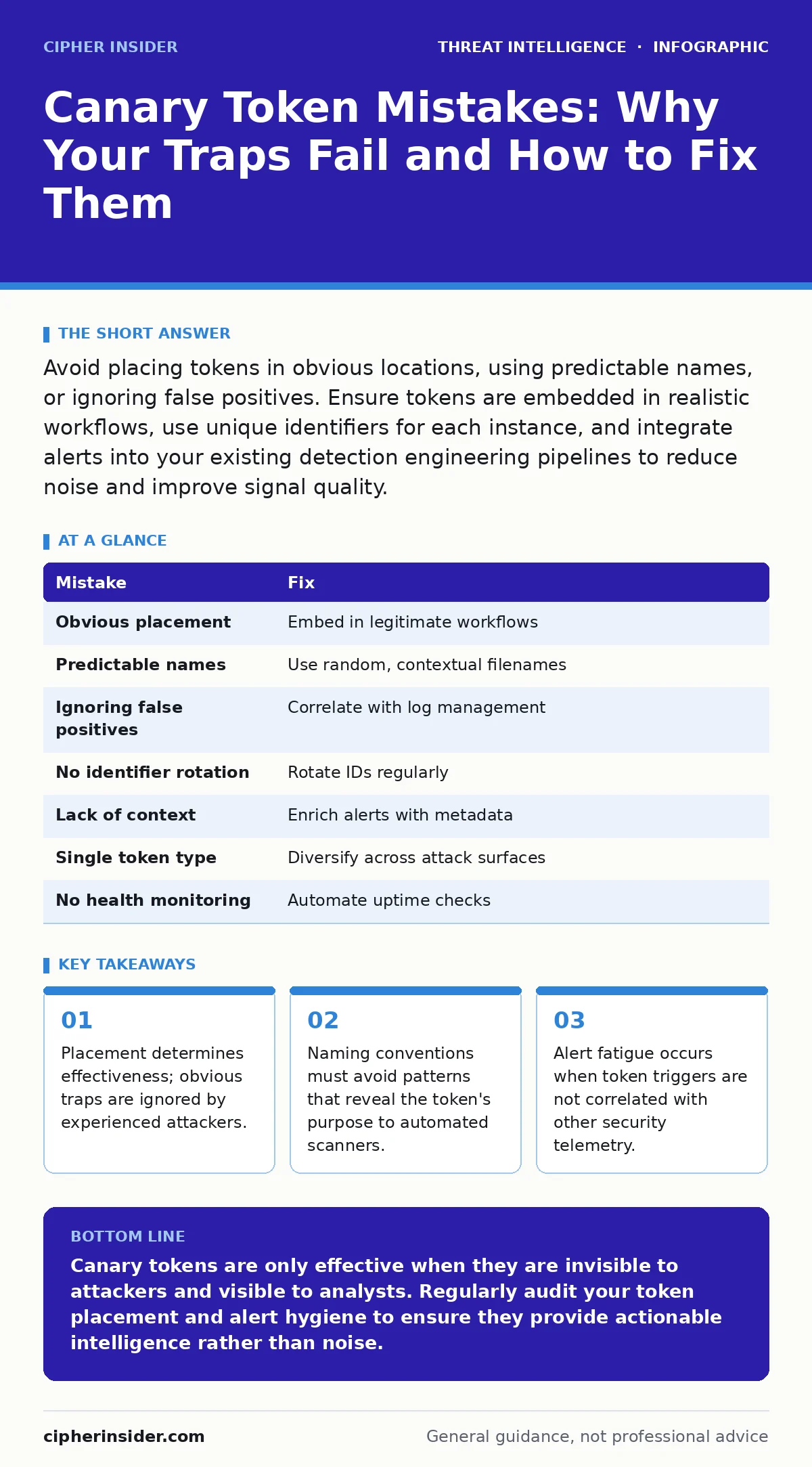
Avoid placing tokens in obvious locations, using predictable names, or ignoring false positives. Ensure tokens are embedded in realistic workflows, use unique identifiers for each instance, and integrate alerts into your existing detection engineering pipelines to reduce noise and improve signal quality.
Mistake 1: Placing Tokens in Obvious Locations
Why it hurts: Attackers perform initial reconnaissance to identify low-hanging fruit. If a canary token sits in a directory named "test" or a file titled "readme.txt" with no legitimate history, an attacker will recognise it as a trap. They will either ignore it or trigger it immediately to map your detection capabilities, giving you no useful intelligence on their actual intent. This renders the token useless for monitoring real-world activity.
The fix: Embed tokens within active, legitimate workflows. Place them in databases that are queried by applications, in email signatures of active staff, or in configuration files that are rarely touched but critical for operations. The token must look like a natural part of the environment. This requires understanding the normal flow of data and access patterns within your organisation.
Mistake 2: Using Predictable Naming Conventions
Why it hurts: Automated tools and script kiddies often scan for common filenames associated with security testing, such as "canary.txt" or "trap.docx". If your tokens follow a predictable pattern, attackers will identify and discard them before they can report any interaction. This reduces the surface area for detection and allows attackers to operate freely in the remaining, unmonitored parts of the system.
The fix: Use random, non-descriptive names that blend in with existing files. If you are placing a token in a financial directory, name it something that resembles a legitimate invoice or report, using the same naming convention as surrounding files. The filename should provide no clue about its function. This forces the attacker to treat the file as a potential target rather than a known security control.
Mistake 3: Ignoring the Source of False Positives
Why it hurts: Canary tokens trigger alerts when accessed. If you do not account for legitimate automated processes, such as backup jobs, antivirus scans, or compliance auditors, you will generate a high volume of false positives. Over time, analysts will stop investigating these alerts, assuming they are noise. This alert fatigue means that when a real attacker triggers a token, the alert may be ignored or deprioritised.
The fix: Integrate token alerts with your log management systems. Correlate token triggers with other security events to determine if the access was part of a legitimate batch job or an anomalous user action. Establish a baseline of expected interactions for each token. If a backup service accesses a token, suppress that specific alert while keeping others active. This refines the signal-to-noise ratio.
Mistake 4: Failing to Rotate Token Identifiers
Why it hurts: A canary token’s security relies on the secrecy of its identifier. If an attacker discovers a token but does not trigger it, they may note its identifier and ignore it in the future. If you do not rotate these identifiers, the same token remains compromised indefinitely. The attacker has learned the shape of your detection and can avoid it, rendering the token a dead end for intelligence gathering.
The fix: Treat token identifiers like credentials. Rotate them regularly, especially after a trigger event or if you suspect reconnaissance. Replace the old token with a new one in the same location. This ensures that any future interaction generates a fresh alert and prevents attackers from mapping your detection footprint. This is particularly important for long-lived tokens in persistent environments.
Mistake 5: Using Tokens Without Contextual Enrichment
Why it hurts: A token trigger tells you that something was accessed, but not why or by whom. Without context, the alert is merely a data point. You cannot distinguish between a curious intern and a sophisticated threat actor. This lack of context delays response and makes it difficult to prioritise incidents. It also hinders your ability to perform effective IOC enrichment, as you lack the surrounding metadata needed to build a complete picture.
The fix: Ensure your token reporting mechanism includes rich metadata. Capture the IP address, user agent, timestamp, and any associated session tokens. Integrate this data into your detection engineering workflows. This allows you to correlate the token trigger with other suspicious activities, such as unusual login times or privilege escalation attacks. The goal is to move from "something was touched" to "who touched it and what else did they do".
See also: Alert Triage and Reporting is the Responsibility of: Who Owns the Noise? · Detection Engineering: How to Build Signals That Catch Threats
Mistake 6: Over-Reliance on Single Token Types
Why it hurts: Different attackers use different tactics. Some focus on email phishing, others on database exfiltration or credential theft. If you only deploy email canaries, you will miss attackers who bypass email entirely. This creates blind spots in your security posture. Attackers will adapt to your visible controls, focusing their efforts on areas where you have no canary presence. This is akin to leaving some doors unlocked because you only secured the front entrance.
The fix: Deploy a diverse set of canary tokens across different attack surfaces. Include email, database, cloud storage, and code repository tokens. Each type serves a different detection purpose. For example, a database canary can detect SQL injection attempts, while a code repository canary can detect unauthorised code commits. This multi-layered approach ensures that regardless of the attacker’s entry point, there is a high probability of detection.
Mistake 7: Neglecting to Monitor Token Health
Why it hurts: Canary tokens rely on external services or internal listeners to report triggers. If the reporting mechanism fails, the token is silent. You may believe you are protected when you are actually blind. This false sense of security is dangerous because it prevents you from detecting active intrusions. Regular health checks are necessary to ensure the entire detection chain is functional.
The fix: Implement automated health checks for your canary infrastructure. Verify that tokens are accessible and that alerts are being received and processed. Monitor the uptime of the reporting service. If a token fails to trigger during a scheduled test, investigate immediately. This ensures that your detection capabilities remain reliable and that you can trust the alerts when they arrive.
| Mistake | Fix |
|---|---|
| Obvious placement | Embed in legitimate workflows |
| Predictable names | Use random, contextual filenames |
| Ignoring false positives | Correlate with log management |
| No identifier rotation | Rotate IDs regularly |
| Lack of context | Enrich alerts with metadata |
| Single token type | Diversify across attack surfaces |
| No health monitoring | Automate uptime checks |
Key takeaways
- Placement determines effectiveness; obvious traps are ignored by experienced attackers.
- Naming conventions must avoid patterns that reveal the token's purpose to automated scanners.
- Alert fatigue occurs when token triggers are not correlated with other security telemetry.
Canary tokens are only effective when they are invisible to attackers and visible to analysts. Regularly audit your token placement and alert hygiene to ensure they provide actionable intelligence rather than noise.
Frequently asked questions
How do canary tokens differ from honeypots?
Honeypots are entire systems or services designed to attract attackers, while canary tokens are small, lightweight artifacts placed within legitimate systems. Tokens are easier to deploy at scale and carry less risk of compromise, whereas honeypots provide deeper insight into attacker behaviour but require more maintenance.
Can attackers detect canary tokens easily?
Experienced attackers can detect poorly implemented tokens through analysis of file properties, metadata, or network behaviour. However, well-crafted tokens that mimic legitimate data and use standard protocols are difficult to distinguish from real assets without direct interaction.
What is the best way to respond to a canary token trigger?
Treat every trigger as a potential incident. Verify the source, correlate with other security events, and isolate affected systems if necessary. Investigate whether the trigger was a false positive or part of a larger attack chain, such as attacker persistence techniques.
Do canary tokens work in cloud environments?
Yes, canary tokens are highly effective in cloud environments. They can be placed in cloud storage buckets, database entries, or configuration files. Cloud-native tokens can leverage cloud logging services for immediate alerting and correlation, enhancing detection speed.
How this guide was produced: written by the Cipher Insider editorial team with AI assistance, checked against the public references listed below, and reviewed when the facts change. See our editorial policy or report an error.