
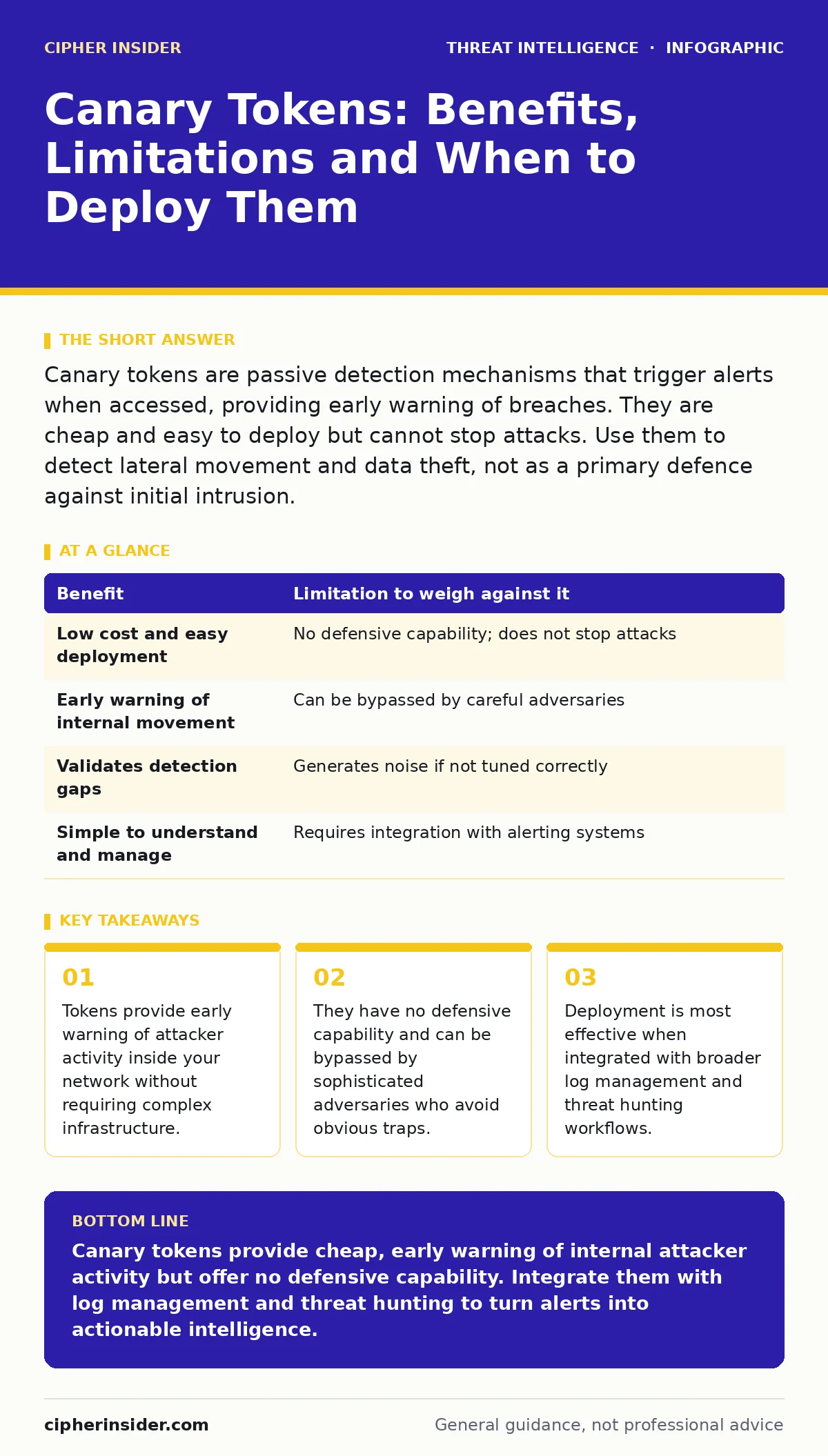
Canary tokens are passive detection mechanisms that trigger alerts when accessed, providing early warning of breaches. They are cheap and easy to deploy but cannot stop attacks. Use them to detect lateral movement and data theft, not as a primary defence against initial intrusion.
The Mechanics of Digital Bait
Canary tokens are digital objects placed in environments where they should not normally be accessed. They contain no sensitive data. Their sole purpose is to trigger an alert when an adversary interacts with them. This interaction usually involves opening a file, clicking a link, or querying a DNS record.
The token itself is harmless. It might appear as a spreadsheet in a shared drive or a contact in an email inbox. When an attacker accesses it, the token communicates with a monitoring server. This communication generates an immediate notification for your security team.
This mechanism relies on the assumption that attackers will search for valuable data. By placing decoys in likely search paths, you increase the chance of detection. The token does not block the attacker. It only informs you that something suspicious has occurred.
Concrete Benefits of Deployment
The primary advantage of canary tokens is their low barrier to entry. You do not need expensive hardware or complex software configurations. Many implementations are free and open source. This allows organisations with limited budgets to gain visibility into attacker behaviour.
Tokens provide early warning. Traditional antivirus solutions often fail to detect fileless attacks or legitimate tools used maliciously. A canary token triggers when an unusual action occurs, such as accessing a dormant account. This can signal the start of lateral movement before significant damage is done.
They also help validate security controls. If a token is triggered, it confirms that an attacker bypassed perimeter defences. This insight is valuable for refining your detection strategy. It shifts the focus from prevention alone to detection and response.
| Benefit | Limitation to weigh against it |
|---|---|
| Low cost and easy deployment | No defensive capability; does not stop attacks |
| Early warning of internal movement | Can be bypassed by careful adversaries |
| Validates detection gaps | Generates noise if not tuned correctly |
| Simple to understand and manage | Requires integration with alerting systems |
Honest Limitations and Risks
Canary tokens are not a silver bullet. They cannot prevent an attack. If an attacker finds a token, they have already breached your perimeter. The token only tells you that they are present. It does not eject them or block their access.
Sophisticated adversaries may recognise and avoid tokens. They often look for anomalies in file metadata or network traffic. If a token behaves differently from real data, an experienced attacker might ignore it. This reduces the effectiveness of the trap against advanced persistent threats.
False positives can also occur. Legitimate users might accidentally trigger a token if it is placed in a high-traffic area. This creates noise in your alerting system. Over time, this can lead to alert fatigue, where security teams ignore notifications.
Integration with Security Workflows
Tokens are most effective when they feed into a broader security strategy. They should not operate in isolation. The alerts they generate need to be correlated with other data sources. This context helps distinguish between accidental triggers and genuine attacks.
Integrating token alerts with your log management systems is critical. This allows you to trace the attacker’s path. You can see what other files were accessed or what commands were run. This supports threat hunting efforts by providing a starting point for investigation.
Consider how tokens relate to other detection methods. For example, if a token is triggered, check for signs of privilege escalation attacks. This might involve looking for new admin accounts or modified group policies. Combining token alerts with these indicators provides a clearer picture of the incident.
When It Is Worth It
Deploy canary tokens when you need low-cost visibility into internal networks. They are particularly useful for monitoring shared drives, email archives, and inactive accounts. These areas are often overlooked by traditional security tools but are attractive targets for attackers.
They are also valuable for testing your detection capabilities. By triggering tokens yourself, you can verify that your alerting systems work. This ensures that your team receives notifications in a timely manner. It is a simple way to validate your security posture without external audits.
Use tokens to protect sensitive data that is not actively used. For instance, old project files or archived emails might contain valuable information. Placing tokens near these assets helps detect attempts to exfiltrate historical data. This adds a layer of defence for dormant but valuable information.
See also: Alert Triage and Reporting is the Responsibility of: Who Owns the Noise? · Detection Engineering: How to Build Signals That Catch Threats
When It Is Not Worth It
Do not rely on canary tokens for perimeter defence. They are ineffective against initial access vectors like phishing or exploit kits. Attackers must already be inside your network for a token to trigger. Therefore, they do not replace firewalls or intrusion prevention systems.
Avoid using tokens as a substitute for proper access controls. If users have unnecessary access to sensitive data, tokens will not prevent leakage. You must still enforce least privilege principles. Tokens only detect the misuse of access, not the existence of excessive permissions.
They are also less useful in highly regulated environments with strict compliance requirements. These environments often require robust audit trails and proven security controls. Canary tokens may not meet these standards due to their passive nature. They are best used as a supplementary measure, not a primary control.
Strategic Placement and Maintenance
The location of your tokens determines their effectiveness. Place them where attackers are likely to look. This includes directories with names like "finance," "hr," or "confidential." However, avoid placing them in locations that legitimate users access frequently. This reduces the risk of false positives.
Regularly review and update your tokens. Attackers adapt to common patterns. If you use the same token types repeatedly, adversaries may learn to ignore them. Rotate your token formats and locations to maintain their effectiveness. This keeps the bait fresh and unpredictable.
Monitor the health of your token infrastructure. Ensure that the monitoring servers are online and responsive. If the alerting mechanism fails, the tokens are useless. Regular testing helps identify and fix these issues before they impact your detection capabilities.
Key takeaways
- Tokens provide early warning of attacker activity inside your network without requiring complex infrastructure.
- They have no defensive capability and can be bypassed by sophisticated adversaries who avoid obvious traps.
- Deployment is most effective when integrated with broader log management and threat hunting workflows.
Canary tokens provide cheap, early warning of internal attacker activity but offer no defensive capability. Integrate them with log management and threat hunting to turn alerts into actionable intelligence.
Frequently asked questions
Can canary tokens stop an attacker from stealing data?
No. Canary tokens are purely detection tools. They alert you to activity but do not block access or prevent data exfiltration.
How do I avoid false positives with canary tokens?
Place tokens in low-traffic areas and restrict access to sensitive directories. Monitor legitimate user behaviour to tune alert thresholds.
Are canary tokens effective against advanced persistent threats?
They can be, but APTs may recognise and avoid them. Tokens are most effective when combined with other detection methods like honeypots.
Do I need special software to use canary tokens?
No. Many open-source solutions exist. You only need a way to monitor the alerts generated when a token is accessed.
How this guide was produced: written by the Cipher Insider editorial team with AI assistance, checked against the public references listed below, and reviewed when the facts change. See our editorial policy or report an error.