
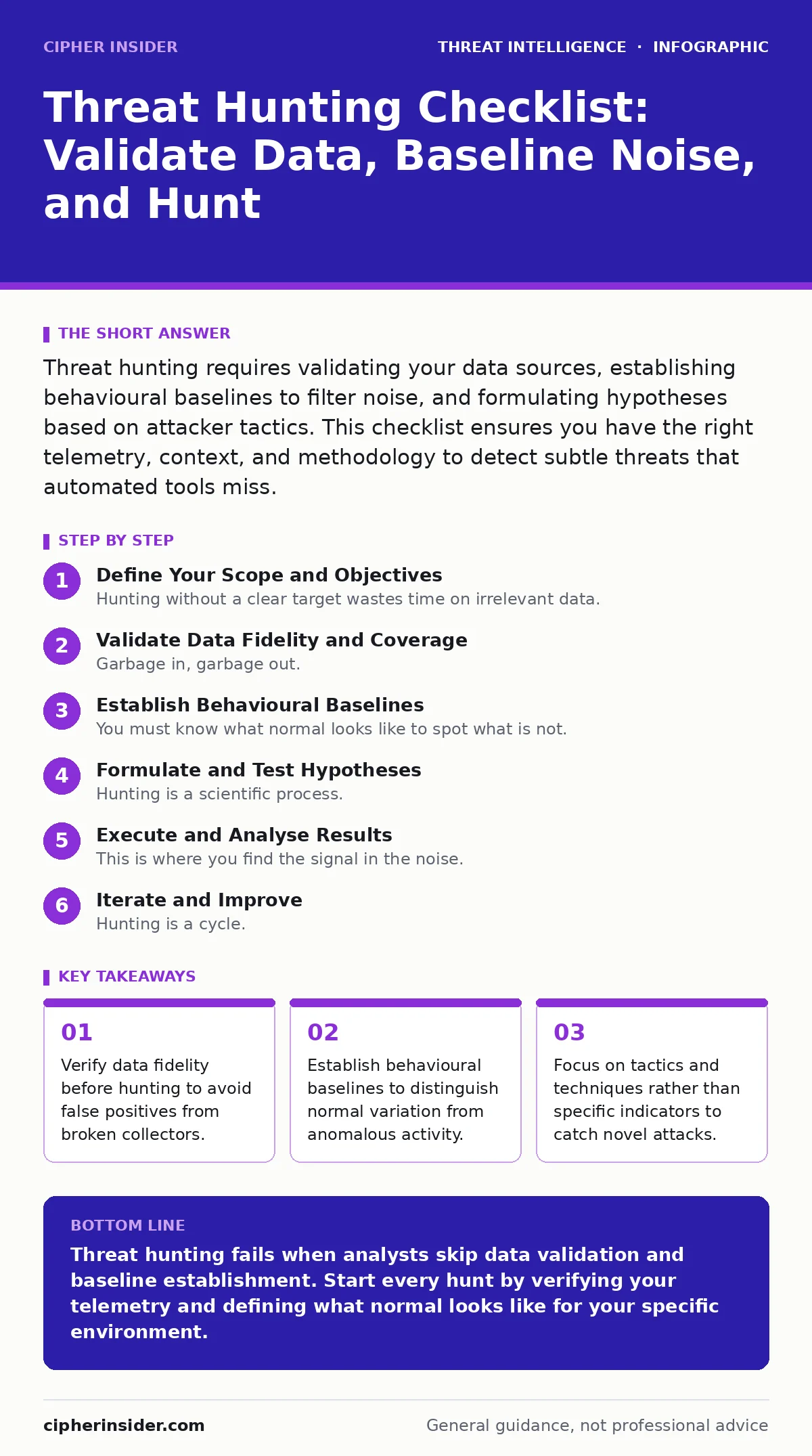
Threat hunting requires validating your data sources, establishing behavioural baselines to filter noise, and formulating hypotheses based on attacker tactics. This checklist ensures you have the right telemetry, context, and methodology to detect subtle threats that automated tools miss.
Define Your Scope and Objectives
Hunting without a clear target wastes time on irrelevant data. You must decide whether you are looking for a specific threat actor, a class of attack, or unusual activity within a particular system. The goal is to reduce the search space to something manageable.
- Define the hypothesis: State what you suspect is happening and why.
- Identify the data sources: List the logs and metrics available for the hypothesis.
- Set the time window: Determine how far back you can reliably search.
A vague hypothesis leads to noise. If you are investigating attacker persistence techniques, your scope differs from investigating initial access. Precision here saves hours of filtering later.
Validate Data Fidelity and Coverage
Garbage in, garbage out. If your logging agents are misconfigured or missing, your hunt will yield nothing but gaps. You cannot hunt what you do not see.
- Verify agent health: Ensure collectors are running and reporting status.
- Check timestamp synchronisation: Confirm all systems use the same time protocol.
- Assess log retention: Know how long data is stored and accessible.
- Confirm field parsing: Ensure logs are structured and searchable.
Bad timestamps make correlation impossible. If a server clock drifts by minutes, you cannot link an authentication event to a file creation. This is a common failure point in log management that undermines hunting efforts.
Establish Behavioural Baselines
You must know what normal looks like to spot what is not. Baselines provide the context for anomalies. Without them, every unusual event looks like an attack.
- Map normal user behaviour: Identify typical login times, locations, and volumes.
- Document system baselines: Record standard processes, services, and network connections.
- Identify seasonal variations: Note expected changes due to updates or business cycles.
- Flag known exceptions: List authorised activities that look like attacks.
Baselines are living documents. As your organisation changes, so does normal behaviour. A sudden spike in data transfer might be malicious or might be a new backup job. Context prevents panic and focuses effort on true deviations.
Formulate and Test Hypotheses
Hunting is a scientific process. You propose a theory and test it against the data. This methodical approach prevents bias and ensures thoroughness.
- List expected indicators: Define what the attack would look like in your logs.
- Create search queries: Write specific queries to find those indicators.
- Run initial searches: Execute queries against a small sample of data.
- Refine queries: Adjust for noise and false positives before full execution.
Hypotheses should be based on attacker reconnaissance patterns or known IOC enrichment data. If you are looking for a specific malware variant, start with its known signatures. If you are looking for stealthy activity, look for deviations from the baseline.
Execute and Analyse Results
This is where you find the signal in the noise. You review the results of your queries and assess their significance. Most results will be benign; your job is to find the needle.
- Review initial hits: Categorise results as true positive, false positive, or unknown.
- Investigate anomalies: Deep dive into events that do not fit the baseline.
- Correlate events: Link related activities across different data sources.
- Document findings: Record what you found, even if it is nothing.
Correlation is key. A single log entry is rarely conclusive. When you see a process start, check if it made a network connection or created a file. This multi-dimensional view reveals the full picture of an incident.
See also: Detect DNS Tunneling: Log Analysis and Network Signatures · Indicators of Compromise: What Small Businesses Need to Know
Iterate and Improve
Hunting is a cycle. Each hunt should improve your next one. You learn what worked, what failed, and what data is missing.
- Update baselines: Incorporate new normal patterns discovered during the hunt.
- Refine queries: Save and optimise queries for future use.
- Fill data gaps: Request logging for systems or events that were missing.
- Share insights: Communicate findings to improve defensive controls.
If you encounter token theft during a hunt, update your monitoring to detect credential misuse. If you see signs of hacktivism, adjust your web application firewalls. Every hunt makes your defences stronger.
Key takeaways
- Verify data fidelity before hunting to avoid false positives from broken collectors.
- Establish behavioural baselines to distinguish normal variation from anomalous activity.
- Focus on tactics and techniques rather than specific indicators to catch novel attacks.
Threat hunting fails when analysts skip data validation and baseline establishment. Start every hunt by verifying your telemetry and defining what normal looks like for your specific environment.
Frequently asked questions
How often should I perform threat hunting?
Hunt regularly, such as weekly or monthly, but also ad-hoc when new intelligence emerges. Consistency builds familiarity with your environment.
Do I need advanced tools for hunting?
You need good data, not necessarily expensive tools. Standard SIEM or log aggregation platforms are sufficient if the data is complete and well-structured.
How do I prioritise what to hunt for?
Focus on high-value assets and recent threat intelligence. Prioritise tactics that are relevant to your industry and technology stack.
What if I find a true positive?
Follow your incident response plan. Contain the threat, preserve evidence, and begin remediation. Document the findings for future hunting.
How this guide was produced: written by the Cipher Insider editorial team with AI assistance, checked against the public references listed below, and reviewed when the facts change. See our editorial policy or report an error.