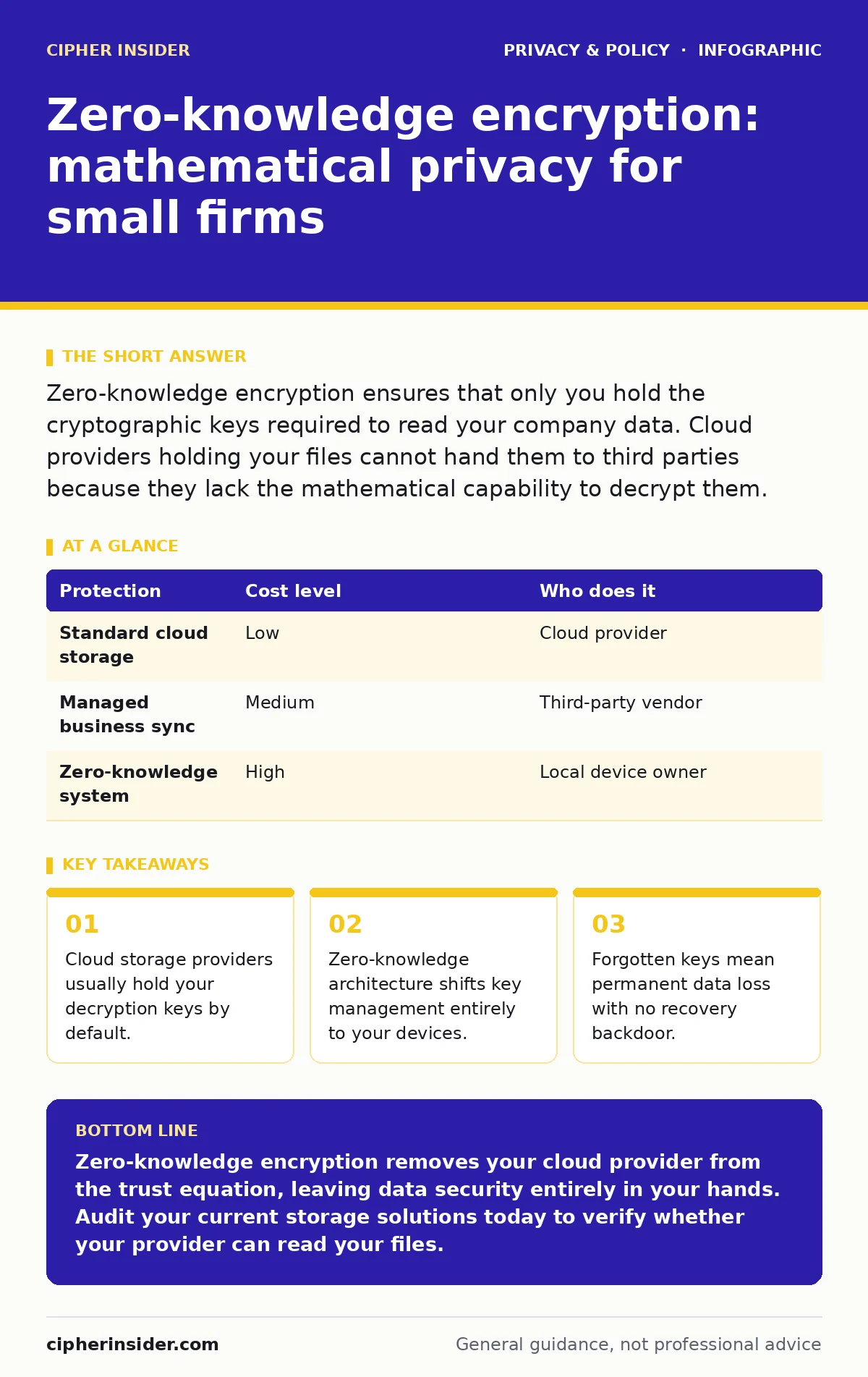
Zero-knowledge encryption ensures that only you hold the cryptographic keys required to read your company data. Cloud providers holding your files cannot hand them to third parties because they lack the mathematical capability to decrypt them.
Why small scale changes the math
Zero-knowledge encryption protects small businesses by ensuring that data remains unreadable to everyone except the key holder. Small teams often rely on consumer cloud services for convenience, assuming their information is secure. Standard cloud storage lets providers inspect your files, index your documents, and reset your passwords. Shifting to systems designed around online anonymity helps prevent casual data harvesting by platform operators.
How client-side encryption works
Client-side encryption means that data transformation happens entirely on your local hardware before transmission. Cryptographic keys are generated on your device using a master password that never travels across the network. The remote server receives only mathematical noise known as ciphertext. When you need to read a file, your local device reverses the algorithm using your private key, keeping the plaintext hidden from network observers and cloud administrators alike.
The hidden cost of absolute privacy
Absolute mathematical privacy introduces severe operational risks that catch many organisations unawares. If you misplace your master password, no customer support desk can reset it for you. The provider possesses no backdoor, no administrative override, and no alternate recovery mechanism. Losing your credentials means losing your entire business archive permanently, turning human forgetfulness into a catastrophic operational failure without appeal.
Implementing zero-knowledge tools in practice
Deploying these architectures requires careful management of hardware tokens and recovery phrases across your team. You must establish secure channels for sharing keys among trusted colleagues without writing them down on sticky notes. When collaborating with external partners, you might use private file sharing services to maintain end-to-end control over sensitive drafts. Training staff to handle passwords correctly matters more than purchasing expensive software licenses.
What should you ask an IT provider about encryption?
You should ask specific questions regarding key custody and server access when evaluating an IT provider for zero-knowledge capabilities. Service providers often market products as secure while retaining server-side access to your decryption keys. You must interrogate their technical architecture directly before signing any service contracts to ensure your data remains mathematically isolated from third-party interference.
- Do you hold copies of our decryption keys on your administrative servers?
- Can your engineering staff decrypt our stored files if compelled by legal authorities?
- Where does the key generation process execute, on our local hardware or in your cloud infrastructure?
- What happens to our data archive if we terminate our service agreement with you?
See also: Smart home privacy risks: recovery steps after a sensor leak · End-to-end encryption mechanics explained clearly
Comparing security models
Security architectures vary widely in how they handle data access and key storage across different cloud platforms. Understanding these structural differences helps you choose the right balance between operational convenience and mathematical protection for your enterprise assets.
| Protection | Cost level | Who does it |
|---|---|---|
| Standard cloud storage | Low | Cloud provider |
| Managed business sync | Medium | Third-party vendor |
| Zero-knowledge system | High | Local device owner |
Avoiding operational failure
Avoiding operational failure in zero-knowledge environments demands robust backup habits combined with cautious password stewardship. Relying solely on encrypted cloud vaults creates a false sense of security if local devices fail unexpectedly. You must also educate employees to recognize mobile app permission abuse that might leak master passwords from compromised smartphones. Balancing usability with cryptographic strength ensures your business survives both digital attacks and human error.
Key takeaways
- Cloud storage providers usually hold your decryption keys by default.
- Zero-knowledge architecture shifts key management entirely to your devices.
- Forgotten keys mean permanent data loss with no recovery backdoor.
Zero-knowledge encryption removes your cloud provider from the trust equation, leaving data security entirely in your hands. Audit your current storage solutions today to verify whether your provider can read your files.
Frequently asked questions
Can a zero-knowledge provider recover my account if I lose my password?
A true zero-knowledge provider cannot recover your account because they never store your password or decryption keys. Account recovery mechanisms rely on server-side key access, which defeats the zero-knowledge guarantee.
Does zero-knowledge encryption protect against malware running on my computer?
Zero-knowledge encryption does not protect against malware running locally on your device while you are actively editing files. Malicious software can capture your keystrokes or read plaintext documents directly from your screen before the encryption algorithm runs.
Is zero-knowledge encryption the same as end-to-end encryption?
End-to-end encryption specifically describes data protected during transit between two parties, whereas zero-knowledge generally applies to stored data where the storage provider cannot read the contents. Both models share the foundational principle that intermediaries cannot access the plaintext.
How do I share encrypted files with clients who lack technical skills?
Sharing encrypted files with non-technical clients typically requires generating temporary web links with built-in decryption parameters handled automatically in the browser. This approach balances user convenience with cryptographic isolation, though you must trust the delivery channel used to send the link.
How this guide was produced: written by the Cipher Insider editorial team with AI assistance, checked against the public references listed below, and reviewed when the facts change. See our editorial policy or report an error.