
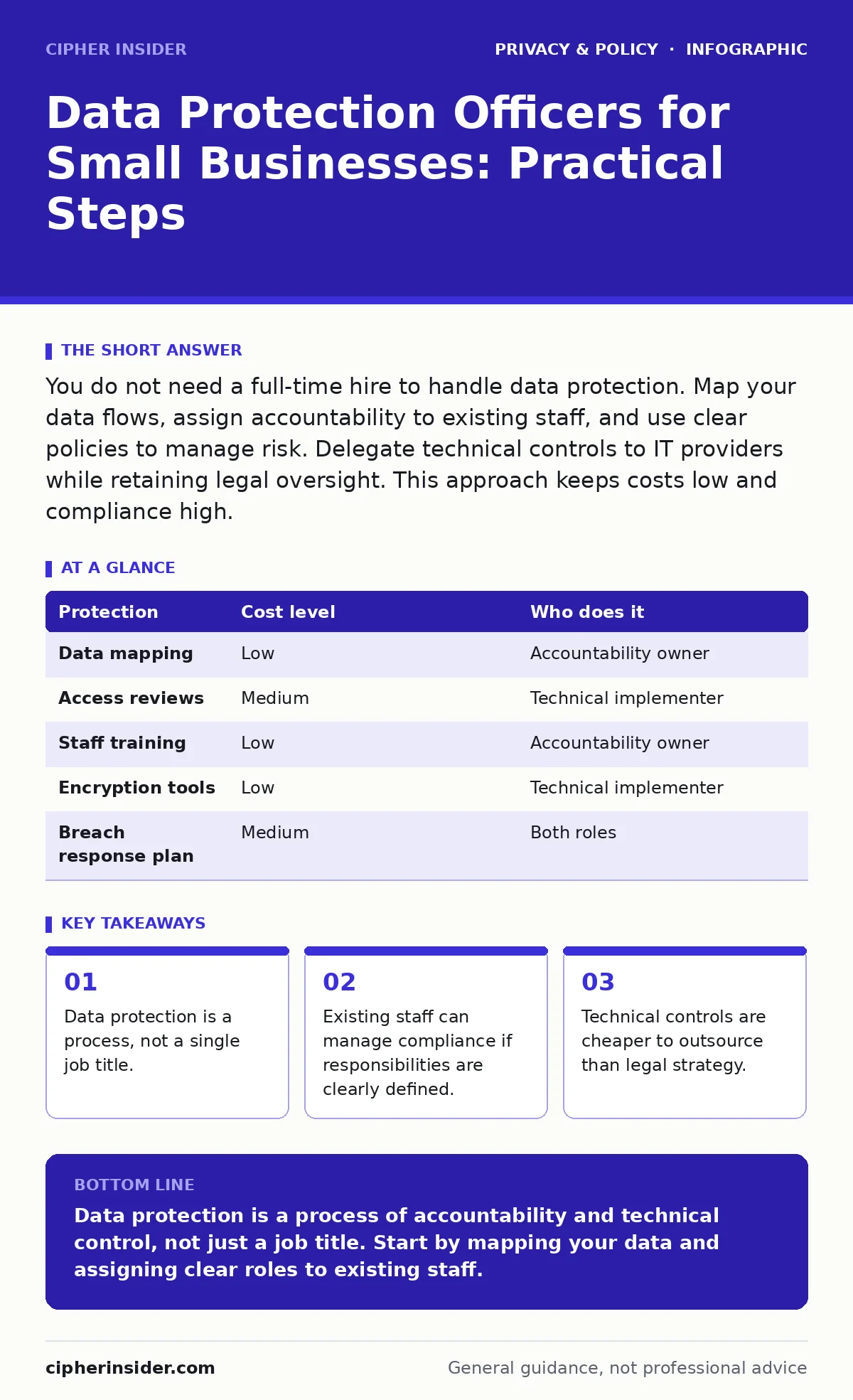
You do not need a full-time hire to handle data protection. Map your data flows, assign accountability to existing staff, and use clear policies to manage risk. Delegate technical controls to IT providers while retaining legal oversight. This approach keeps costs low and compliance high.
The Myth of the Dedicated Officer
Many small businesses believe they must hire a Data Protection Officer (DPO) to stay legal. This assumption drives unnecessary costs and creates confusion. The law often requires a DPO only for large-scale processing or sensitive data handling. For most small firms, accountability is the requirement, not a specific job title.
You need someone responsible for data governance, not necessarily a full-time employee. They act as the first point of contact for regulators and data subjects. This role can be internal or external, depending on your resources and risk profile.
The key is clarity. If everyone thinks someone else is handling privacy, nothing gets done. You must assign ownership. This ownership does not mean one person does all the work. It means one person coordinates the effort and holds others accountable.
Mapping Your Data Reality
Before you can protect data, you must know where it lives. A data map is a visual or written record of how information moves through your organisation. It shows collection points, storage locations, and sharing partners. Without this map, you are guessing at your risks.
Start by listing every system that holds personal data. This includes email servers, cloud storage, customer relationship management tools, and even shared drives. Note who has access to each system. Identify where the data goes when you delete it. Many firms forget about backups or third-party processors.
This exercise reveals hidden liabilities. You might find customer data stored on a laptop that is no longer in use. Or you may discover that a marketing tool shares data with partners you did not approve. Mapping forces you to confront these gaps. It turns abstract privacy concerns into concrete technical tasks.
Assigning Roles and Responsibilities
Once you have mapped your data, you must assign roles. The accountability owner oversees the strategy. They ensure policies are written and updated. They also handle complaints and regulatory inquiries. This person needs a legal or administrative background, not necessarily technical skills.
The technical implementer executes the controls. They configure firewalls, manage access rights, and ensure encryption is active. This role is often filled by your IT manager or a trusted provider. They need to understand the security implications of business decisions. They translate policy into configuration.
Separating these roles creates a healthy check and balance. The accountability owner asks "why" and "who". The technical implementer answers "how" and "what". If one person holds both roles, they may cut corners to save time. Clear separation ensures that security decisions are scrutinised.
Affordable Protection Strategies
You do not need expensive software to start protecting data. Basic hygiene measures yield the highest return on investment. Implement multi-factor authentication on all accounts that hold sensitive data. This simple step blocks most credential-based attacks. It adds a layer of verification that passwords alone cannot provide.
Use role-based access control. This principle ensures that staff only see the data they need to do their jobs. A receptionist does not need access to payroll files. Limiting access reduces the damage if an account is compromised. It also simplifies audits because you can prove who had access to what.
Regular backups are non-negotiable. Store copies of critical data off-site or in a separate cloud environment. Test these backups regularly to ensure they can be restored. This protects against ransomware and accidental deletion. It is a cheap insurance policy against data loss.
| Protection | Cost level | Who does it |
|---|---|---|
| Data mapping | Low | Accountability owner |
| Access reviews | Medium | Technical implementer |
| Staff training | Low | Accountability owner |
| Encryption tools | Low | Technical implementer |
| Breach response plan | Medium | Both roles |
What to Delegate to Providers
Small teams often lack the expertise to manage complex technical controls. This is where delegation becomes a strength, not a weakness. You can delegate the implementation of security tools to an IT provider. They have the skills to configure servers and networks correctly. They can also monitor for suspicious activity.
However, you cannot delegate accountability. You remain liable for how data is handled. Therefore, you must choose providers carefully. Ask them specific questions about their security practices. Do not accept vague promises. Look for evidence of regular testing and clear incident response procedures.
You should also delegate routine monitoring. Providers can watch for unusual login attempts or data transfers. They can alert you to potential issues before they become crises. This frees your internal team to focus on strategy and policy. It ensures that technical expertise is applied where it matters most.
See also: Packers and Crypters: How Malware Hides from Small Business Defences · Smartphone Privacy Settings for Small Business Operations
Training and Culture
Technology fails if people do not follow the rules. Training is not a one-time event. It is an ongoing process that reinforces good habits. Staff should know how to spot phishing emails. They should understand why they must lock their screens. They should know who to contact if they suspect a leak.
Training should be practical. Use real-world scenarios that your staff will encounter. Explain the consequences of poor data handling. Make it clear that privacy is a team effort. When staff understand the "why", they are more likely to follow the "how".
Culture matters more than policy. If leadership ignores privacy, staff will too. Model the behaviour you expect. Follow the same rules as everyone else. This sets a tone of seriousness and respect. It shows that data protection is a core value, not a checkbox.
Review and Adapt
Data protection is not static. New tools, new threats, and new laws emerge constantly. You must review your practices regularly. At least once a year, revisit your data map. Check if new systems have been added. Verify that access rights are still appropriate.
Update your policies to reflect changes. If you start using a new cloud service, update your data processing agreements. If a staff member leaves, revoke their access immediately. This continuous improvement prevents stagnation. It ensures that your protections remain relevant.
You should also monitor related topics. Understanding encrypted email helps you secure communications. Knowing about ad tracking informs your marketing data practices. Awareness of reducing your digital footprint can guide your public-facing data strategies. These areas intersect with your core data protection efforts.
The Path Forward
Start small. Map your data. Assign roles. Implement basic controls. Delegate technical tasks. Train your staff. Review regularly. This approach builds a solid foundation for data protection. It scales as your business grows. It keeps you compliant without breaking the bank.
Remember that data protection is a journey, not a destination. There is no final state of perfect security. There is only continuous improvement. By embedding these practices into your daily operations, you turn privacy into a competitive advantage. You show clients and partners that you value their trust.
Key takeaways
- Data protection is a process, not a single job title.
- Existing staff can manage compliance if responsibilities are clearly defined.
- Technical controls are cheaper to outsource than legal strategy.
Data protection is a process of accountability and technical control, not just a job title. Start by mapping your data and assigning clear roles to existing staff.
Frequently asked questions
Do I really need a Data Protection Officer?
Only if you process large amounts of sensitive data or monitor behaviour systematically. Most small businesses need an accountability owner, not a dedicated DPO.
Can I use an external consultant for this?
Yes. Many small firms hire external consultants to manage compliance. This provides expertise without the overhead of a full-time salary.
What is the first step I should take?
Create a data map. Identify where personal data is stored, who has access, and how it is shared. This reveals your immediate risks.
How often should I review my data protection measures?
At least annually, or whenever you introduce new systems or change business processes. Regular reviews prevent configuration drift and policy gaps.
How this guide was produced: written by the Cipher Insider editorial team with AI assistance, checked against the public references listed below, and reviewed when the facts change. See our editorial policy or report an error.