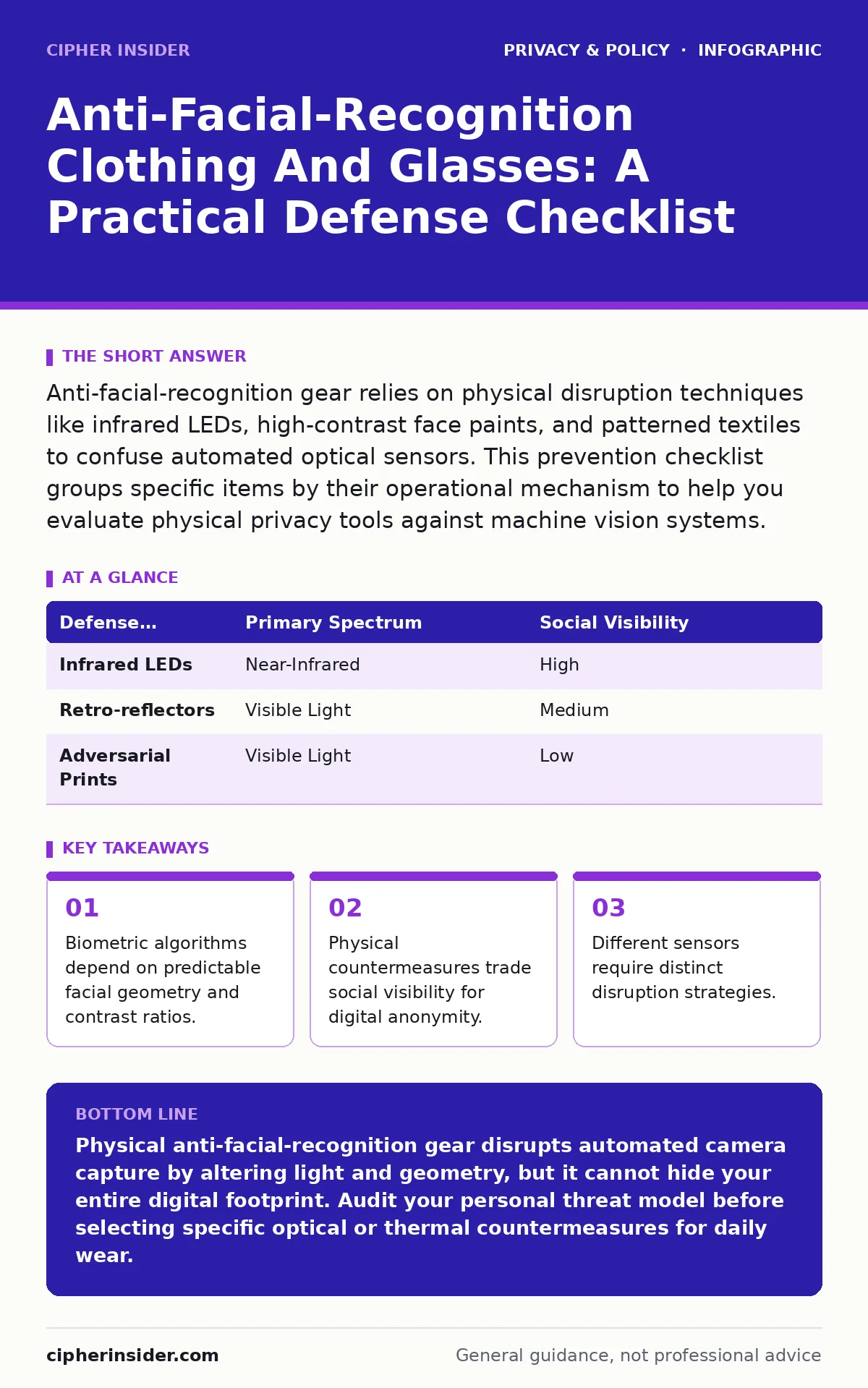
Anti-facial-recognition gear relies on physical disruption techniques like infrared LEDs, high-contrast face paints, and patterned textiles to confuse automated optical sensors. This prevention checklist groups specific items by their operational mechanism to help you evaluate physical privacy tools against machine vision systems.
Understanding Physical Privacy Tools
People seeking to protect their biometric identity from automated cameras often turn to specialized garments and accessories. Biometric facial recognition systems scan imagery for geometric landmarks and relative distances between facial features. Physical defense items interfere with this mapping process by introducing noise, glare, or false geometry into the optical feed.
Imagine walking past a smart public display that logs your demographic data for online tracking campaigns without your consent. Specialized accessories alter how digital sensors interpret your face, forcing classification algorithms to fail or produce garbage data. Understanding these tools requires looking past marketing claims to examine the underlying physics of optical capture.
Optical Disruption Accessories
Optical countermeasures manipulate light entering the camera lens to obscure facial features or create false highlights. These items target the visible light spectrum and rely on reflection or glare.
- infrared LED spectacles: active infrared emissions saturate camera sensors and create bright blinding artifacts over the eye region
- retro-reflective scarves: glass bead coatings bounce flash photography directly back at the source to wash out surrounding facial details
- prismatic visor frames: faceted surfaces fracture light rays to confuse edge-detection algorithms looking for jawline contours
- asymmetric face stickers: high-contrast geometric shapes placed on cheeks create false facial landmarks that trick neural networks
Thermal and Infrared Countermeasures
Thermal imaging and near-infrared sensors operate outside the visible spectrum, requiring materials that block or emit specific heat and light wavelengths. These tools address cameras equipped with night vision or heat-sensing capabilities.
- phase-change material liners: pocketed materials absorb facial heat temporarily to flatten thermal signatures captured by infrared lenses
- carbon-infused mesh balaclavas: embedded conductive threads diffuse radiant heat patterns across the head to prevent thermal facial profiling
- near-infrared absorbent makeup: carbon-based pigments absorb invisible light wavelengths to obscure skin texture maps used by advanced sensors
Textile and Pattern Camouflage
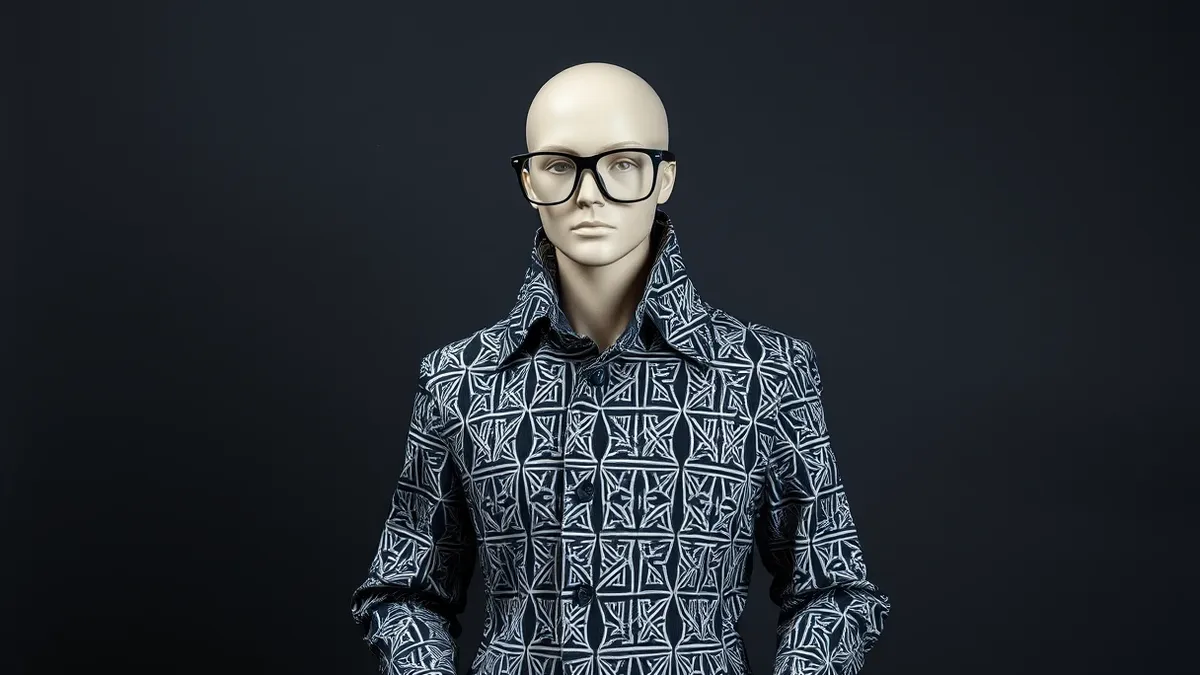
Pattern-based defenses exploit how convolutional neural networks classify textures and shapes in two-dimensional imagery. These garments print adversarial patterns designed to trigger false classifications in machine vision models.
- adversarial knit sweaters: distorted facial prints woven into fabric confuse object detection models into seeing multiple people at once
- asymmetrical cut caps: unusual brim angles cast deep shadows across the brow to disrupt automated landmark placement algorithms
- disruptive paint hoodies: chaotic brushstroke patterns break up the continuous silhouette of the head and shoulders
| Defense Mechanism | Primary Spectrum | Social Visibility |
|---|---|---|
| Infrared LEDs | Near-Infrared | High |
| Retro-reflectors | Visible Light | Medium |
| Adversarial Prints | Visible Light | Low |
Operational Limitations and Edge Cases
Physical defenses fail when environmental lighting changes or when cameras operate from unusual angles and distances. Security systems frequently combine multiple camera feeds and machine learning models, meaning a trick that fools one algorithm might fail against another.
Suppose a high-resolution telephoto lens captures your profile from a distance where small accessories lose their disruptive effect. Adversarial clothing offers zero defense against gait analysis, height estimation, or smartphone tracking beacons carried in your pocket.
See also: Zero-knowledge encryption: mathematical privacy for small firms
Combining Physical and Digital Defenses
Physical gear represents only one layer of a wider privacy strategy that must also address digital footprints. Publicly accessible databases often link your physical presence to your real-world identity through cross-referenced public records and social media profiles.
Comprehensive privacy maintenance requires pairing physical visibility controls with data minimization routines like removing your data from people-search sites. Leaving your real name and face connected to public databases undermines the anonymity gained by wearing specialized clothing on the street.
| Strategy Layer | Protection Target | Primary Limitation |
|---|---|---|
| Physical Gear | Live Camera Feeds | Contextual Social Friction |
| Data Removal | Public Databases | Continuous Re-listing |
| Traffic Routing | Network Metadata | Speed and Latency Costs |
Evaluating Your Threat Model
Choosing the right combination of protective gear depends entirely on the specific surveillance risks present in your local environment. Fixed closed-circuit television networks require different countermeasures than mobile police body-worn cameras or automated toll-road scanners.
Assess whether your primary concern is retail analytics, municipal monitoring, or targeted tracking before investing time in specialized garments. Purchasing commercial anti-surveillance items without defining your specific adversaries often leads to wasted effort and a false sense of security.
Key takeaways
- Biometric algorithms depend on predictable facial geometry and contrast ratios.
- Physical countermeasures trade social visibility for digital anonymity.
- Different sensors require distinct disruption strategies.
Physical anti-facial-recognition gear disrupts automated camera capture by altering light and geometry, but it cannot hide your entire digital footprint. Audit your personal threat model before selecting specific optical or thermal countermeasures for daily wear.
Frequently asked questions
Do anti-facial-recognition glasses block all security cameras?
No, most specialized glasses only disrupt specific camera types like those using near-infrared illumination or active flash photography. Standard optical lenses in daylight often capture your face clearly despite these accessories.
Can police confiscate anti-facial-recognition clothing?
Legal frameworks regarding face-obscuring clothing vary widely by jurisdiction and public event regulations. Local laws often prohibit masks or face coverings in specific public zones regardless of the technical intent.
Are homemade adversarial items as effective as commercial products?
Homemade prints and accessories can work if designed using the exact same algorithmic patterns used by researchers. Poorly crafted patterns usually fail because machine vision models easily filter out amateur noise.
Does wearing this gear draw unwanted attention from security staff?
Yes, highly unusual accessories, flashing infrared lights, or stark face paints often attract immediate human scrutiny. Drawing attention locally can defeat the purpose of trying to blend into a crowd anonymously.
How this guide was produced: written by the Cipher Insider editorial team with AI assistance, checked against the public references listed below, and reviewed when the facts change. See our editorial policy or report an error.