Use this structured checklist to capture, analyse and interpret memory dumps. It ensures you recover running processes, network connections and hidden code before the evidence vanishes. Follow the sequence to maintain chain of custody while extracting actionable intelligence from RAM.
Understanding Volatile Artefacts
Volatile memory, or random access memory, holds the active state of a computer system. Unlike data on a hard drive, this information disappears when power is removed. This characteristic makes it both fragile and valuable. Attackers often inject code directly into memory to avoid leaving traces on the disk. If you only examine the storage medium, you will miss these transient threats.
Memory forensics allows you to inspect the running environment at a specific moment in time. This includes active network connections, loaded libraries and decrypted data. Understanding what resides in RAM helps you reconstruct the actions of a user or malware. It provides context that static files cannot offer.
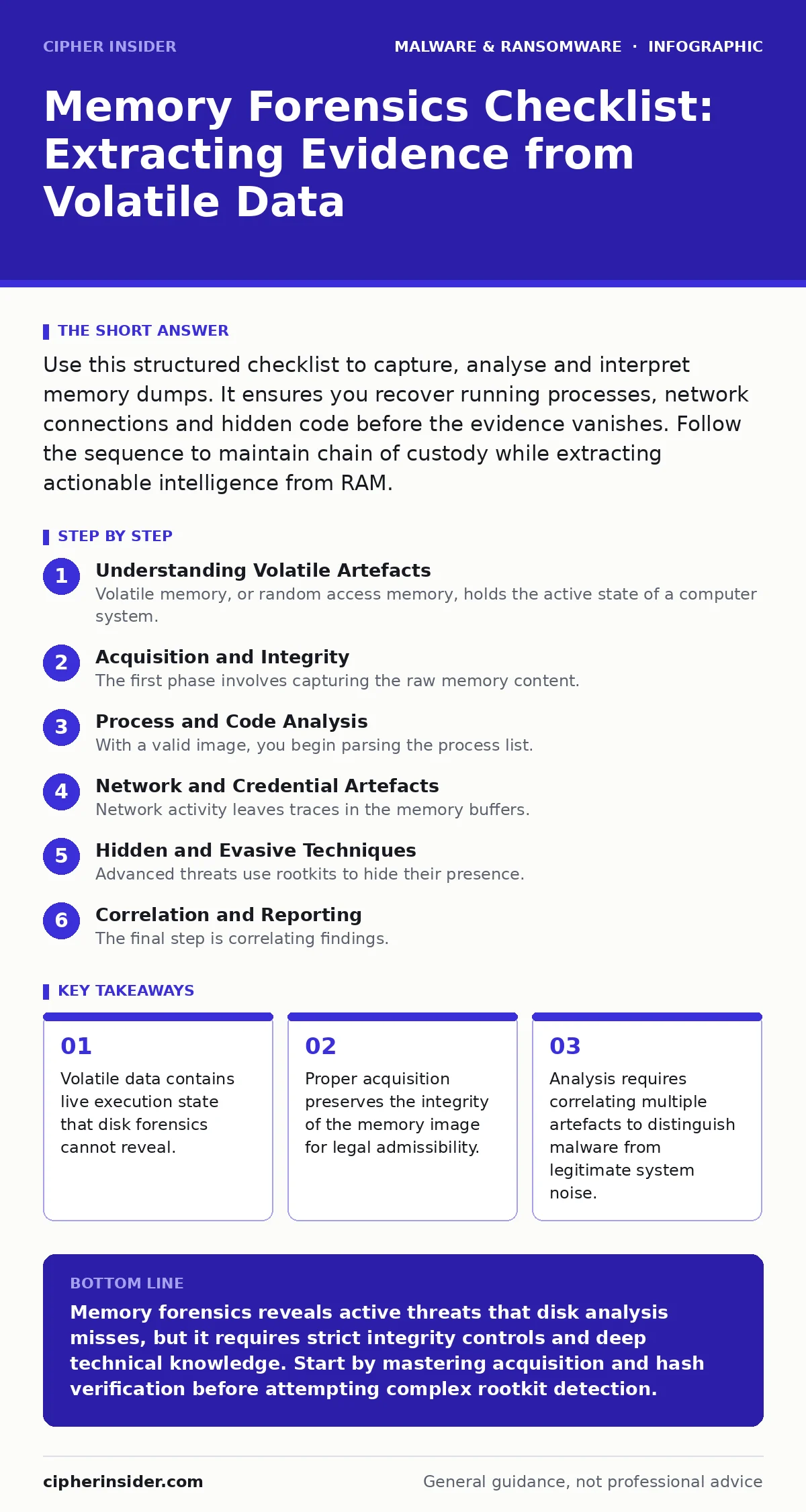
Acquisition and Integrity
The first phase involves capturing the raw memory content. You must ensure the acquisition tool is trusted and signed. A compromised tool can alter the data it collects, rendering the evidence useless. Use a hardware dongle or a bootable environment to prevent the host operating system from interfering. The goal is to get a bit-for-bit copy of the physical memory.
Once captured, you must calculate a cryptographic hash of the image. This hash serves as a fingerprint for the data. Any change to the file will alter the hash, proving tampering. Store the hash alongside the image in your case notes. This step establishes the chain of custody. Without it, the evidence may be inadmissible in formal proceedings.
- Verify acquisition tool signatures: Ensures the collector has not been tampered with.
- Capture full physical memory: Guarantees no regions are skipped or truncated.
- Generate SHA-256 hash immediately: Provides a baseline for integrity verification.
- Secure storage of the image: Prevents accidental deletion or modification.
Process and Code Analysis
With a valid image, you begin parsing the process list. Operating systems maintain structures that describe every running program. Malware often hides by modifying these structures or injecting code into legitimate processes. This technique is known as process hollowing or injection. You must examine the virtual memory of each process.
Look for sections that do not belong to the executable file on disk. Discrepancies between the file on the drive and the code in memory indicate active manipulation. Check for unsigned modules or drivers. Legitimate system components are usually signed by the vendor. Unsigned code suggests a third-party or malicious origin. This analysis reveals what is actually running, not just what is installed.
- List all active processes: Identifies every program consuming resources.
- Check for hidden processes: Reveals entities removed from standard system tables.
- Analyse memory sections for anomalies: Detects injected code or unpacked payloads.
- Verify module signatures: Distinguishes trusted software from unsigned executables.
Network and Credential Artefacts
Network activity leaves traces in the memory buffers. You can reconstruct open sockets and recent connections. This helps identify command-and-control servers. Look for unusual ports or protocols. Compare these against the expected behaviour of the host. Credentials are another critical artefact. Many applications store passwords or tokens in memory for convenience. These are often stored in plaintext or weakly encrypted.
Extracting these can reveal lateral movement paths. Attackers use these credentials to access other systems. This is particularly relevant when analysing systems compromised by ransomware or botnets. Understanding how the attacker moved helps contain the breach. It also informs the discussion around the ransomware payment debate, as recovery may depend on these insights.
- Enumerate open network connections: Maps communication with external hosts.
- Extract DNS cache entries: Shows recent domain resolutions.
- Search for credential strings: Recovers passwords or tokens in use.
- Identify SSL/TLS keys: Allows decryption of captured network traffic.
Hidden and Evasive Techniques
Advanced threats use rootkits to hide their presence. These modify kernel structures to bypass detection. Memory forensics can detect these modifications by scanning for hooks. A hook is a pointer to a function that redirects execution. If a system call points to an unexpected location, a rootkit may be active. You should also look for packed code.
Packers compress or encrypt executable sections to evade signature-based detection. These unpack themselves in memory. By analysing the unpacked state, you can see the true code. This is similar to how behavior-based detection works, focusing on actions rather than static signatures. Identifying these techniques requires deep knowledge of the operating system internals. It separates simple malware from sophisticated intrusions.
- Scan for API hooks: Detects kernel-level manipulation by rootkits.
- Identify packed executables: Reveals code that is compressed or encrypted.
- Check for suspended threads: Finds processes paused to avoid detection.
- Analyse registry hives in memory: Catches changes not yet written to disk.
See also: Malware Droppers and Loaders: Risks and Protection for Small Businesses · Computer Worms Types: How Self-Replicating Threats Spread and Infect
Correlation and Reporting
The final step is correlating findings. A single artefact is rarely conclusive. You must link processes, network connections and file handles. For example, a suspicious process should have a corresponding network connection. If it does not, it may be a dormant payload. Document every finding with timestamps and memory addresses. This allows other analysts to reproduce your results.
The report should explain the significance of each artefact. Avoid technical jargon where possible. The goal is to provide actionable intelligence. This might include indicators of compromise or recommendations for patching. Proper documentation supports future investigations. It also helps in understanding trends, such as the rise of malicious mobile apps or clipboard hijackers. Clear reporting turns raw data into security value.
- Correlate processes with network activity: Validates the purpose of running code.
- Map file handles to disk objects: Links memory artefacts to physical files.
- Document timestamps and offsets: Ensures reproducibility of findings.
- Generate actionable indicators: Provides specific values for detection systems.
Key takeaways
- Volatile data contains live execution state that disk forensics cannot reveal.
- Proper acquisition preserves the integrity of the memory image for legal admissibility.
- Analysis requires correlating multiple artefacts to distinguish malware from legitimate system noise.
Memory forensics reveals active threats that disk analysis misses, but it requires strict integrity controls and deep technical knowledge. Start by mastering acquisition and hash verification before attempting complex rootkit detection.
Frequently asked questions
Can I perform memory forensics on a live server?
Yes, but you must use trusted tools to avoid altering the state. The risk of interference is higher than with a crashed system.
Do I need a large amount of storage for memory images?
Memory images match the installed RAM size. A 16GB system produces a 16GB image, which is manageable for most forensic workstations.
Is memory forensics legal without a warrant?
Laws vary by jurisdiction. Always consult legal counsel before acquiring evidence from systems you do not own or manage.
How does this relate to antivirus quarantine?
Quarantine isolates files but does not remove memory-resident threats. Memory analysis identifies what remains active after quarantine.
How this guide was produced: written by the Cipher Insider editorial team with AI assistance, checked against the public references listed below, and reviewed when the facts change. See our editorial policy or report an error.