
Behaviour-based detection fails when you ignore system noise, lack context, or rely on static signatures. Fix these errors by establishing clear baselines, using threat intelligence to filter false positives, and focusing on the final outcome of process chains rather than individual steps.
Mistake 1: Monitoring without a baseline
You cannot detect abnormal behaviour if you do not know what normal looks like. Every system has a unique pattern of file access, network connections, and process creation. Without a recorded baseline of this activity, every action appears equally suspicious. This leads to alert fatigue, where analysts ignore warnings because most are benign.
Why it hurts:
The detection engine generates noise that drowns out genuine threats. You waste time investigating routine software updates or scheduled backups. The signal-to-noise ratio becomes so poor that critical events are missed entirely.
The fix:
Establish a baseline during a quiet period with no unusual activity. Record typical process trees, file modifications, and network destinations. Update this baseline regularly as software changes. Use this data to filter out expected behaviour. This approach mirrors the principles found in guides on memory forensics, where distinguishing resident code from background noise is the first step.
Mistake 2: Ignoring process lineage
Many attackers use living-off-the-land binaries, which are legitimate system tools used for malicious purposes. Tools like PowerShell or Windows Command Prompt are standard but dangerous when misused. Detecting these tools alone is ineffective because they are used daily by administrators. You must look at who started them and what they did next.
Why it hurts:
Isolated process detection creates a blind spot. An attacker can launch a legitimate tool from a hidden parent process. If you only see the child process, you miss the malicious intent. This allows botnets to maintain control without triggering alarms.
The fix:
Monitor the full process tree, not just individual executables. Track the parent-child relationship between processes. Flag legitimate tools when they are spawned by unexpected parents. Look for unusual command-line arguments passed to these tools. This provides context that single-process monitoring cannot offer.
Mistake 3: Over-reliance on static signatures
Behaviour-based detection is often mixed with signature-based methods. Signatures look for known byte sequences in files. While fast, they fail against new or modified malware. Relying too heavily on signatures means you miss fileless attacks or polymorphic code. These threats change their appearance but keep the same behaviour.
Why it hurts:
You create a false sense of security. The system reports that it has scanned the file, but the scan missed the payload. Attackers use obfuscation to hide the malicious code from static analysis. The behaviour remains undetected until it is too late.
The fix:
Combine static analysis with behavioural monitoring. Use signatures for known threats but rely on behaviour for unknown ones. Ensure your detection engine watches for actions, not just file contents. This layered approach catches threats that evade signature databases. It complements strategies discussed in the ransomware payment debate, where early detection prevents the need for negotiation.
Mistake 4: Neglecting resource constraints
Monitoring every system call is computationally expensive. It slows down the host system and consumes significant CPU and memory. If you monitor too much, the system becomes unusable. If you monitor too little, you miss critical events. Finding the right balance is difficult.
Why it hurts:
Performance degradation leads users to disable security tools. Attackers exploit this by targeting systems with heavy monitoring loads. The detection engine may drop events due to backlog. Critical alerts are lost in the data overflow.
The fix:
Prioritise high-risk activities for detailed monitoring. Focus on process creation, file encryption, and network connections. Use sampling for less critical events. Optimise your rules to reduce overhead. This ensures the system remains responsive while maintaining security.
Mistake 5: Missing lateral movement indicators
Attackers often move silently between systems once they have initial access. They use legitimate protocols to spread. Detecting the initial compromise is not enough. You must watch for unusual access patterns across the network. This includes accessing shared drives or querying directory services.
Why it hurts:
The infection spreads before you notice. The initial host is quarantined, but the attacker has already moved to other systems. This containment failure leads to widespread damage. It is similar to how adware can spread through shared resources, though with less malicious intent.
The fix:
Monitor for unusual authentication attempts and resource access. Look for accounts accessing resources they never touched before. Flag rapid movement between systems. Use network traffic analysis to spot anomalies. This helps contain the breach before it escalates.
Mistake 6: Failing to correlate events in time
Malicious activity often happens in stages over time. A single event may look benign. For example, a process reading a file is normal. But if that process reads many files quickly, it is suspicious. Correlating events across time windows reveals patterns. Without this, you miss the bigger picture.
Why it hurts:
Staged attacks evade detection. Each step is too small to trigger an alert. The cumulative effect is significant, but individual steps are ignored. This allows clipboard hijackers to operate by slowly stealing data without triggering immediate alarms.
The fix:
Use temporal correlation rules. Group events by source, destination, and time. Look for sequences that match known attack patterns. Alert on the combination of events, not just single actions. This reveals the intent behind seemingly harmless activities.
Mistake 7: Ignoring user context
Administrators perform actions that look like attacks. They install software, modify files, and access sensitive data. If you do not account for their role, you generate false positives. Distinguishing between an admin and an attacker is vital. Context matters more than the action itself.
Why it hurts:
False positives erode trust in the detection system. Analysts ignore alerts because they are often wrong. Real threats are buried under noise. This is similar to the issue with fake antivirus software, which generates constant alerts to confuse users.
The fix:
Integrate user and entity behaviour analytics. Tag administrative accounts and their typical activities. Allow higher thresholds for trusted users. Investigate anomalies based on deviation from their norm. This reduces noise and focuses attention on genuine threats.
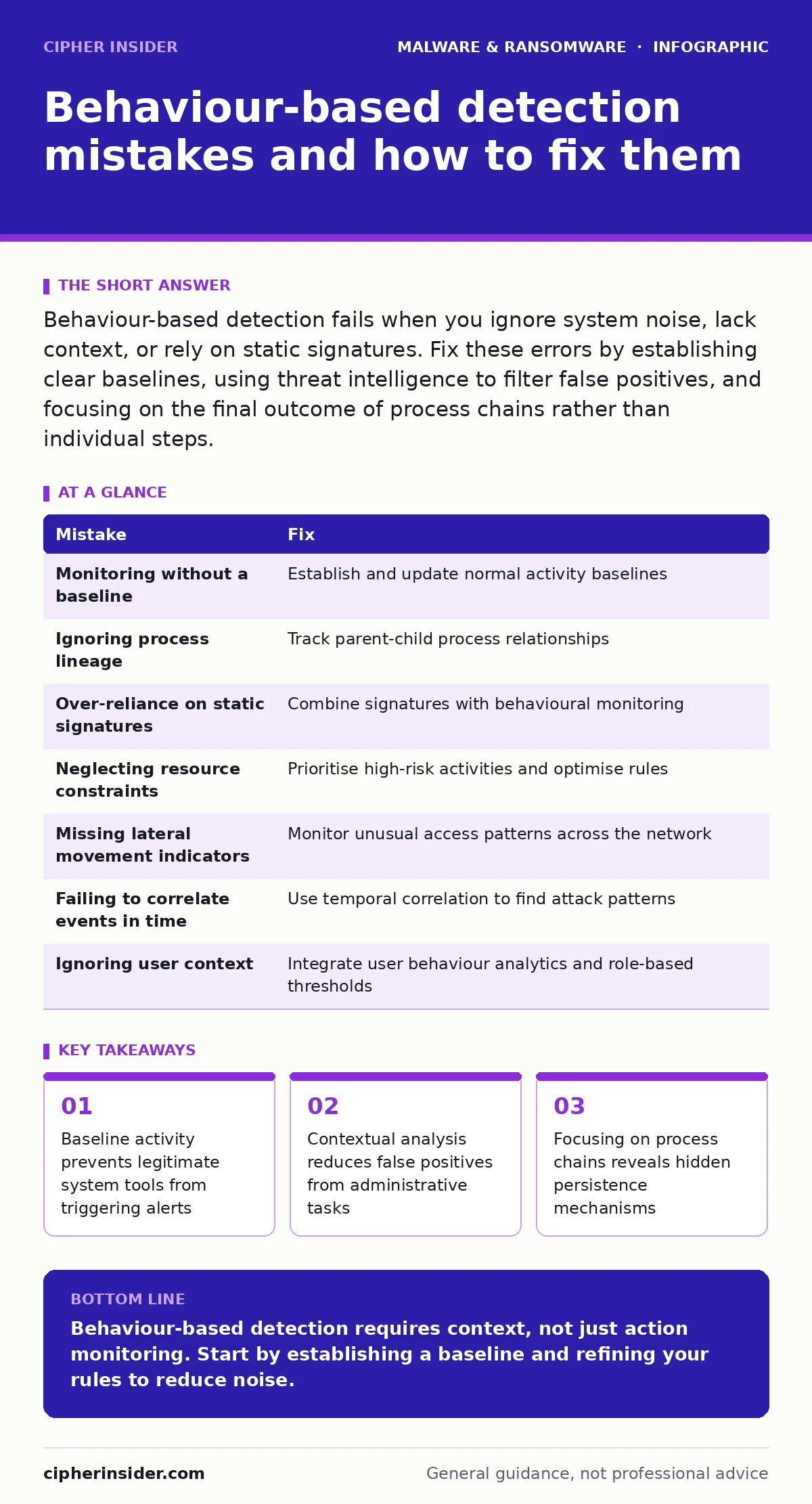
| Mistake | Fix |
|---|---|
| Monitoring without a baseline | Establish and update normal activity baselines |
| Ignoring process lineage | Track parent-child process relationships |
| Over-reliance on static signatures | Combine signatures with behavioural monitoring |
| Neglecting resource constraints | Prioritise high-risk activities and optimise rules |
| Missing lateral movement indicators | Monitor unusual access patterns across the network |
| Failing to correlate events in time | Use temporal correlation to find attack patterns |
| Ignoring user context | Integrate user behaviour analytics and role-based thresholds |
Key takeaways
- Baseline activity prevents legitimate system tools from triggering alerts
- Contextual analysis reduces false positives from administrative tasks
- Focusing on process chains reveals hidden persistence mechanisms
- Resource constraints limit the depth of real-time behavioural monitoring
Behaviour-based detection requires context, not just action monitoring. Start by establishing a baseline and refining your rules to reduce noise.
Frequently asked questions
How do I distinguish between an admin and an attacker?
Use role-based tagging and monitor for deviations from their typical activity patterns.
Can behaviour-based detection stop fileless malware?
Yes, because it monitors actions rather than file contents, catching scripts and memory-resident code.
Why does my detection system slow down my computer?
Monitoring every system call consumes significant CPU and memory resources.
How often should I update my baseline?
Update it after any major software change or system configuration update.
How this guide was produced: written by the Cipher Insider editorial team with AI assistance, checked against the public references listed below, and reviewed when the facts change. See our editorial policy or report an error.