You fall for romance scams when you share personal data early, accept payment requests, or isolate the relationship. These mistakes allow attackers to build false trust. The fix involves verifying identity through independent channels, keeping conversations public, and never sending money or sensitive documents to someone you have not met in person.
Mistake 1: Sharing High-Resolution Photos Early in the Conversation
You provide clear, high-resolution images of your face, home, or documents within the first few days of contact. Attackers use facial recognition tools to verify your identity or harvest biometric data. They may also use these images to create deepfakes or to sell your likeness on dark web forums. This data helps them craft highly personalised attacks against your family or colleagues later. The images serve as proof of life, which increases the perceived legitimacy of the scammer.
Why it hurts: Your biometric data cannot be changed like a password. Once an attacker has a clear image of your face, they can potentially bypass facial recognition systems or create synthetic identities. This compromises your long-term digital identity. The exposure creates a permanent risk that outlasts the specific scam attempt. You lose control over how your likeness is used in future social engineering campaigns.
The fix: Use low-resolution images that do not show distinctive background details. Avoid sharing photos that contain metadata, such as GPS coordinates or device information. Wait until you have verified the person’s identity through multiple independent channels. Treat every photo as public information. This limits the attacker’s ability to build a detailed profile of your life.
Mistake 2: Moving Conversations to Encrypted Messaging Apps Immediately
You agree to move from the dating platform to a private messaging app like Signal or Telegram within hours. Scammers do this to avoid detection by platform security teams. Dating sites use automated filters to spot malicious bot traffic and known scam patterns. Private apps encrypt messages, making it impossible for security operations centers to scan for threats. This isolation removes the safety net provided by the original platform.
Why it hurts: You lose the ability to report the user or have the conversation reviewed by moderators. The attacker gains full control over the communication channel. If the scammer sends a malicious link or file, you have no secondary verification from the platform. This increases the blast radius of any subsequent attack, as you are now in a closed environment. The lack of oversight makes it easier for the attacker to escalate the scam.
The fix: Keep conversations on the original platform for at least several weeks. Use the platform’s built-in video chat feature to verify the person’s identity. If you must move platforms, use a service that allows message archiving and reporting. Do not accept friend requests or contact details until you have established a baseline of trust. This maintains a layer of security oversight.
Mistake 3: Accepting Requests to Receive Packages or Mail
You provide your home address or accept a request to receive a package on behalf of the scammer. The package often contains counterfeit goods, illegal substances, or stolen items. This makes you an unwitting participant in smuggling or fraud. Law enforcement may seize the package and investigate you as the recipient. The attacker uses your address to launder goods or to establish a physical presence in your area.
Why it hurts: You become a legal liability for crimes you did not commit. The presence of illegal items at your address can lead to police involvement and significant stress. Attackers use this tactic to create a sense of obligation, making you less likely to report them. It also provides the scammer with a verified residential address, which they can use for further identity theft. Your home security is compromised by the association with criminal activity.
The fix: Never accept packages from someone you have not met in person. Use a PO box or a workplace address if you must receive mail, though avoiding it entirely is safer. Report any request to receive mail as a scam attempt. This prevents you from being used as a mule for illegal goods. It also protects your residential privacy from malicious actors.
Mistake 4: Sharing Financial Details or Banking Credentials
You provide bank account numbers, sort codes, or credit card details under the guise of "proving" your financial stability or sending money. Attackers use this information to initiate unauthorised transactions or to apply for loans in your name. They may also use the details to verify your identity for other fraudulent purposes. This mistake gives the attacker direct access to your financial assets. The damage can be immediate and difficult to reverse.
Why it hurts: Your financial identity is compromised, leading to potential fraud and debt. Recovery from financial theft is time-consuming and often incomplete. The attacker can use your details to bypass certain security checks at other institutions. This mistake mirrors the risks associated with phishing, where credentials are stolen for immediate gain. You lose control over your financial reputation and credit standing.
The fix: Never share banking details with someone you have not met. Use secure payment methods that do not expose your account information. If you must send money, use a traceable method that offers buyer protection, though the best option is to avoid sending money entirely. Monitor your bank statements regularly for unauthorised transactions. This limits the attacker’s ability to exploit your financial data.
Mistake 5: Isolating the Relationship from Friends and Family
You keep the relationship secret from your friends and family, often because the scammer claims they are "shy" or that the relationship is "special". This isolation prevents others from spotting red flags or inconsistencies in the scammer’s story. Friends and family provide an external perspective that can challenge the attacker’s narrative. Without this social check, you are more vulnerable to manipulation and gaslighting.
Why it hurts: You lose the protective buffer of social scrutiny. Attackers rely on isolation to maintain control and prevent intervention. The lack of external input allows the scammer to distort reality and increase your emotional dependence. This dynamic is similar to insider threats, where trust is exploited from within. You become more susceptible to high-pressure tactics and financial requests.
The fix: Share details of the relationship with trusted friends or family members. Ask them to review conversations or profiles for inconsistencies. Keep the relationship public and integrated into your existing social circle. This provides an additional layer of verification and support. It also reduces the attacker’s ability to manipulate your perception of reality.
See also: What Is Credit Monitoring: How It Works and Its Hidden Limits
Mistake 6: Ignoring Inconsistencies in the Scammer’s Story
You overlook contradictions in the scammer’s background, such as changing job titles, locations, or personal history. Attackers often use complex, evolving narratives to maintain engagement. Inconsistencies are common because the scammer is managing multiple victims simultaneously. Ignoring these signs allows the attacker to deepen the emotional bond. This mistake reflects a failure to apply critical thinking to the relationship.
Why it hurts: You continue to invest time and emotion in a fraudulent relationship. The inconsistencies serve as early warning signs that are ignored. This allows the attacker to escalate the scam to financial requests. The emotional investment makes it harder to recognise the fraud later. You become trapped in a cycle of justification and denial.
The fix: Take notes on the scammer’s story and check for contradictions. Verify facts through independent sources, such as searching for their name or photos. Ask direct questions about inconsistencies and observe the response. If the scammer becomes defensive or angry, disengage immediately. This maintains your critical distance and protects you from manipulation.
Mistake 7: Sending Money for "Emergencies" or "Travel"
You send money to help the scammer with an emergency, medical bill, or travel expense. This is the primary goal of the scam. Attackers create urgent scenarios to bypass your rational decision-making. The money is often sent via irreversible methods like wire transfers or gift cards. This mistake results in direct financial loss. The attacker uses the urgency to prevent you from verifying the claim.
Why it hurts: You lose money that is unlikely to be recovered. The financial loss is often accompanied by emotional distress and shame. Attackers may continue to request money, claiming the initial amount was insufficient. This creates a cycle of financial exploitation. The irreversible nature of the payment methods makes recovery nearly impossible.
The fix: Never send money to someone you have not met in person. Refuse any request for financial assistance, regardless of the urgency. Report the request to the platform and to relevant authorities. This stops the financial exploitation and protects your assets. It also signals to the attacker that you are not a viable target.
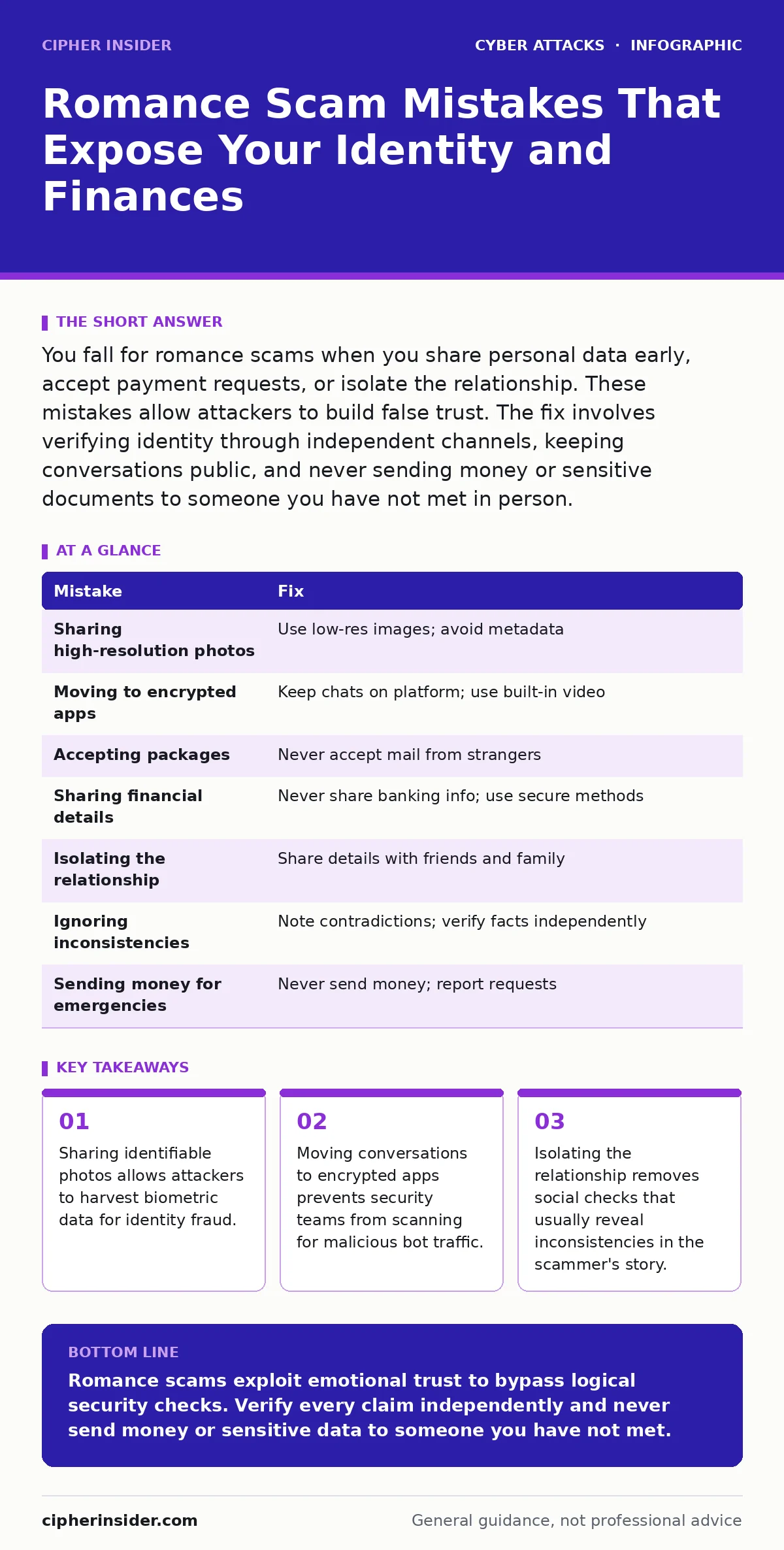
| Mistake | Fix |
|---|---|
| Sharing high-resolution photos | Use low-res images; avoid metadata |
| Moving to encrypted apps | Keep chats on platform; use built-in video |
| Accepting packages | Never accept mail from strangers |
| Sharing financial details | Never share banking info; use secure methods |
| Isolating the relationship | Share details with friends and family |
| Ignoring inconsistencies | Note contradictions; verify facts independently |
| Sending money for emergencies | Never send money; report requests |
Key takeaways
- Sharing identifiable photos allows attackers to harvest biometric data for identity fraud.
- Moving conversations to encrypted apps prevents security teams from scanning for malicious bot traffic.
- Isolating the relationship removes social checks that usually reveal inconsistencies in the scammer's story.
Romance scams exploit emotional trust to bypass logical security checks. Verify every claim independently and never send money or sensitive data to someone you have not met.
Frequently asked questions
How can I tell if a dating profile is fake?
Check for limited photos, generic language, and rapid requests to move off-platform. Reverse image search their photos.
What should I do if I have already sent money?
Contact your bank immediately to report fraud. Report the scam to the platform and local authorities.
Are video calls enough to verify identity?
Video calls help but are not foolproof. Scammers can use deepfakes or pre-recorded videos. Verify identity through multiple channels.
Can I recover money sent via gift cards?
No, gift card transactions are irreversible. Treat gift card requests as immediate confirmation of a scam.
How this guide was produced: written by the Cipher Insider editorial team with AI assistance, checked against the public references listed below, and reviewed when the facts change. See our editorial policy or report an error.