
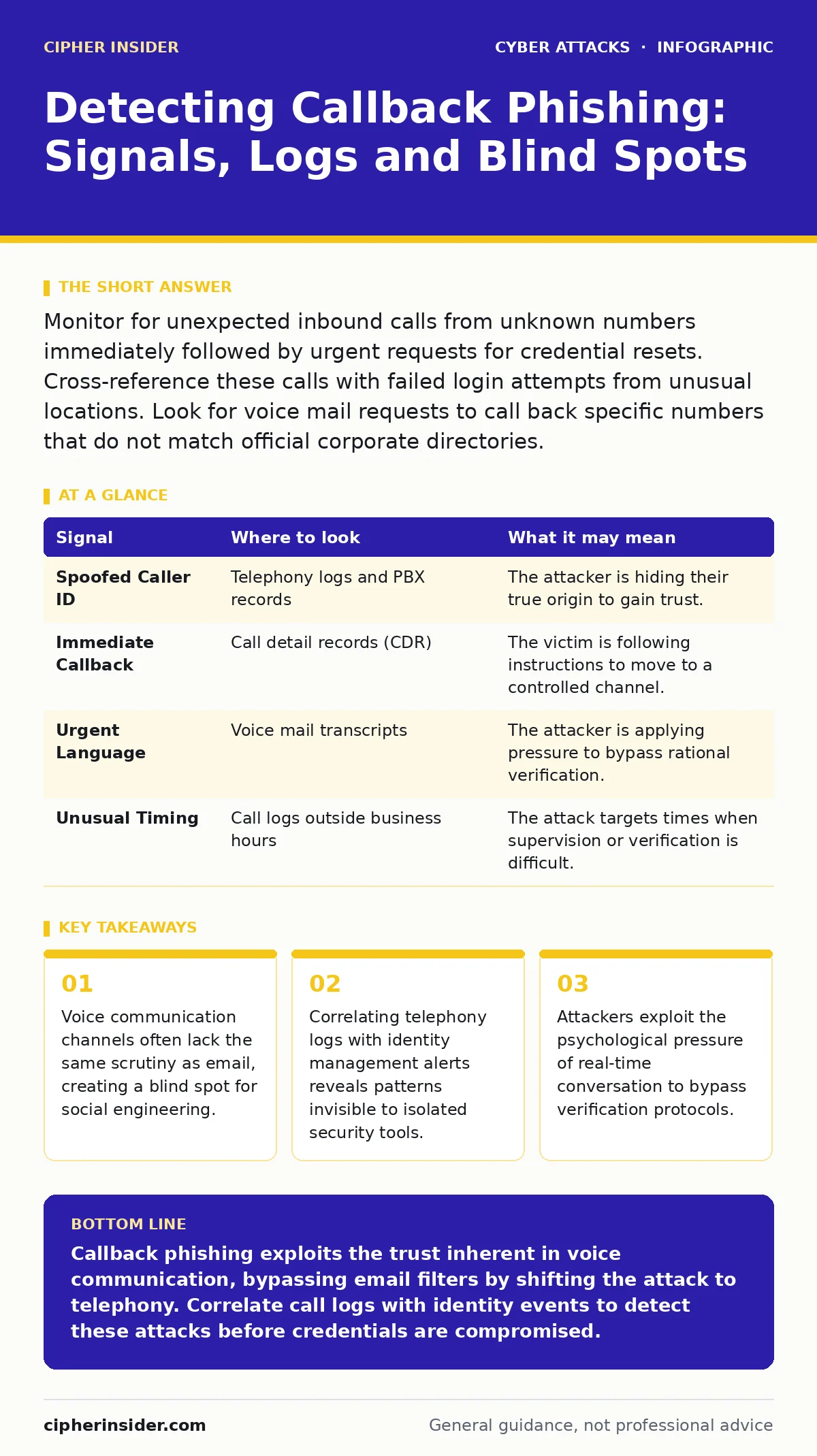
Monitor for unexpected inbound calls from unknown numbers immediately followed by urgent requests for credential resets. Cross-reference these calls with failed login attempts from unusual locations. Look for voice mail requests to call back specific numbers that do not match official corporate directories.
The Mechanics of Voice-Based Social Engineering
Callback phishing relies on the assumption that a voice call carries more authority than an email. The attacker initiates contact, often using spoofed caller ID, to create a sense of urgency. They then instruct the target to call back a specific number, claiming the line is secure or that the initial connection was poor. This technique shifts the interaction away from email filters and into the telephony system, which is rarely monitored for security events.
The core mechanism is trust exploitation. People are conditioned to comply with spoken requests from perceived authority figures. By moving the conversation to a callback, the attacker isolates the victim from digital evidence trails that might raise suspicion, such as poor grammar or mismatched sender addresses. The goal is to obtain credentials or reset tokens before the victim has time to verify the request through independent channels.
Telephony Logs and Caller ID Spoofing
Your first line of defence in detecting this attack lies in the telephony infrastructure. Most modern business communication systems log inbound calls, including the originating number and the time of connection. Attackers frequently use Voice over Internet Protocol (VoIP) to spoof caller IDs, making the call appear to originate from a legitimate internal department or a trusted partner.
However, the metadata often tells a different story. Look for calls that arrive from short codes, international prefixes that do not align with business operations, or numbers that have no prior history of interaction with the employee. If an employee receives a call from a number that claims to be from IT support but the number is not listed in the internal directory, this is a significant red flag.
| Signal | Where to look | What it may mean |
|---|---|---|
| Spoofed Caller ID | Telephony logs and PBX records | The attacker is hiding their true origin to gain trust. |
| Immediate Callback | Call detail records (CDR) | The victim is following instructions to move to a controlled channel. |
| Urgent Language | Voice mail transcripts | The attacker is applying pressure to bypass rational verification. |
| Unusual Timing | Call logs outside business hours | The attack targets times when supervision or verification is difficult. |
Correlating Voice and Digital Activity
The most effective detection method involves correlating telephony data with identity management logs. A callback phishing attack does not happen in isolation. The attacker will usually request a password reset or a multi-factor authentication code. This action generates events in your identity provider, such as Microsoft Entra ID or Okta.
Suppose an employee receives a call from an unknown number and, within minutes, a password reset request is triggered for their account. If this reset originates from a geographic location or IP address that does not match the employee’s usual pattern, the correlation becomes clear. Security information and event management (SIEM) systems can be configured to alert when a telephony event precedes a high-risk identity event. This cross-domain analysis is critical because it connects the social engineering vector with the technical outcome.
For deeper insights into how attackers manipulate communication channels, see our guide on adversary-in-the-middle phishing.
Voice Mail and Transcript Analysis
Voice mail is a critical evidence source in callback phishing. Attackers often leave messages that are carefully scripted to sound professional and urgent. These messages may include specific instructions to call a provided number, claiming that the initial call was disconnected or that the line is now secure.
Modern unified communications platforms can transcribe voice mails automatically. You should scan these transcripts for keywords associated with urgency, such as "immediate action," "account locked," or "security breach." Additionally, check if the number provided in the voice mail matches any known corporate numbers. If the number is new, external, or formatted unusually, it is likely malicious. Do not rely on the display name alone, as this can be easily manipulated by the caller.
The Human Element and Verification Failures
Even with technical controls, the human element remains a vulnerability. Employees may feel pressured to comply with a voice request because it feels personal and direct. The attacker leverages this psychological pressure to bypass standard verification procedures. A common blind spot is the assumption that if a caller knows the employee’s name and role, they must be legitimate.
Attackers gather this information from public sources such as LinkedIn or company websites. They use this data to craft convincing narratives. The failure to verify the caller’s identity through an independent channel is the primary reason these attacks succeed. Verification should always involve contacting the purported sender through a known, trusted method, such as an internal directory number, rather than the number provided by the caller.
To strengthen the human layer of defence, refer to our guide on security awareness training.
See also: Difference Between Session Hijacking and Spoofing: Mechanisms and Defences
Common Blind Spots in Detection
Many organisations focus heavily on email security, leaving voice communications largely unmonitored. This creates a significant blind spot. Telephony logs are often siloed from security operations, making it difficult to detect patterns that span both domains. Additionally, many organisations do not have policies in place for verifying unsolicited voice requests, leaving employees without clear guidance.
Another blind spot is the reliance on caller ID alone. As VoIP technology makes spoofing trivial, the presence of a familiar number on the display is no longer proof of legitimacy. Security teams must move beyond static checks and implement dynamic correlation between voice and digital events. Without this integration, callback phishing remains a hidden threat that bypasses traditional perimeter defences.
For a broader perspective on communication-based threats, see our guide on evil twin Wi-Fi attacks.
Implementing Continuous Monitoring
Detection requires continuous monitoring and regular tuning of alert rules. Start by establishing a baseline of normal telephony activity for your organisation. Identify what constitutes unusual calling patterns, such as calls from international numbers or calls during non-business hours. Use this baseline to create alerts that flag deviations.
Regularly review these alerts to reduce false positives and improve detection accuracy. Engage with your telephony provider to understand the capabilities of their logging and analytics tools. Ensure that voice data is integrated into your broader security monitoring strategy. This holistic approach ensures that no communication channel is left unchecked.
Strengthening Organizational Resilience
Building resilience against callback phishing requires a combination of technical controls and cultural changes. Technical measures include call authentication protocols and integration between telephony and identity systems. Cultural measures involve fostering an environment where employees feel empowered to question unexpected requests without fear of reprimand.
Regularly test your detection capabilities with simulated attacks. This helps identify gaps in your monitoring and training programmes. Encourage employees to report suspicious calls as part of a broader security culture. By combining vigilant monitoring with educated users, you can significantly reduce the risk of successful callback phishing attacks.
See our guide on security culture for strategies to embed these practices into daily operations.
Key takeaways
- Voice communication channels often lack the same scrutiny as email, creating a blind spot for social engineering.
- Correlating telephony logs with identity management alerts reveals patterns invisible to isolated security tools.
- Attackers exploit the psychological pressure of real-time conversation to bypass verification protocols.
Callback phishing exploits the trust inherent in voice communication, bypassing email filters by shifting the attack to telephony. Correlate call logs with identity events to detect these attacks before credentials are compromised.
Frequently asked questions
How can I tell if a caller ID is spoofed?
Caller ID alone cannot be trusted. Look for discrepancies between the number and the caller’s claimed identity, and check if the number is listed in official directories.
What is the first step to improving detection?
Integrate telephony logs into your SIEM and establish baselines for normal calling behaviour. This allows you to identify deviations that may indicate an attack.
How this guide was produced: written by the Cipher Insider editorial team with AI assistance, checked against the public references listed below, and reviewed when the facts change. See our editorial policy or report an error.