
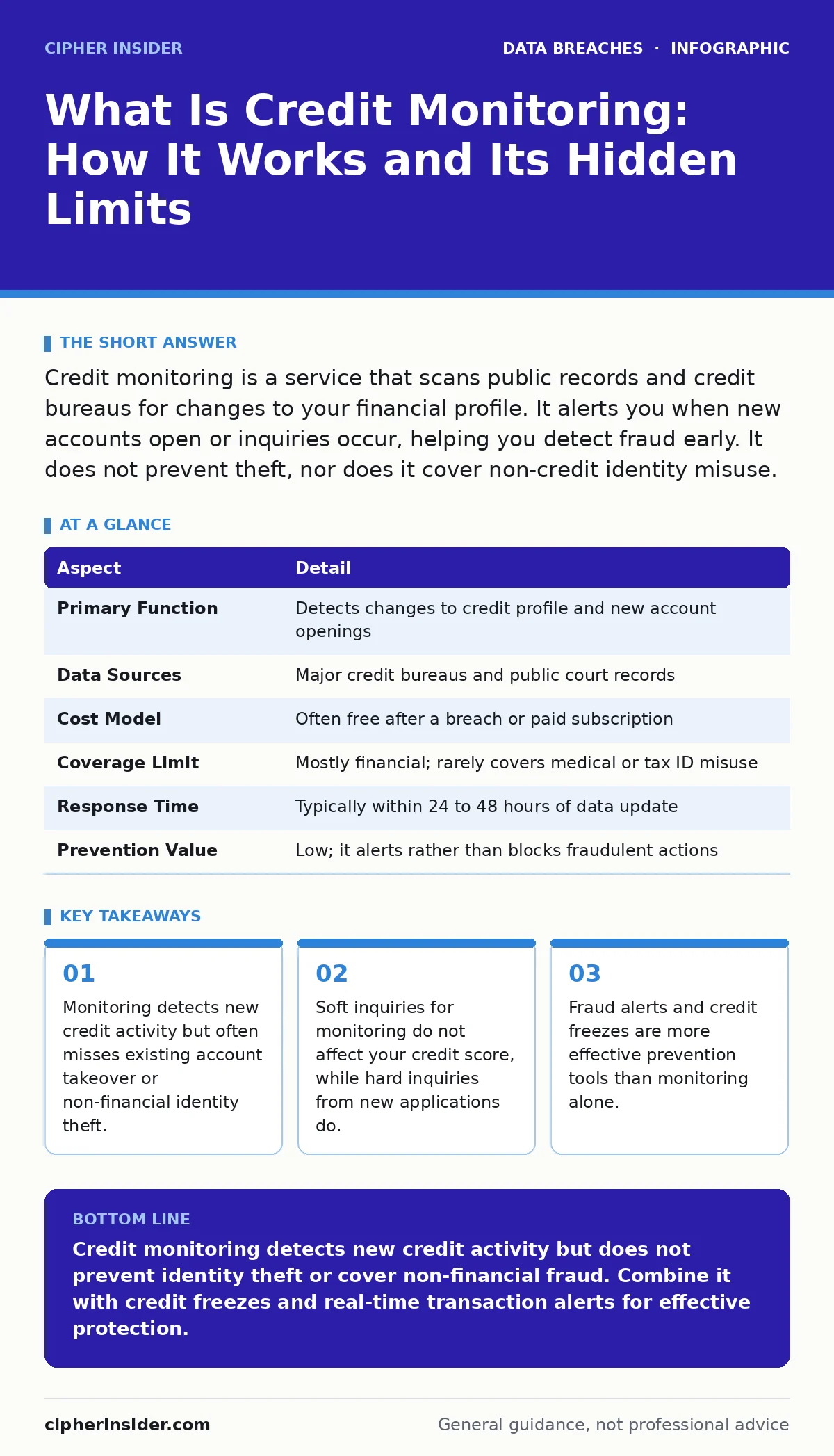
Credit monitoring is a service that scans public records and credit bureaus for changes to your financial profile. It alerts you when new accounts open or inquiries occur, helping you detect fraud early. It does not prevent theft, nor does it cover non-credit identity misuse.
What is credit monitoring
Credit monitoring is a service that continuously scans credit bureau databases and public records for changes to your financial identity. It notifies you when specific triggers occur, such as a new credit account opening or a hard inquiry being made. This service acts as a detection layer rather than a prevention mechanism. You receive alerts via email, app notification or phone call when the system flags unusual activity. The core function is to reduce the time between a breach and your awareness of it.
| Aspect | Detail |
|---|---|
| Primary Function | Detects changes to credit profile and new account openings |
| Data Sources | Major credit bureaus and public court records |
| Cost Model | Often free after a breach or paid subscription |
| Coverage Limit | Mostly financial; rarely covers medical or tax ID misuse |
| Response Time | Typically within 24 to 48 hours of data update |
| Prevention Value | Low; it alerts rather than blocks fraudulent actions |
How credit monitoring works
The service relies on data aggregation from the major credit reporting agencies. These agencies maintain detailed files on your borrowing history, including loans, credit cards and utility payments. When a lender checks your credit to approve a new application, it performs a hard inquiry. This inquiry appears on your report immediately. The monitoring service compares your current file against previous snapshots. If a discrepancy arises, such as a new mortgage application in a different state, the system generates an alert.
The process involves constant polling of the credit bureaus. Most services check your file daily or weekly. This frequency ensures that most fraudulent account openings are caught before the fraudster can withdraw significant funds. However, the detection depends entirely on the lender reporting the activity to the bureau. If a fraudster uses a stolen identity to open an account with a lender that does not report to the major bureaus, the monitoring service will not see it. This creates a blind spot in the detection process.
Who credit monitoring affects
Credit monitoring affects anyone who interacts with the formal financial system. This includes individuals with credit cards, mortgages, student loans or auto financing. People with limited credit history are also at risk, as fraudsters often target "thin files" because they are easier to manipulate. The service is particularly relevant for victims of data breaches. When personal information is exposed, the likelihood of identity theft increases significantly.
However, the impact is not uniform. Individuals who maintain a credit freeze, also known as a security freeze, see less value in monitoring. A freeze prevents new accounts from being opened entirely, rendering the detection alert redundant for that specific vector. For those who do not use freezes, monitoring provides a safety net. It is also useful for parents of minor children, as child identity theft often goes unnoticed for years until the child applies for their first credit card.
What people usually get wrong
Many consumers confuse credit monitoring with credit protection. Monitoring is passive; it watches and reports. Protection is active; it blocks or prevents. A common misconception is that paying for a monitoring service stops fraud from happening. It does not. It only tells you that fraud has likely occurred. Another error is assuming that monitoring covers all forms of identity theft. It typically ignores medical identity theft, tax identity theft and utility fraud. These forms of theft do not always involve credit bureaus.
Users also misunderstand the role of credit scores in monitoring. Monitoring services track the data that influences your score, but they do not guarantee score improvement. Some services bundle credit repair advice with monitoring, creating confusion about their primary function. The monitoring component is strictly observational. It does not negotiate with creditors or dispute errors on your behalf unless it is part of a broader credit repair package.
The hidden costs of reliance
Relying solely on credit monitoring introduces a false sense of security. This psychological effect can lead to neglecting more robust security measures. For instance, you might skip enabling multi-factor authentication on your banking apps because you believe the monitoring service will catch any issues. This is a dangerous trade-off. Monitoring cannot stop a login from a stolen password. It only sees the aftermath if that login results in a credit inquiry.
There is also the cost of attention. Frequent false positives can lead to alert fatigue. You may start ignoring notifications because they often turn out to be legitimate updates, such as a credit limit increase you requested. When a real fraud alert arrives, you might dismiss it as another false alarm. This delay allows fraudsters more time to damage your financial standing. The cognitive load of managing these alerts is a non-trivial burden.
See also: How Data Scraping Works: The Step-by-Step Breakdown
What to do about it
To maximise the benefit of credit monitoring, you must combine it with proactive controls. Start by placing a credit freeze with all three major credit bureaus. This prevents any new accounts from being opened without your explicit permission. You can temporarily lift the freeze when you need to apply for credit. This method is free in most jurisdictions and is more effective than monitoring alone.
Secondly, enable transaction alerts on your existing bank and credit accounts. These alerts notify you of purchases, not just new accounts. This covers the gap where fraudsters use existing cards rather than opening new ones. Thirdly, review your credit reports annually. Direct access to your full report allows you to spot errors or unfamiliar accounts that might not trigger an automated alert.
- Place a security freeze on your credit files.
- Set up real-time push notifications for all financial accounts.
- Check your full credit report at least once a year.
- Use unique passwords for each financial service to prevent credential stuffing.
Integrating with broader security
Credit monitoring is one layer in a multi-layered security strategy. It works best when combined with data encryption and strong authentication practices. If your device is compromised, monitoring cannot help you. You need to secure the endpoints where you access financial services. Understanding the risks of password reuse is critical, as many breaches occur because users recycle credentials across banking and shopping sites.
Similarly, awareness of oversharing on social media can help prevent social engineering attacks that bypass technical controls. Fraudsters often gather personal details from public profiles to answer security questions. Monitoring will not stop this initial reconnaissance. By tightening your digital footprint and using data loss prevention techniques for sensitive files, you reduce the attack surface. Credit monitoring then serves as a final checkpoint for financial anomalies.
Key takeaways
- Monitoring detects new credit activity but often misses existing account takeover or non-financial identity theft.
- Soft inquiries for monitoring do not affect your credit score, while hard inquiries from new applications do.
- Fraud alerts and credit freezes are more effective prevention tools than monitoring alone.
Credit monitoring detects new credit activity but does not prevent identity theft or cover non-financial fraud. Combine it with credit freezes and real-time transaction alerts for effective protection.
Frequently asked questions
Does credit monitoring affect my credit score?
No. Monitoring services use soft inquiries, which do not impact your credit score. Only hard inquiries from new credit applications lower your score.
Is credit monitoring worth paying for?
It depends on your risk profile. If you use credit freezes and transaction alerts, the marginal benefit of paid monitoring is low. It is most valuable for high-risk individuals or those who cannot manage freezes.
Can credit monitoring detect child identity theft?
Standard monitoring often misses it because minors do not have credit files. Specialised child identity monitoring services exist that check for the creation of a credit file in a child's name.
How quickly does credit monitoring alert me?
Most services alert within 24 to 48 hours of a change appearing on your credit report. The delay depends on how quickly the lender reports the activity to the credit bureaus.
How this guide was produced: written by the Cipher Insider editorial team with AI assistance, checked against the public references listed below, and reviewed when the facts change. See our editorial policy or report an error.