
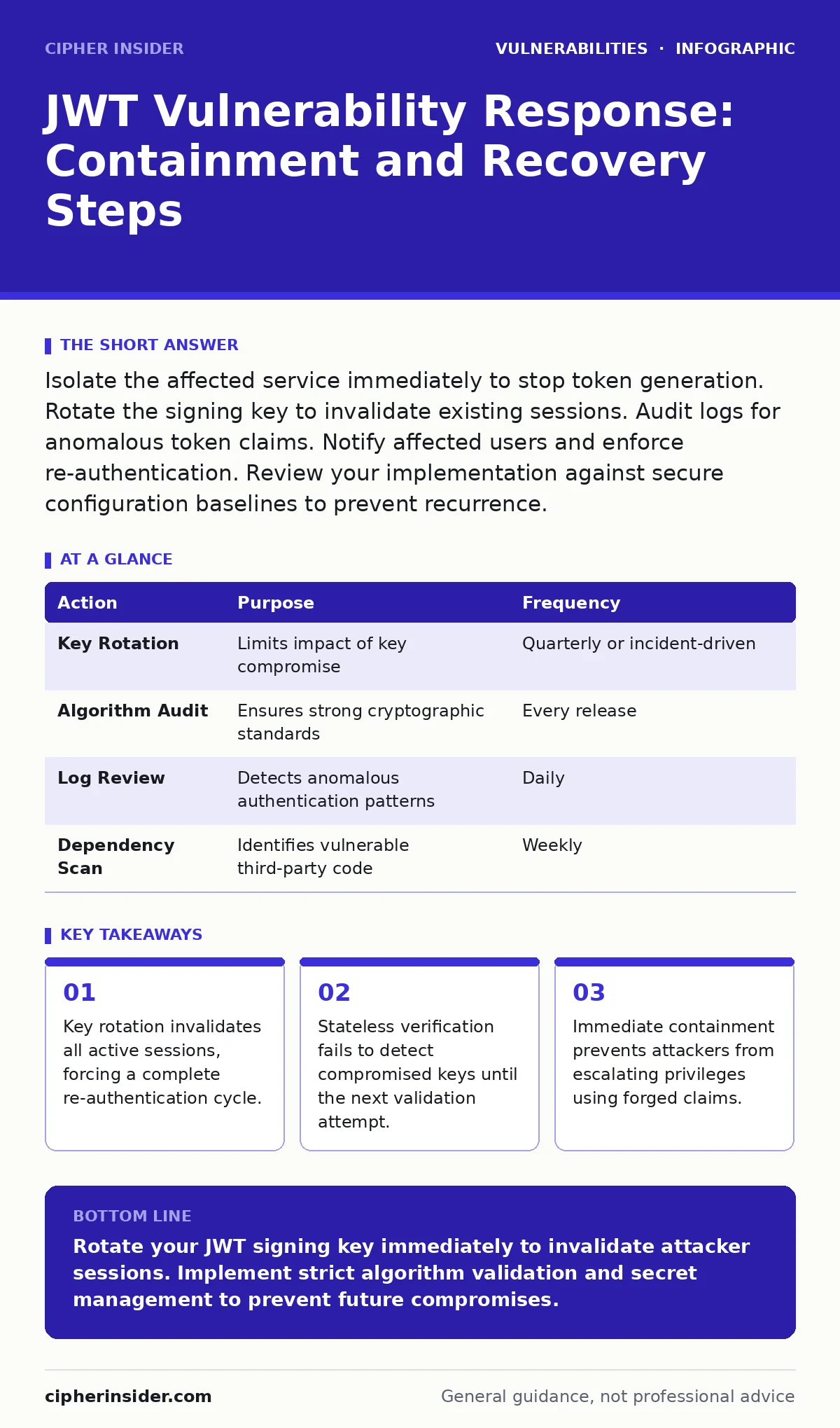
Isolate the affected service immediately to stop token generation. Rotate the signing key to invalidate existing sessions. Audit logs for anomalous token claims. Notify affected users and enforce re-authentication. Review your implementation against secure configuration baselines to prevent recurrence.
First hour
The initial response to a JSON Web Token (JWT) vulnerability focuses on stopping the attack vector. JWTs are stateless, meaning the server does not store session data. This design creates a blind spot during incident response. You cannot simply "log out" a specific user from the server side. The attacker holds a valid cryptographic signature.
Your first task is to identify the scope. Check which services use the compromised signing key. Look for unusual traffic patterns in your application logs. Identify requests that contain tokens with unexpected claims or scopes. This helps you understand if an attacker is impersonating administrators or accessing sensitive data.
Immediate containment checklist
- Isolate the affected microservice or application server from the network.
- Disable the current JWT signing key in your configuration management system.
- Enable verbose logging for all authentication endpoints to capture evidence.
- Block known malicious IP addresses associated with the attack traffic.
- Notify your internal security team and technical leadership immediately.
Isolating the service prevents further token generation. Disabling the key stops the server from accepting new tokens signed with that key. This breaks the attacker's ability to maintain access. You must preserve logs before rotating keys, as these records may be needed for forensic analysis.
First day
The second phase involves validating your containment and beginning recovery. You must rotate the JWT signing key. This is the cryptographic equivalent of changing a master password. Every token signed with the old key becomes invalid immediately.
Rotation causes disruption. Legitimate users will find their sessions terminated. They must re-authenticate to receive a new token signed with the new key. This is a necessary trade-off. Security outweighs convenience in this scenario. The alternative is allowing an attacker to persist indefinitely.
Key rotation procedure
- Generate a new cryptographic key pair for JWT signing.
- Update your application configuration to use the new key for signing.
- Configure the verification logic to accept both the old and new keys temporarily.
- Monitor authentication errors to ensure the transition is smooth.
- Remove support for the old key once all active sessions have expired or been refreshed.
Using a grace period where both keys are accepted reduces user friction. It allows existing sessions to expire naturally while new sessions use the new key. After the grace period, remove the old key entirely. This ensures no token signed with the compromised key can ever be validated again.
First week
The final phase focuses on root cause analysis and preventing recurrence. You must determine how the vulnerability was exploited. Was it a weak signing algorithm? Was the secret key exposed in source code? Understanding the cause dictates your long-term fix.
Weak algorithms like HS256 with short secrets are common pitfalls. Attackers can brute-force these secrets. You should enforce asymmetric algorithms like RS256 where possible. This separates the signing key (private) from the verification key (public), reducing the risk of exposure.
Preventing repeat incidents
- Implement strict algorithm validation in your JWT library configuration.
- Store signing secrets in a dedicated secrets management system, not in environment variables or code.
- Regularly audit your codebase for hard-coded credentials using automated scanning tools.
- Review your implementation against secure configuration baselines to ensure compliance with industry standards.
- Conduct periodic penetration tests to identify weaknesses in your authentication flow.
These measures harden your authentication infrastructure. They reduce the attack surface available to malicious actors. Security is not a one-time fix. It requires continuous monitoring and improvement.
Who to tell
Transparency builds trust. You must notify affected users about the breach. Explain what happened, what data was at risk, and what steps you took. Avoid technical jargon. Focus on the impact and the resolution.
Internal stakeholders need detailed reports. Include technical findings, timeline of events, and lessons learned. This information helps improve your incident response plan. External regulators may require notification depending on the data involved. Ensure you comply with relevant data protection laws.
How to stop a repeat
Prevention requires a holistic approach. You must address both technical and procedural weaknesses. Technical controls like key management and algorithm validation are critical. Procedural controls like code reviews and security training are equally important.
Regularly update your dependencies. Vulnerabilities in third-party libraries can expose your system. Use automated tools to scan for known vulnerabilities in your software supply chain. This helps you stay ahead of emerging threats.
| Action | Purpose | Frequency |
|---|---|---|
| Key Rotation | Limits impact of key compromise | Quarterly or incident-driven |
| Algorithm Audit | Ensures strong cryptographic standards | Every release |
| Log Review | Detects anomalous authentication patterns | Daily |
| Dependency Scan | Identifies vulnerable third-party code | Weekly |
This table outlines a proactive security posture. Regular reviews catch issues before they become incidents. Consistency is key to maintaining security over time.
See also: Side-Channel Attack Response: Recovery Steps and Containment · Watering Hole Attack Response: Containment and Recovery Steps
Related considerations
JWT vulnerabilities often intersect with other security domains. For example, if an attacker gains access to your network via remote code execution vulnerabilities, they may target your JWT signing infrastructure. Similarly, host header injection can be used to manipulate how tokens are generated or stored.
Understanding these connections helps you build a more resilient system. You should also consider vulnerabilities in VPN appliances if your JWT services are exposed behind a VPN. A breach in the gateway can lead to unauthorized access to the token signing service.
Final checks
Before declaring the incident resolved, perform a final validation. Ensure the new key is active and the old key is fully decommissioned. Verify that all logs are preserved and backed up. Confirm that all affected users have been notified and have re-authenticated.
Review your incident response plan. Document any gaps or inefficiencies. Update your procedures based on the lessons learned. This continuous improvement cycle strengthens your organization's security posture.
Key takeaways
- Key rotation invalidates all active sessions, forcing a complete re-authentication cycle.
- Stateless verification fails to detect compromised keys until the next validation attempt.
- Immediate containment prevents attackers from escalating privileges using forged claims.
Rotate your JWT signing key immediately to invalidate attacker sessions. Implement strict algorithm validation and secret management to prevent future compromises.
Frequently asked questions
Can I revoke a specific JWT without rotating the key?
No, because JWTs are stateless. The server does not track individual tokens. You must rotate the key to invalidate all tokens signed with it.
How long should I keep the old JWT key active?
Only long enough for existing sessions to expire naturally. This minimizes user disruption while ensuring security. A few hours is usually sufficient.
What is the difference between HS256 and RS256 for JWTs?
HS256 uses a shared secret, while RS256 uses asymmetric cryptography. RS256 is more secure because the private signing key never leaves the server.
Do I need to notify users if no sensitive data was accessed?
Yes, transparency is best practice. Inform users of the potential risk and the steps taken to secure their accounts. This builds trust and demonstrates accountability.
How this guide was produced: written by the Cipher Insider editorial team with AI assistance, checked against the public references listed below, and reviewed when the facts change. See our editorial policy or report an error.