
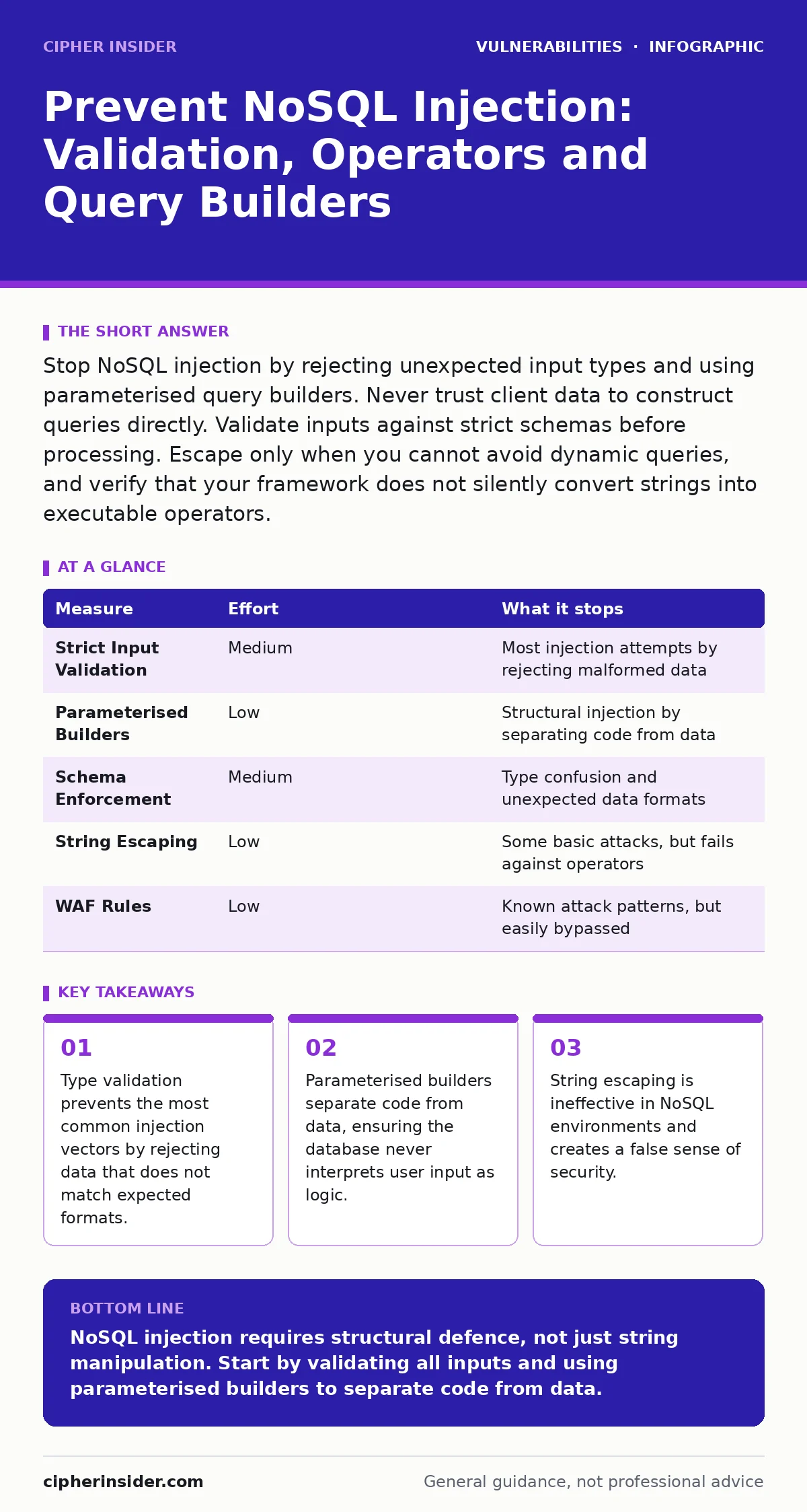
Stop NoSQL injection by rejecting unexpected input types and using parameterised query builders. Never trust client data to construct queries directly. Validate inputs against strict schemas before processing. Escape only when you cannot avoid dynamic queries, and verify that your framework does not silently convert strings into executable operators.
Why NoSQL Injection Differs from SQL
Traditional SQL injection relies on breaking out of a string literal to inject SQL commands. NoSQL databases like MongoDB use document-oriented queries that resemble JSON or JavaScript objects. When you insert user input directly into these objects, the database interprets special characters as operators rather than text.
Imagine a login form that checks credentials. If the input is treated as a document key, an attacker can inject logical operators. This allows them to bypass authentication without knowing the password. The mechanism differs from SQL because the injection happens at the object construction level, not just the string level.
The Failure of String Escaping
Many developers assume that escaping special characters prevents injection. This works for SQL because the database expects a specific string format. In NoSQL, the query engine evaluates the structure of the input object. Escaping a dollar sign or a bracket does not stop the database from recognising it as an operator.
Suppose you escape every special character in a user’s input. An attacker can still use simple values that match operator names. For example, inputting a specific string might be interpreted as a "not equal" operator. This makes escaping a dangerous reliance. It gives you confidence while leaving the application vulnerable to sophisticated attacks.
Input Validation as the First Line
The most effective defence is strict input validation. You must define exactly what data is acceptable for each field. If a field expects an email address, reject any input that does not match the email format. This removes the ability for an attacker to inject operators because their input is discarded before it reaches the database layer.
Validation should happen as early as possible in the request lifecycle. Use allowlists rather than blocklists. An allowlist specifies what is permitted, whereas a blocklist attempts to identify every possible threat. Attackers will always find new ways to bypass a blocklist. An allowlist is inherently more secure because it rejects anything that is not explicitly allowed.
This approach aligns with best practices for CWE weakness categories related to input validation. By treating all external input as untrusted, you reduce the attack surface significantly. This principle applies regardless of the database technology you use.
Using Parameterised Query Builders
When dynamic queries are necessary, use parameterised builders provided by your database driver. These builders separate the query structure from the data values. The driver ensures that the data is treated strictly as data, not as part of the query logic.
Imagine you need to search for a user by name. Instead of constructing a query string manually, you pass the name as a parameter to the builder. The builder handles the encoding and structure. This prevents the database from interpreting the input as an operator.
Many modern frameworks offer these builders by default. Ensure you are using the secure methods provided by the framework. Avoid methods that allow raw query construction. This is a critical step in maintaining security misconfigurations at a low level. Proper configuration of your ORM or query builder is often overlooked but vital for protection.
Schema Enforcement and Type Safety
NoSQL databases are often schema-less, which offers flexibility but increases risk. Enforcing a schema ensures that data types are consistent. If a field is defined as an integer, the database will reject string input. This prevents type confusion attacks that can lead to injection.
You can enforce schemas at the application level or within the database. Application-level enforcement is faster and catches errors before they reach the database. Database-level enforcement provides a second layer of defence. Using both creates a robust safety net.
This practice helps manage IT asset inventory by ensuring that data structures are predictable and documented. Predictable structures make it easier to audit and secure your application. It also simplifies the process of automatic software updates because the data format remains stable.
See also: XML External Entity Prevention Checklist for Secure Applications · Command Injection Explained: How Code Runs Outside Its Box
What Does Not Work
Several common measures are ineffective against NoSQL injection. Web application firewalls (WAFs) can catch known patterns but miss novel attacks. They rely on signatures that attackers can easily bypass. Relying solely on a WAF is a false sense of security.
Similarly, using dynamic application security testing (DAST) tools alone is insufficient. These tools can find some vulnerabilities but cannot cover all possible input combinations. They are a supplement to secure coding, not a replacement. You must build security into the code itself.
Practical Prevention Measures
The following table ranks prevention measures by their effectiveness and effort. Prioritise measures that remove the most risk with reasonable effort.
| Measure | Effort | What it stops |
|---|---|---|
| Strict Input Validation | Medium | Most injection attempts by rejecting malformed data |
| Parameterised Builders | Low | Structural injection by separating code from data |
| Schema Enforcement | Medium | Type confusion and unexpected data formats |
| String Escaping | Low | Some basic attacks, but fails against operators |
| WAF Rules | Low | Known attack patterns, but easily bypassed |
Focus on validation and builders first. These measures address the root cause of the vulnerability. Escaping and WAFs are secondary and should not be relied upon as primary defences.
Closing Checklist
Use this checklist to audit your application today. These steps address the most critical risks associated with NoSQL injection.
- Implement strict input validation for all user-facing fields.
- Replace manual query construction with parameterised builders.
- Review database schemas to enforce type consistency.
Key takeaways
- Type validation prevents the most common injection vectors by rejecting data that does not match expected formats.
- Parameterised builders separate code from data, ensuring the database never interprets user input as logic.
- String escaping is ineffective in NoSQL environments and creates a false sense of security.
NoSQL injection requires structural defence, not just string manipulation. Start by validating all inputs and using parameterised builders to separate code from data.
Frequently asked questions
Can I prevent NoSQL injection if I use an ORM?
Only if you use the ORM’s secure methods. Raw queries or unsafe methods in an ORM can still be vulnerable. Always verify that the ORM treats input as data, not code.
Is NoSQL injection only a risk for MongoDB?
No. Any NoSQL database that uses document-oriented queries or allows dynamic query construction is at risk. Couchbase and RethinkDB are also susceptible.
How do I test for NoSQL injection?
Use **dynamic application security testing (DAST)** tools that support NoSQL. However, manual testing with varied inputs is also necessary to find edge cases that tools might miss.
Does encryption prevent NoSQL injection?
No. Encryption protects data at rest and in transit but does not prevent the injection of malicious queries. The injection happens before the data is stored or transmitted.
How this guide was produced: written by the Cipher Insider editorial team with AI assistance, checked against the public references listed below, and reviewed when the facts change. See our editorial policy or report an error.