
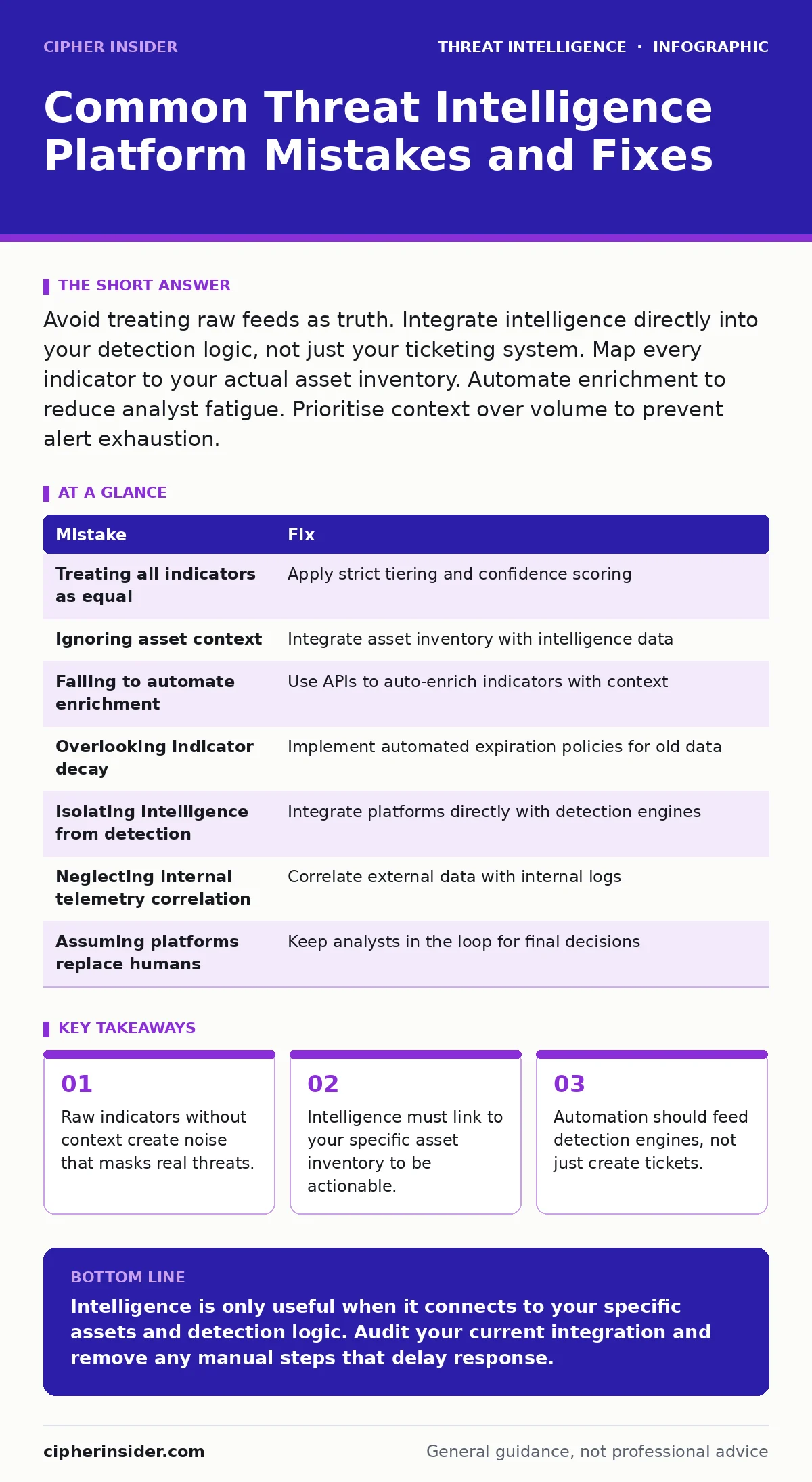
Avoid treating raw feeds as truth. Integrate intelligence directly into your detection logic, not just your ticketing system. Map every indicator to your actual asset inventory. Automate enrichment to reduce analyst fatigue. Prioritise context over volume to prevent alert exhaustion.
Mistake 1: Treating all indicators as equally valid
Not every indicator of compromise carries the same weight. A domain registered yesterday is less significant than a known command-and-control server observed in your network. Prioritising all data equally overwhelms your analysts.
Why it hurts:
Your team spends time investigating low-value noise. High-fidelity threats get buried under routine alerts. Analysts develop fatigue and miss critical signals because they cannot distinguish signal from noise.
The fix:
Apply a strict tiering system. Assign confidence scores to each intelligence source. Only investigate indicators that match your specific technology stack. Filter out generic malware hashes that do not apply to your operating systems.
Mistake 2: Ignoring asset context
Intelligence platforms often report threats against generic IP addresses or domains. Your environment contains specific servers, workstations and services. Without linking external data to your internal asset inventory, you cannot assess risk accurately.
Why it hurts:
You receive alerts for threats targeting software you do not use. You cannot determine if an indicator affects a critical production server or a decommissioned test machine. This leads to false positives and wasted investigation time.
The fix:
Integrate your asset management database with your intelligence platform. Tag every asset with its criticality, owner and software versions. When an indicator arrives, the platform should automatically check if it matches your active assets. This process reduces irrelevant alerts significantly.
Mistake 3: Failing to automate enrichment
Analysts manually looking up indicators in external databases is inefficient and slow. Modern platforms should enrich raw data automatically with context such as geolocation, reputation scores and associated malware families.
Why it hurts:
Manual lookup delays response times. Analysts spend hours gathering basic context instead of hunting for active threats. This bottleneck prevents your team from performing deeper analysis tasks like threat hunting.
The fix:
Configure your platform to automatically enrich indicators upon ingestion. Use APIs to pull in reputation data and historical context. Ensure this enriched data flows directly into your security information and event management system. This allows your detection rules to use richer context.
Mistake 4: Overlooking indicator decay
Indicators of compromise have a limited lifespan. Domains expire, IP addresses change and malware hashes become obsolete. Using stale data creates a false sense of security and clutter your detection rules.
Why it hurts:
Stale indicators trigger false positives. Your detection rules become bloated and slow. You may miss new variants because your rules are clogged with outdated signatures. This reduces the overall effectiveness of your defences.
The fix:
Implement an automated expiration policy for all indicators. Remove indicators that are older than your defined retention period. Regularly audit your intelligence database to remove redundant or outdated entries. This keeps your detection logic lean and accurate.
Mistake 5: Isolating intelligence from detection
Many organisations store threat intelligence in a separate platform from their detection engines. This siloed approach requires manual transfer of data, which is error-prone and slow.
Why it hurts:
There is a delay between receiving intelligence and deploying detection rules. Attackers can exploit this window. Analysts must manually translate intelligence into detection queries, which introduces human error and inconsistency.
The fix:
Integrate your intelligence platform directly with your detection engine. Use standard protocols like OpenC2 or STIX/TAXII to share data. Ensure that high-confidence indicators automatically create or update detection rules. This reduces the time from detection to response.
See also: Canary Token Mistakes: Why Your Traps Fail and How to Fix Them · Canary Tokens: Benefits, Limitations and When to Deploy Them
Mistake 6: Neglecting internal telemetry correlation
External intelligence is only half the picture. You must correlate external indicators with your internal logs to confirm compromise. Without this correlation, you cannot distinguish between a false positive and a real breach.
Why it hurts:
You may alert on an indicator that appears in your logs but is benign. Conversely, you may miss a real threat because the indicator was not present in your external feeds. This lack of correlation leads to both false alarms and missed detections.
The fix:
Correlate external intelligence with your internal log management system. Look for matches between external indicators and internal network traffic. Use this correlation to validate alerts before escalation. This ensures that your response efforts focus on confirmed threats.
Mistake 7: Assuming platforms replace human analysis
Threat intelligence platforms provide data, not decisions. They cannot understand the nuanced context of your business operations. Relying solely on automated alerts leads to rigid and often incorrect responses.
Why it hurts:
Automated systems lack the ability to assess business impact. They may flag a legitimate business transaction as malicious. This causes disruption to business operations and erodes trust in the security team.
The fix:
Use the platform to surface potential threats, but always involve human analysts in the final decision. Train your team to interpret the context behind the data. Encourage analysts to refine detection rules based on their findings. This human-in-the-loop approach ensures accuracy.
| Mistake | Fix |
|---|---|
| Treating all indicators as equal | Apply strict tiering and confidence scoring |
| Ignoring asset context | Integrate asset inventory with intelligence data |
| Failing to automate enrichment | Use APIs to auto-enrich indicators with context |
| Overlooking indicator decay | Implement automated expiration policies for old data |
| Isolating intelligence from detection | Integrate platforms directly with detection engines |
| Neglecting internal telemetry correlation | Correlate external data with internal logs |
| Assuming platforms replace humans | Keep analysts in the loop for final decisions |
Key takeaways
- Raw indicators without context create noise that masks real threats.
- Intelligence must link to your specific asset inventory to be actionable.
- Automation should feed detection engines, not just create tickets.
Intelligence is only useful when it connects to your specific assets and detection logic. Audit your current integration and remove any manual steps that delay response.
Frequently asked questions
How often should I update my threat intelligence feeds?
Update feeds in real-time if possible. Real-time updates ensure you have the latest indicators and reduce the window of exposure to new threats.
Can threat intelligence platforms detect zero-day attacks?
No. Zero-day exploits have no known indicators yet. Intelligence platforms rely on known data. Use behavioural detection and anomaly monitoring to catch unknown threats.
What is the best way to handle false positives?
Feed false positives back into your platform. Train your system to ignore similar patterns in the future. This improves the accuracy of your detection rules over time.
Should I use multiple intelligence sources?
Yes. Using multiple sources provides a broader view. However, you must deduplicate and prioritise the data to avoid overwhelming your analysts with redundant information.
How this guide was produced: written by the Cipher Insider editorial team with AI assistance, checked against the public references listed below, and reviewed when the facts change. See our editorial policy or report an error.