
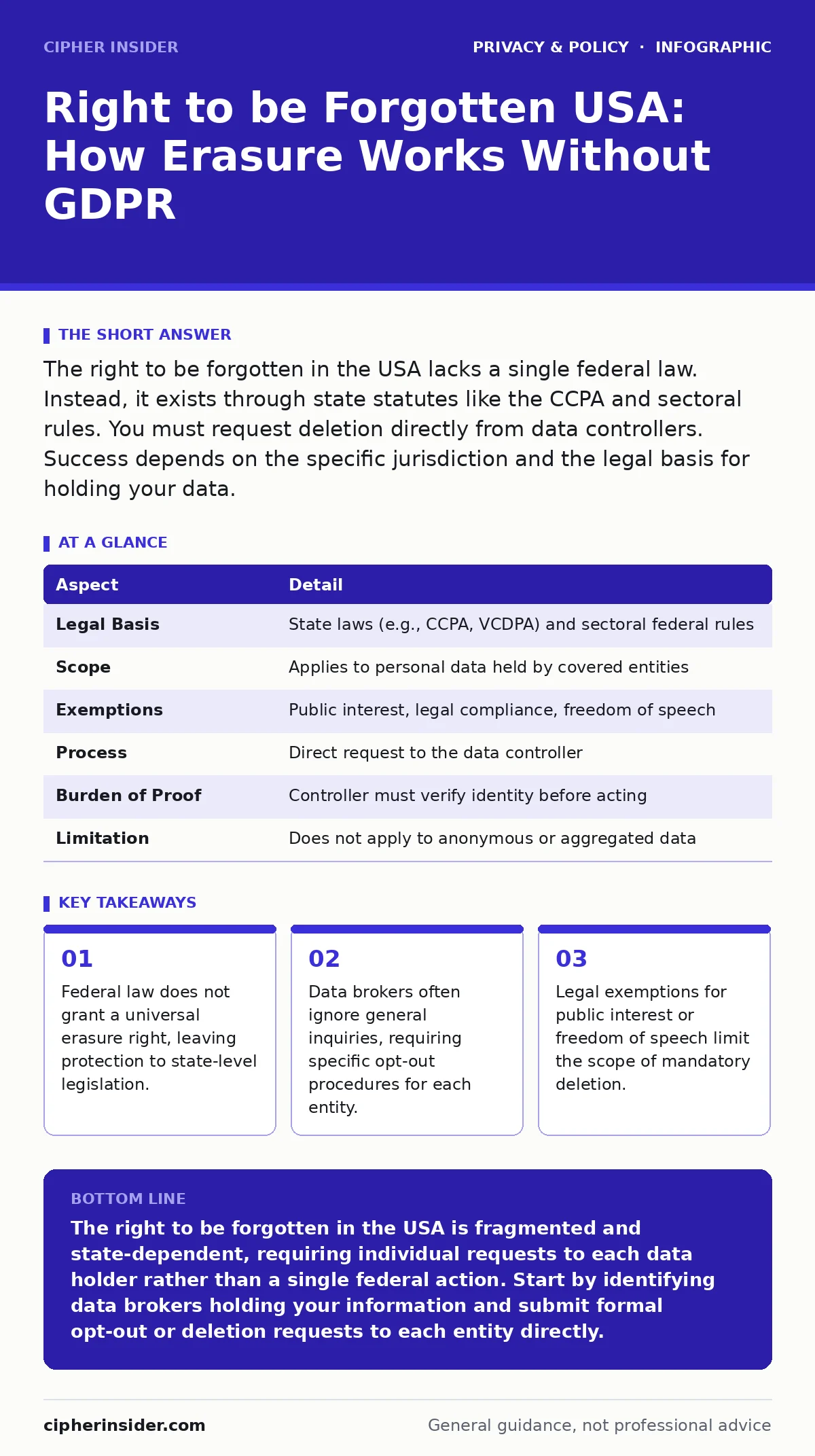
The right to be forgotten in the USA lacks a single federal law. Instead, it exists through state statutes like the CCPA and sectoral rules. You must request deletion directly from data controllers. Success depends on the specific jurisdiction and the legal basis for holding your data.
The Mechanics of Digital Erasure
Imagine a library that refuses to burn books but agrees to remove specific citations from its index. This analogy captures the nuance of the right to be forgotten. It is not an absolute right to obliterate history. It is a right to restrict the processing of personal data when it is no longer necessary or lawful. In the European Union, the General Data Protection Regulation mandates this erasure. In the United States, the mechanism differs significantly. There is no single federal statute that grants individuals the power to demand the deletion of their digital footprint across all platforms.
The concept relies on the distinction between data storage and data processing. Holding data is not inherently illegal. Processing data without a valid legal basis is. When you exercise this right, you are asking the data controller to cease processing and, where feasible, delete the stored information. The term "data controller" refers to the organisation that determines the purposes and means of processing personal data. They are the entity you must contact, not the server hosting the information.
| Aspect | Detail |
|---|---|
| Legal Basis | State laws (e.g., CCPA, VCDPA) and sectoral federal rules |
| Scope | Applies to personal data held by covered entities |
| Exemptions | Public interest, legal compliance, freedom of speech |
| Process | Direct request to the data controller |
| Burden of Proof | Controller must verify identity before acting |
| Limitation | Does not apply to anonymous or aggregated data |
Right to be Forgotten USA
People searching for the right to be forgotten USA often expect a single button to clear their internet history. The reality is more complex. The United States employs a sectoral approach to privacy. This means different laws apply to different types of data and industries. Health data falls under HIPAA. Financial data falls under GLBA. Education data falls under FERPA. None of these federal laws provide a broad, general right to erasure for all personal data. They only allow deletion or correction within their specific domains.
Consequently, the right to be forgotten in the USA is primarily a state-level right. States like California, Virginia, Colorado, and Utah have enacted comprehensive privacy laws. These laws grant consumers the right to delete personal information held by businesses. However, these laws only apply to businesses that meet certain thresholds, such as revenue or the volume of data processed. If a company does not meet these thresholds, you may have no legal recourse to demand deletion. This fragmentation creates a patchwork of rights. Your ability to erase your data depends entirely on where you live and where the company is based.
Who Holds Your Data
You cannot delete what you do not know exists. Most personal data is not held by the social media platforms you use daily. It is held by data brokers. These companies collect public records, purchase consumer lists, and aggregate behavioural data to build detailed profiles. They sell this information to advertisers, insurers, and political campaigns. Because data brokers operate in the shadows, they are often the hardest entities to engage.
Many people overlook the role of third-party processors. When you use a mobile app, the developer often shares your location or device ID with analytics providers. These providers become separate data controllers. You must request deletion from each entity individually. This is why understanding mobile app permission abuse is critical. Excessive permissions allow apps to harvest data that is then sold to brokers who do not respect your initial privacy settings. Identifying these secondary holders is the most difficult step in the erasure process.
How to Request Deletion
The process begins with identification. You must locate the privacy policy of the organisation holding your data. Look for sections labelled "Consumer Rights," "Data Deletion," or "Opt-Out." Most compliant organisations provide a web form or a dedicated email address for these requests. Do not use general customer support channels. They are not equipped to handle data subject requests.
You must verify your identity. The data controller will ask for proof that you are the person associated with the data. This usually involves providing a government-issued ID or answering security questions. This step protects against fraudulent deletion requests. However, it creates a privacy risk. You are submitting sensitive identification documents to the very company you are asking to delete your data. Ensure you send this information through a secure, encrypted channel.
- Locate the specific privacy request portal.
- Prepare proof of identity and residence.
- Submit the request clearly stating the legal basis (e.g., "CCPA Deletion Request").
- Keep a record of the submission date and confirmation number.
- Follow up if no response is received within the statutory period.
What People Usually Get Wrong
A common misconception is that the right to be forgotten applies to search engines. In the USA, search engines are generally protected by the First Amendment. They are not required to remove links to lawful public records or news articles simply because you dislike the content. The European Court of Justice ruled that search engines must delist certain links, but this precedent does not apply in the United States. You cannot force a search engine to erase a news story about your past legal troubles if the story is factual and publicly available.
Another error is assuming deletion is immediate. Organisations have statutory periods to respond, often ranging from 30 to 45 days. They may also extend this period if the request is complex. Furthermore, they are not required to delete data if it is necessary for legal compliance, contractual obligations, or public interest. If your data is part of a financial record required for tax purposes, they must retain it. The right to be forgotten is not a right to rewrite history. It is a right to stop unnecessary processing.
See also: What is online tracking: how data follows you and how to stop it · Differential Privacy Meaning: How Noise Protects Your Data
Navigating the Exceptions
Not all data is eligible for deletion. Organisations can refuse your request if the data is necessary for exercising the right of freedom of expression and information. This protects journalists and researchers. They can also refuse if retention is required by law. For example, banks must keep transaction records for a certain period to prevent money laundering. They cannot delete this data upon request.
Public bodies are often exempt from state privacy laws. If your data is held by a government agency, the right to be forgotten may not apply. You must instead use freedom of information laws to request redaction or correction. This distinction is vital. The mechanisms for dealing with private companies and public institutions are entirely different. Understanding this boundary prevents wasted effort and frustration.
The Role of Anonymity
Deletion is not the only path to privacy. Anonymisation removes the link between data and your identity. If data is truly anonymised, it is no longer considered personal data. The right to be forgotten does not apply to anonymous data. This is why differential privacy is gaining traction. This technique adds statistical noise to datasets, allowing for analysis without identifying individuals. It offers a technical solution to the privacy dilemma.
However, true anonymisation is difficult. Re-identification attacks can often link anonymous data back to individuals using other available datasets. Relying solely on anonymisation is risky. It is better to limit the collection of data in the first place. This is where online anonymity tools come into play. Using privacy-focused browsers and search engines reduces the amount of personal data collected, making erasure less necessary.
Next Steps for Protection
You cannot control all data collection. You can, however, minimise your exposure. Review your privacy settings on all major platforms. Disable location tracking and ad personalisation. Use unique passwords for each account to prevent credential stuffing attacks. Consider using a privacy-focused email provider for registrations.
If you are dealing with a large organisation, appointing data protection officers is a common practice for them, but for you, the equivalent is vigilance. Monitor your credit reports and online presence regularly. If you discover data brokers holding your information, submit opt-out requests immediately. Do not wait for a data breach to act. Proactive management of your digital footprint is the most effective form of privacy protection.
Key takeaways
- Federal law does not grant a universal erasure right, leaving protection to state-level legislation.
- Data brokers often ignore general inquiries, requiring specific opt-out procedures for each entity.
- Legal exemptions for public interest or freedom of speech limit the scope of mandatory deletion.
The right to be forgotten in the USA is fragmented and state-dependent, requiring individual requests to each data holder rather than a single federal action. Start by identifying data brokers holding your information and submit formal opt-out or deletion requests to each entity directly.
Frequently asked questions
Does the right to be forgotten apply to my employer?
Generally, state privacy laws exempt employee data or require separate employee-specific provisions. Check your state's specific labour and privacy regulations for details on workplace data retention.
Can I delete my data from a government website?
Government agencies are usually exempt from state consumer privacy laws. You must use freedom of information requests or specific agency procedures to request redaction or correction of public records.
What happens if a company ignores my deletion request?
You can file a complaint with your state's attorney general. Some state laws allow for private lawsuits if the company fails to comply, but this is rare and legally complex.
Does deleting my data remove it from search engines?
No. Search engines in the USA are not required to remove links to lawful public content. You can request de-indexing in specific circumstances, but success is not guaranteed and varies by platform.
How this guide was produced: written by the Cipher Insider editorial team with AI assistance, checked against the public references listed below, and reviewed when the facts change. See our editorial policy or report an error.