
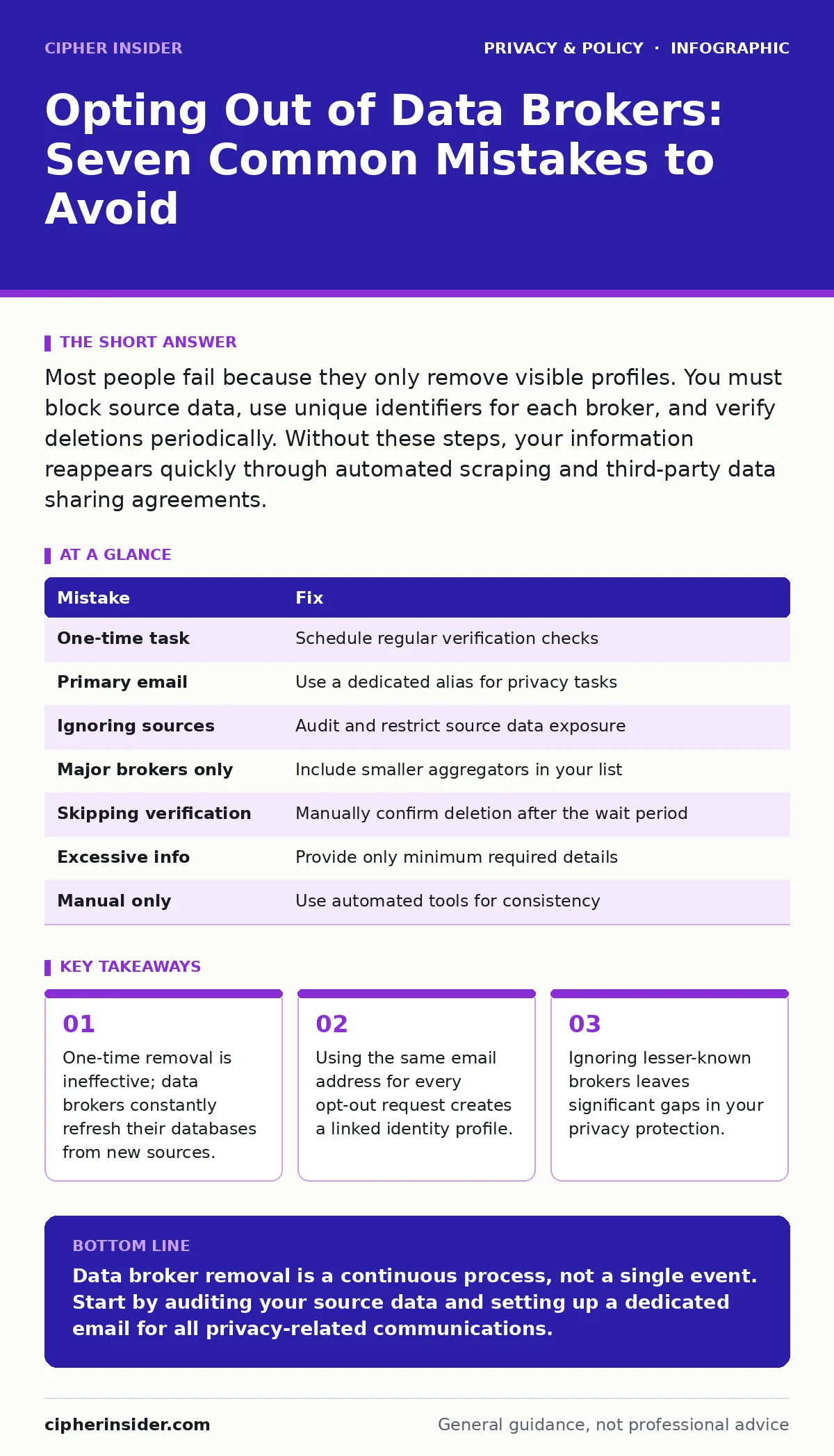
Most people fail because they only remove visible profiles. You must block source data, use unique identifiers for each broker, and verify deletions periodically. Without these steps, your information reappears quickly through automated scraping and third-party data sharing agreements.
Mistake 1: Treating Opt-Out as a One-Off Task
Why it hurts: Data brokers operate on continuous ingestion cycles. They scrape public records, social media, and other aggregators daily. When you remove your data, the broker’s automated systems will likely repopulate your profile within days or weeks when they pull from a new source. Your effort vanishes because the underlying data flow remains active.
The fix: Schedule regular verification checks. Set a calendar reminder to review major brokers every three to six months. If a profile reappears, submit a new removal request immediately. Consistency matters more than intensity. You are managing a process, not completing a task.
Mistake 2: Using Your Primary Email Address for Removals
Why it hurts: Every opt-out form is a data collection point. When you use your primary email, you link your real identity to your interest in privacy. Brokers may use this confirmation to enrich your profile, noting that you actively manage your digital footprint. This creates a paradox where removing data generates new data points.
The fix: Create a dedicated email alias for privacy tasks. Use a secondary address that you do not use for banking, social media, or work. This isolates your privacy efforts from your primary identity. It prevents brokers from cross-referencing your opt-out activity with other datasets.
Mistake 3: Ignoring the Source Data
Why it hurts: Brokers do not invent data; they aggregate it. If your address, phone number, or email appear on public court records, professional networking sites, or company directories, brokers will find them again. Removing the broker’s profile does not stop the source from leaking your information. You are mopping the floor while the tap remains running.
The fix: Audit where your personal information originates. Check public records portals and professional networks for exposed details. Remove or restrict access to your data at the source where possible. This reduces the volume of new data available for brokers to scrape. For deeper context on how these networks operate, see our guide on data brokers.
Mistake 4: Focusing Only on Major Brokers
Why it hurts: The largest brokers receive the most attention, but hundreds of smaller aggregators exist. These niche brokers often specialise in specific data types, such as asset ownership, criminal records, or email harvesting. They may not have user-friendly opt-out portals, making them harder to remove. Ignoring them leaves significant gaps in your privacy coverage.
The fix: Maintain a list of known brokers, including smaller ones. Check for new entrants regularly. Use automated tools that scan for your information across multiple platforms simultaneously. Manual searches are insufficient for the sheer volume of aggregators. Prioritise brokers that share data with advertising networks.
Mistake 5: Skipping the Verification Step
Why it hurts: Many brokers confirm receipt of your opt-out request but do not actually delete your data. Some provide a temporary suppression that expires. Without verification, you assume deletion occurred. This false sense of security allows your data to remain accessible to advertisers and other third parties.
The fix: Search for your name and details on the broker’s site after the claimed deletion period. Use different search queries, such as your phone number or address. If your data persists, escalate the request or use legal mechanisms available in your jurisdiction. Do not rely on confirmation emails alone.
See also: Tor Browser Explained: Routing, Relays, and Real Anonymity · End-to-end encryption mechanics explained clearly
Mistake 6: Providing Excessive Personal Information
Why it hurts: Opt-out forms often ask for more data than necessary, such as your full date of birth or mother’s maiden name. Providing this information helps brokers verify your identity but also enriches their database with sensitive details. You are trading privacy for convenience. The more you share, the more accurate and valuable your profile becomes to buyers.
The fix: Provide only the minimum required information to identify your profile. Usually, this is your name and the URL of the profile you wish to remove. Avoid answering optional questions. If the form requires excessive data to proceed, consider whether the broker is acting in good faith.
Mistake 7: Relying Solely on Manual Removal
Why it hurts: Manual removal is time-consuming and prone to error. You may miss steps, use the wrong form, or forget to follow up. The volume of brokers makes this approach unsustainable for most individuals. Fatigue leads to incomplete efforts, leaving your data exposed.
The fix: Consider automated opt-out services that handle the submission and verification process. These tools maintain updated lists of brokers and submit requests on your behalf. They reduce the administrative burden and increase consistency. Ensure the service itself adheres to strict privacy standards.
| Mistake | Fix |
|---|---|
| One-time task | Schedule regular verification checks |
| Primary email | Use a dedicated alias for privacy tasks |
| Ignoring sources | Audit and restrict source data exposure |
| Major brokers only | Include smaller aggregators in your list |
| Skipping verification | Manually confirm deletion after the wait period |
| Excessive info | Provide only minimum required details |
| Manual only | Use automated tools for consistency |
Key takeaways
- One-time removal is ineffective; data brokers constantly refresh their databases from new sources.
- Using the same email address for every opt-out request creates a linked identity profile.
- Ignoring lesser-known brokers leaves significant gaps in your privacy protection.
Data broker removal is a continuous process, not a single event. Start by auditing your source data and setting up a dedicated email for all privacy-related communications.
Frequently asked questions
Can I legally stop data brokers from collecting my information?
Laws vary by jurisdiction. Some regions grant you the right to opt-out of the sale of your data, while others do not. Check local privacy regulations for specific rights and procedures.
How long does it take for data to disappear after opting out?
It varies by broker. Some delete data within days, while others take weeks. Always verify the deletion manually after the stated period to ensure compliance.
Do opt-out requests affect my credit score?
No. Data brokers are separate from credit bureaus. Opting out of people-search sites does not impact your credit history or scoring models.
Should I use a pseudonym for online activities?
Using a pseudonym can reduce the amount of real data linked to your identity. It adds a layer of separation between your online actions and your legal name. For more strategies, see our guide on pseudonymization.
How this guide was produced: written by the Cipher Insider editorial team with AI assistance, checked against the public references listed below, and reviewed when the facts change. See our editorial policy or report an error.