
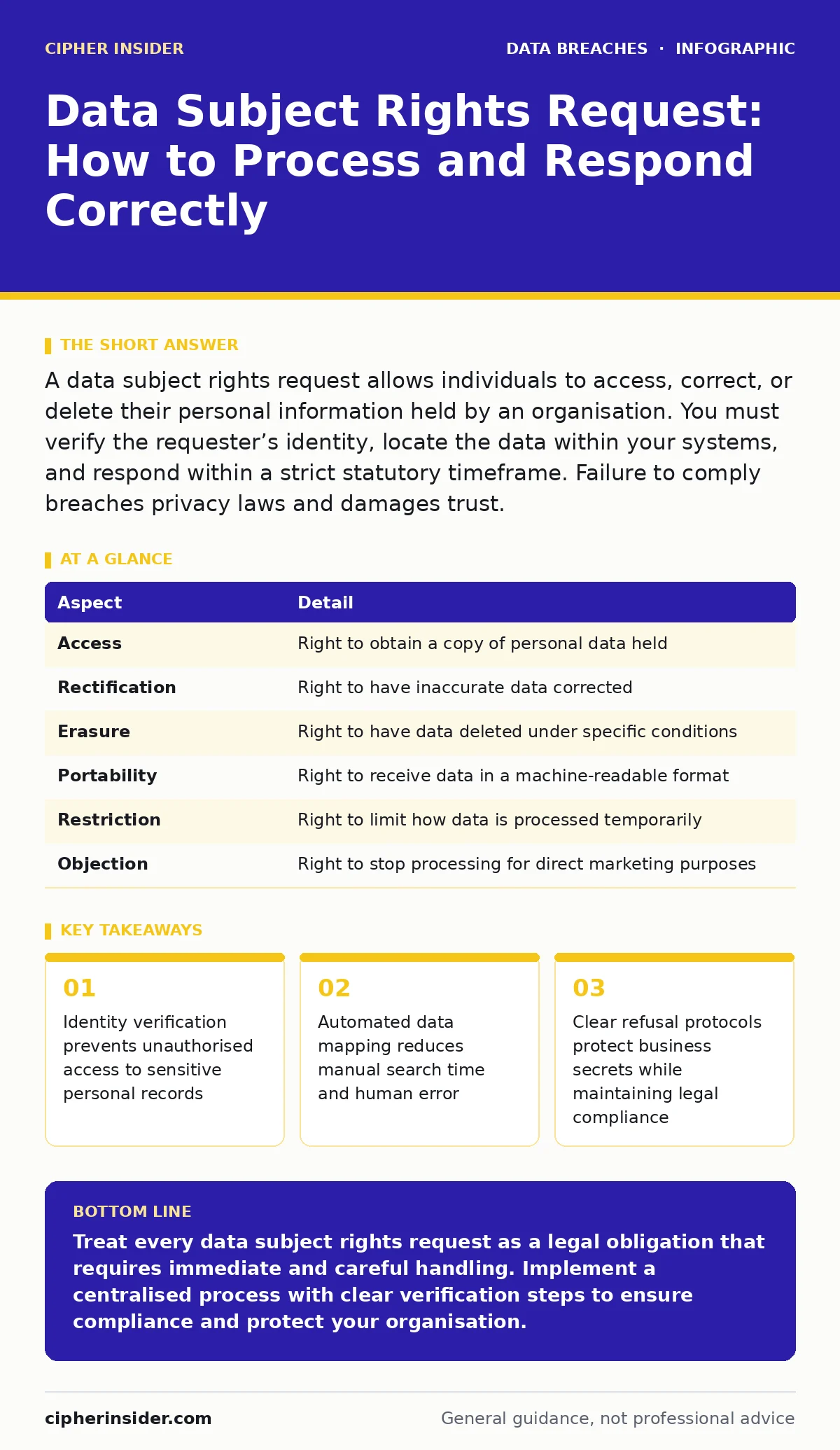
A data subject rights request allows individuals to access, correct, or delete their personal information held by an organisation. You must verify the requester’s identity, locate the data within your systems, and respond within a strict statutory timeframe. Failure to comply breaches privacy laws and damages trust.
The Library Analogy for Personal Data
Imagine a library where every book belongs to a specific patron. When a patron asks to see their books, the librarian must find every copy, check out the patron’s identity, and hand them the volumes. If the patron asks for their books to be burned, the librarian must destroy every copy, including those in the archive or loaned to others. This analogy mirrors how organisations handle personal data. The organisation is the librarian, the data is the book, and the individual is the patron. The process is not about hiding information but about managing ownership and access rights.
What Is a Data Subject Rights Request
A data subject rights request is a formal demand from an individual for an organisation to exercise their legal rights over personal data. These rights typically include access, rectification, erasure, restriction of processing, data portability, and objection to processing. The request triggers a legal obligation for the data controller to act. The controller is the entity that determines why and how personal data is processed. The request does not require the individual to use specific legal terminology. A simple email stating "delete my data" can constitute a valid request if the intent is clear.
| Aspect | Detail |
|---|---|
| Access | Right to obtain a copy of personal data held |
| Rectification | Right to have inaccurate data corrected |
| Erasure | Right to have data deleted under specific conditions |
| Portability | Right to receive data in a machine-readable format |
| Restriction | Right to limit how data is processed temporarily |
| Objection | Right to stop processing for direct marketing purposes |
How the Request Mechanism Works
The mechanism begins when an individual submits a request. The organisation must log the request immediately to start the statutory clock. The first step is identity verification. You must ensure the person making the request is the data subject. This prevents identity theft and unauthorised data disclosure. If the request is complex or involves large volumes of data, the timeframe may extend. However, you must inform the requester of any delay and the reason for it. The organisation must then search all systems where the data might reside. This includes active databases, email servers, and backup tapes.
Who Is Affected by These Requests
Any organisation that processes personal data of individuals within a specific jurisdiction is affected. This includes small businesses, non-profits, and large corporations. The scope extends to third-party processors who handle data on behalf of the controller. If you outsource customer support or cloud storage, those vendors are part of the chain. The request may require you to coordinate with multiple parties. This coordination adds complexity and time. You must have clear contracts with vendors that specify their obligations in such scenarios. This relates directly to how you conduct third-party risk assessments.
Common Mistakes in Handling Requests
Many organisations fail because they do not map their data flows. They assume data is only in the main database. In reality, data exists in spreadsheets, local hard drives, and archived emails. Another common error is ignoring informal requests. A request does not need to be in a specific format. If an individual asks for their data in a chat window, it is still a valid request. Failing to respond within the deadline is a direct violation. Some organisations try to refuse requests based on minor inconveniences. Refusal is only valid under specific legal exemptions, such as national security or vital interests.
See also: What is online tracking: how data follows you and how to stop it · Differential Privacy Meaning: How Noise Protects Your Data
What to Do About Incoming Requests
Start by building a central intake point for all requests. This could be a dedicated email address or a web form. Train all staff to recognise a request and forward it to the privacy team. Develop a standard operating procedure for each type of right. For access requests, create a template response that includes the required disclosures. For erasure requests, define the technical steps to delete data from all systems. Test these procedures regularly. Simulate a request to identify gaps in your process. Ensure your data retention policies align with your ability to erase data. If you keep data longer than necessary, you increase the risk of non-compliance.
Balancing Rights with Business Needs
Organisations often worry that granting rights will disrupt operations. For example, deleting a customer’s data might break a financial record required for tax purposes. In such cases, you can refuse the erasure request based on legal obligations. You must document this refusal and explain it to the requester. Another concern is the cost of fulfilling requests.
While you cannot charge a fee for most requests, you can refuse manifestly unfounded or excessive requests. This requires careful assessment. You must prove that the request is repetitive or unreasonable. This balance protects your business while respecting individual rights. It also helps mitigate risks associated with data scraping by limiting the amount of data available to bad actors.
Building a Sustainable Process
Sustainability comes from automation and clear documentation. Use software tools to tag and locate personal data. This reduces the manual effort required for each request. Document every step of the process, from receipt to resolution. This documentation serves as evidence of compliance in case of an audit. Review your processes annually. Laws and technologies change, and your procedures must adapt. Engage with your legal team to ensure your interpretations are current. A well-defined process reduces stress on staff and ensures consistent outcomes. It also demonstrates a commitment to privacy, which can enhance your reputation.
Key takeaways
- Identity verification prevents unauthorised access to sensitive personal records
- Automated data mapping reduces manual search time and human error
- Clear refusal protocols protect business secrets while maintaining legal compliance
Treat every data subject rights request as a legal obligation that requires immediate and careful handling. Implement a centralised process with clear verification steps to ensure compliance and protect your organisation.
Frequently asked questions
How long do I have to respond to a data subject rights request?
You generally have one month to respond. This period can be extended by two additional months for complex requests, provided you inform the requester within the first month.
Can I charge a fee for processing a data subject rights request?
No, you cannot charge a fee for standard requests. You may charge a reasonable fee for manifestly unfounded or excessive requests, particularly if they are repetitive.
What if the requester is not the data subject?
You must verify the identity of the requester. If they cannot prove they are the data subject or have legal authority to act on their behalf, you must refuse the request.
Do I need to delete data from backups immediately?
Immediate deletion from backups is often technically impossible. You must ensure that the data is rendered inaccessible and is overwritten in the next normal backup cycle.
How this guide was produced: written by the Cipher Insider editorial team with AI assistance, checked against the public references listed below, and reviewed when the facts change. See our editorial policy or report an error.