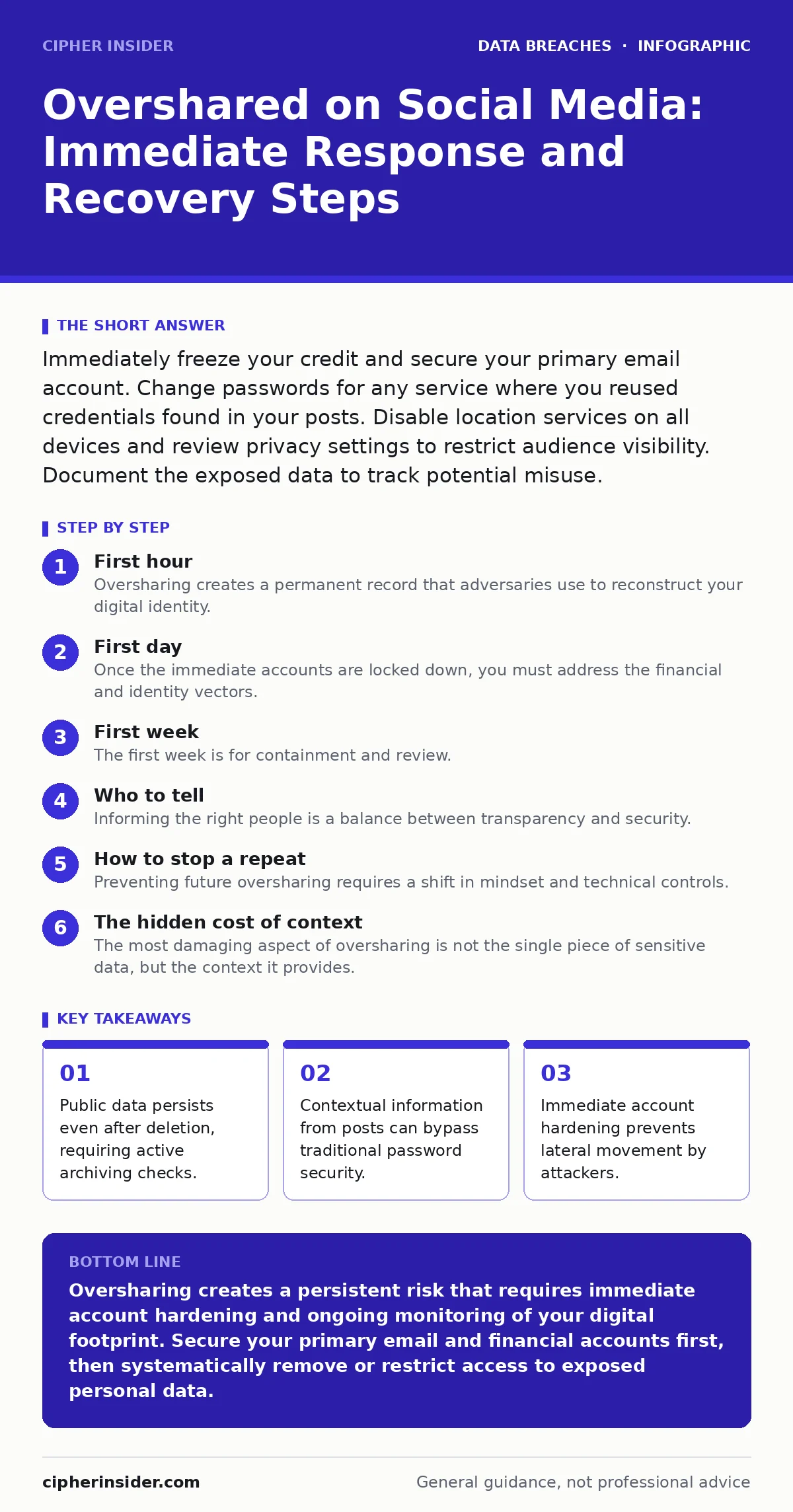
Immediately freeze your credit and secure your primary email account. Change passwords for any service where you reused credentials found in your posts. Disable location services on all devices and review privacy settings to restrict audience visibility. Document the exposed data to track potential misuse.
First hour
Oversharing creates a permanent record that adversaries use to reconstruct your digital identity. The goal in this initial phase is not to erase the past, but to stop the bleeding of new information and secure the accounts linked to the exposed data. You must act before the data is indexed or scraped by automated tools.
- Secure your primary email account immediately.
- Enable hardware-based multi-factor authentication where possible.
- Delete the specific posts containing sensitive information.
- Disable location services on all connected devices.
- Screenshot the exposed content for your own records.
Your primary email account is the key to resetting passwords for every other service you use. If an attacker gains access to your email, they can reset your banking, social media, and work credentials. Change the password to a unique, complex string that you have not used elsewhere. If you rely on SMS for two-factor authentication, switch to an authenticator app or a security key. SMS interception is a common vector for account takeover, and your phone number may already be visible in your public profile.
First day
Once the immediate accounts are locked down, you must address the financial and identity vectors. Attackers often use social media data to answer security questions or verify identity with support teams. This is known as social engineering, where human psychology is exploited to gain unauthorized access.
Check your credit reports with the major bureaus. Place a fraud alert or a credit freeze on your files. A fraud alert requires lenders to verify your identity before issuing new credit, adding a layer of friction for attackers. A credit freeze prevents new accounts from being opened entirely, which is more secure but requires you to temporarily lift the freeze when you need to apply for credit yourself.
Review the content you shared. Did you post photos of your home interior? Attackers can identify high-value items or security systems from these images. Did you share your workplace logo or badge? This information helps attackers tailor phishing emails that appear to come from your colleagues or IT department. This technique is known as spear phishing, where the attacker uses specific details to increase the likelihood of the victim trusting the message.
If you shared sensitive documents, such as a utility bill or a passport, you must assume that data is compromised. Do not wait for signs of misuse. Proactively contact the issuing authorities to report the potential exposure. This step is critical for preventing child identity theft, as parents often inadvertently share photos of birth certificates or school records.
First week
The first week is for containment and review. You need to ensure that the data has not spread to other platforms or data brokers. Social media platforms often share data with third-party services for advertising or analytics purposes. This is a form of data scraping, where automated tools collect public information to build detailed profiles.
Audit your privacy settings on all social media accounts. Restrict who can see your posts, tag you, or find you via your email address or phone number. Turn off features that allow location tagging on photos. Even if you delete the tag, the metadata may remain in the file if it has been downloaded by others.
Check for credential leaks. If you used the same password for your social media account as you did for your email or banking, assume those accounts are compromised. Change those passwords immediately. Use a password manager to generate unique passwords for each service. This prevents a single breach from cascading across your entire digital life.
Who to tell
Informing the right people is a balance between transparency and security. You do not need to announce the oversharing to the world, but you should alert individuals who might be targeted using your information.
Notify your employer if you shared work-related information, such as internal processes, client names, or office layouts. This helps your security team monitor for potential phishing attempts or physical security risks. They may need to update their third-party risk assessments to account for the new exposure.
Tell your family members if you shared their information or images. They should also review their own privacy settings and monitor their accounts for unusual activity. If you shared financial documents, inform your bank or credit card issuer. They can place additional monitoring on your accounts or issue new cards to prevent payment card theft.
How to stop a repeat
Preventing future oversharing requires a shift in mindset and technical controls. Treat every post as if it will be public forever, even if you set it to "private." Screenshots and data exports can bypass these restrictions.
Implement a delay before posting. Use a draft folder to review content after a night's sleep. Ask yourself what information a stranger could infer from this post. Could they guess your home address? Your daily routine? Your security questions?
Use tools that strip metadata from images before uploading. Metadata is hidden data within a file that can include GPS coordinates, device information, and timestamps. Many smartphones do this automatically, but it is worth verifying.
Regularly audit your digital footprint. Search for your name and key identifiers quarterly. Remove outdated or unnecessary information. This reduces the amount of data available for attackers to piece together.
See also: What is online tracking: how data follows you and how to stop it · Differential Privacy Meaning: How Noise Protects Your Data
The hidden cost of context
The most damaging aspect of oversharing is not the single piece of sensitive data, but the context it provides. A single password is hard to crack. A password combined with your dog's name, your mother's maiden name, and your high school mascot is trivial. This is why security questions are often ineffective.
Attackers build a profile over time. They collect small pieces of information from various posts to create a comprehensive picture of your life. This profile allows them to bypass multi-factor authentication, which relies on something you know (password), something you have (phone), and something you are (biometric). If they know your habits and preferences, they can manipulate the "something you know" factor.
Imagine you post a photo of your new car. An attacker sees the make, model, and license plate. They cross-reference this with public vehicle registration data to find your address. They then use your address to answer security questions for your bank account. This chain of inference is how oversharing leads to significant financial loss.
Long-term resilience
Recovery from oversharing is an ongoing process. You cannot fully erase digital data, but you can control its accessibility and impact. Regularly update your security software and keep your devices patched. This protects against malware that could steal your credentials directly.
Educate yourself on the latest social engineering tactics. Attackers constantly evolve their methods to exploit human trust. By understanding how they operate, you can better recognize and resist their attempts.
Consider using a separate email address for social media accounts. This isolates your social identity from your primary professional and financial accounts. If the social media email is compromised, the attacker has limited access to your other services.
Monitor your financial statements and credit reports regularly. Look for small, unauthorized charges that could indicate a larger breach. Report any suspicious activity immediately. Early detection limits the damage and speeds up recovery.
Key takeaways
- Public data persists even after deletion, requiring active archiving checks.
- Contextual information from posts can bypass traditional password security.
- Immediate account hardening prevents lateral movement by attackers.
Oversharing creates a persistent risk that requires immediate account hardening and ongoing monitoring of your digital footprint. Secure your primary email and financial accounts first, then systematically remove or restrict access to exposed personal data.
Frequently asked questions
Can I completely delete my social media history?
No, deleted content may remain in backups, caches, or screenshots taken by others. Focus on restricting future access and monitoring for misuse.
Should I change all my passwords after oversharing?
Change passwords for any account where you used the same credentials as your social media accounts. Use unique passwords for all other services as a best practice.
How do I know if my data was scraped?
Search for your personal information online. If you find your data on unknown websites or data broker sites, it has likely been scraped. Request removal where possible.
Is a credit freeze enough protection?
A credit freeze prevents new accounts from being opened, but it does not protect existing accounts from fraud. Combine it with regular monitoring and multi-factor authentication.
How this guide was produced: written by the Cipher Insider editorial team with AI assistance, checked against the public references listed below, and reviewed when the facts change. See our editorial policy or report an error.