
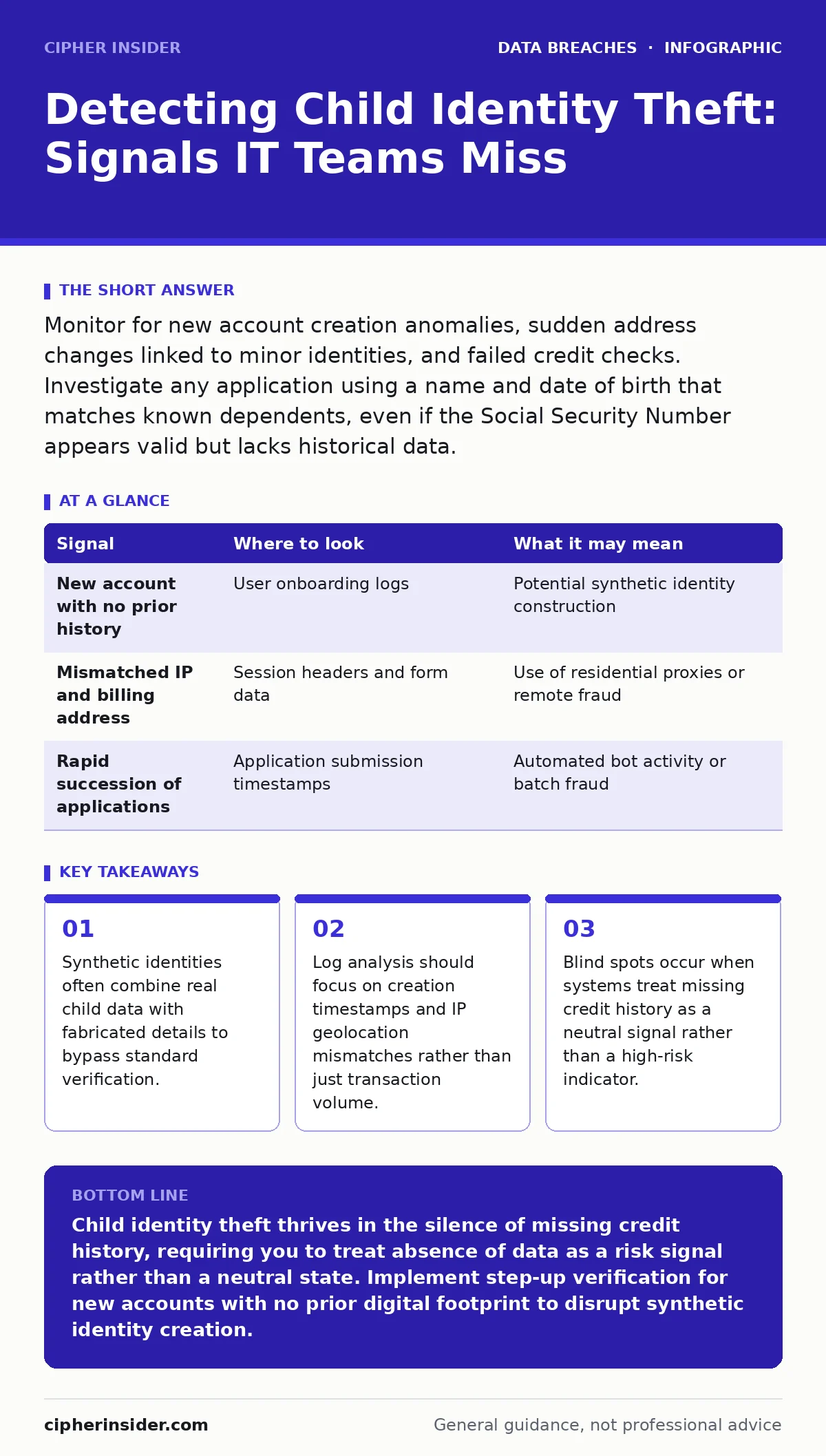
Monitor for new account creation anomalies, sudden address changes linked to minor identities, and failed credit checks. Investigate any application using a name and date of birth that matches known dependents, even if the Social Security Number appears valid but lacks historical data.
The Synthetic Identity Trap
Child identity theft rarely involves immediate financial drain. Instead, fraudsters use the stolen data to construct synthetic identities. These profiles mix genuine information, such as a child’s name and date of birth, with fabricated elements like a fake address or a generated phone number. The goal is not to spend money today but to establish a credit history over years.
You must understand that a clean record is not always innocent. In the world of financial crime, a total lack of history can be more suspicious than a modest one. This approach exploits the patience of automated underwriting systems that reward length of account tenure.
Initial Account Creation Signals
The first point of failure for detection is usually the application stage. Look for applications submitted from devices or IP addresses that do not match the stated residence. Fraudsters often use residential proxies to mask their true location. These proxies route traffic through ordinary homes, making the source appear legitimate to basic geo-IP checks.
Check the timestamp of the application. If an account is created late at night from a region thousands of miles away from the claimed address, flag it for manual review. Automated systems often accept these applications because the data fields themselves are syntactically correct.
| Signal | Where to look | What it may mean |
|---|---|---|
| New account with no prior history | User onboarding logs | Potential synthetic identity construction |
| Mismatched IP and billing address | Session headers and form data | Use of residential proxies or remote fraud |
| Rapid succession of applications | Application submission timestamps | Automated bot activity or batch fraud |
Verification System Gaps
Many verification tools rely on third-party databases to confirm identity. These databases may not contain records for minors. When a system receives a "no record found" response, it often defaults to a neutral or positive state if other data points align. This is a critical design flaw.
You should configure your systems to treat "no record" as a distinct risk category, not a blank slate. If the applicant claims to be an adult but the database returns no history for that Social Security Number or national ID, the system should trigger a secondary verification step. This step might require government-issued photo identification that matches the facial features in real-time.
Behavioural Anomalies in Usage
Once an account is open, the behaviour patterns differ from typical users. Fraudsters may make small, regular transactions to build a positive payment history. These transactions are often just below the threshold that triggers manual review. They might purchase low-cost digital goods or subscription services that do not require immediate physical delivery.
Monitor for changes in contact information shortly after account creation. A sudden update to a different zip code or phone number area code can indicate that the fraudster is moving the identity to a new jurisdiction. This movement helps them avoid detection if the original data source is compromised or flagged.
Log Analysis for IT Teams
For security operations centres, the evidence lies in the metadata. Examine the user-agent strings in your web server logs. Look for inconsistencies between the declared device type and the actual browser capabilities. Fraudsters often use headless browsers or automated scripts that leave subtle traces in the HTTP headers.
Correlate login attempts with account creation events. If a single IP address is associated with multiple new accounts using different personal details, investigate the pattern. Even if the names and dates of birth differ, the digital fingerprint of the device may remain constant. This technique is common in credential leaks where attackers test batches of stolen data.
The Role of Social Data
Fraudsters harvest personal details from public sources before constructing their synthetic identities. This data scraping allows them to fill out application forms with high accuracy. They may find a child’s name and birthdate in public records, school newsletters, or family social media posts.
You cannot stop the initial theft of this data, but you can detect its misuse. Cross-reference new account details against known public records if your compliance framework allows. If the data matches a public profile that lists a minor, the application should be rejected immediately. This links back to the risks of oversharing on social media, where families inadvertently provide the building blocks for these crimes.
Common Blind Spots
One major blind spot is the assumption that financial institutions are the only targets. Child identity theft also affects healthcare and educational records. Attackers may use stolen identities to obtain fraudulent prescriptions or access student loan programs. These sectors often have weaker identity verification controls than banking systems.
Another blind spot is the reliance on static data. If your system only checks the name and date of birth, it misses the context. You must evaluate the relationship between data points. A name that matches a known minor in a public database should trigger an alert, even if the rest of the application appears valid. This is similar to database exposure, where incomplete data sets lead to false assumptions about safety.
Integrating Detection Strategies
Effective detection requires a layered approach. Combine real-time monitoring with periodic audits. Review accounts that have been dormant for long periods and suddenly become active. This "sleeping" behaviour is a hallmark of synthetic identity fraud, where the attacker waits for the credit history to mature before extracting value.
Collaborate with third-party risk assessments to ensure your vendors are not inadvertently facilitating this theft. If your service relies on external identity providers, verify that they have robust checks in place for synthetic profiles. This protects your organisation from liability if a fraudster uses your platform to launder a stolen identity.
Key takeaways
- Synthetic identities often combine real child data with fabricated details to bypass standard verification.
- Log analysis should focus on creation timestamps and IP geolocation mismatches rather than just transaction volume.
- Blind spots occur when systems treat missing credit history as a neutral signal rather than a high-risk indicator.
Child identity theft thrives in the silence of missing credit history, requiring you to treat absence of data as a risk signal rather than a neutral state. Implement step-up verification for new accounts with no prior digital footprint to disrupt synthetic identity creation.
Frequently asked questions
How do I distinguish between a genuine new user and a synthetic identity?
Genuine new users often have some peripheral digital footprint or consistent behavioural patterns. Synthetic identities typically lack any history and may exhibit automated or inconsistent interaction patterns.
What is the first sign of child identity theft in logs?
The first sign is often a new account creation with a mismatch between the IP location and the stated address, combined with a lack of prior historical data for the provided identity details.
Can I detect child identity theft without credit bureau access?
Yes, by analysing behavioural anomalies, IP geolocation mismatches, and cross-referencing application data against public records or internal databases of known dependents.
Why do standard fraud detection tools miss child identity theft?
Standard tools often flag high-risk behaviour like large transactions. Child identity theft involves small, gradual actions to build history, which appears benign to traditional rule-based systems.
How this guide was produced: written by the Cipher Insider editorial team with AI assistance, checked against the public references listed below, and reviewed when the facts change. See our editorial policy or report an error.