
Data scraping involves automated tools that systematically request and extract information from websites or APIs. Attackers bypass rate limits, parse the returned code, and store the data. You can interrupt this process by implementing behavioural analysis, challenging automated requests, and limiting the volume of data exposed through public endpoints.
The Foundation of Exposure
Data scraping relies on the fundamental design of the web: information is served to a client for display. When you publish a product page, a directory listing, or a user profile, you are transmitting structured data to a browser. The browser renders this into a visual interface, but the underlying code remains accessible. Attackers do not need to hack your server to access this information. They simply request the same files your users do, but at a scale and speed that humans cannot match.
This method exploits the trust inherent in public-facing applications. Unlike a direct server-side attack, scraping respects the application’s permission model. If a user can see the data, a scraper can see it too. The distinction lies in the volume and the intent. This dynamic creates a specific risk profile where the defence must focus on behaviour rather than just authentication. See how database exposure differs from this surface-level extraction, as the latter does not require backend access.
### Stage 1: Reconnaissance and Target Selection
The process begins with identification. An attacker selects a target based on the value of the data it holds. E-commerce sites, real estate listings, and professional networks are common targets because they contain large volumes of structured, high-value information. The attacker maps the site’s structure to understand how data is organised. They look for predictable URL patterns, such as /product/123 or /user/456.
This stage relies on the predictability of web design. Consistent naming conventions make it easy to generate thousands of valid requests. If your site uses sequential IDs, an attacker can iterate through them without needing a directory. The flaw here is architectural. By making the resource location guessable, you reduce the effort required to harvest the data. This is not a security bug in the traditional sense, but a design choice that facilitates automation.
### Stage 2: Request Generation and Obfuscation
Once the target is mapped, the scraper begins sending requests. To avoid immediate detection, the tool must mimic a legitimate user. It rotates IP addresses using proxy networks to distribute the load across many sources. It also modifies the HTTP headers to match those of common browsers, including user-agent strings and language preferences.
This stage exploits the difficulty of distinguishing humans from machines. Most basic defences check for known bot signatures or block requests from data centre IP ranges. Sophisticated scrapers use residential proxies, which route traffic through real user devices, making the source appear legitimate. The trade-off for the attacker is cost and complexity, but the result is a stream of requests that look identical to normal traffic. This is where many organisations fail to detect the intrusion.
### Stage 3: Parsing and Extraction
The server responds to the requests with HTML, JSON, or XML. The scraper receives this raw data and parses it to extract specific fields. It does not care about the visual layout. It uses selectors or regular expressions to find the price, the description, or the contact details. This process is highly efficient and can be tuned to ignore irrelevant content.
The reliance here is on the structure of the response. If your API returns clean JSON, parsing is trivial. If your site uses complex JavaScript to render content, the scraper may need to use a headless browser, which is slower but more thorough. The vulnerability is the consistency of the data format. As long as the structure remains predictable, the extraction process continues uninterrupted. This stage highlights why oversharing on social media is dangerous, as it provides structured personal data that is easy to parse.
### Stage 4: Data Storage and Processing
The extracted data is saved to a local database or file system. The scraper may deduplicate entries, normalise formats, and link related records. This processed data is then ready for use, whether for competitive analysis, spam generation, or further attacks. The attacker now holds a mirror of your public information, but in a format that is easier to search and exploit.
This stage relies on the volume of data collected. The value increases with completeness. A partial dataset is less useful than a comprehensive one. The attacker’s goal is to build a resource that can be queried efficiently. This is why they often scrape over long periods, slowly building a large repository. This accumulation creates a persistent risk, even if the initial scraping is detected later.
### Stage 5: Exploitation or Monetisation
The harvested data is put to use. It might be used to train machine learning models, to send targeted phishing emails, or to create fake accounts. In some cases, the data is sold to third parties. The specific use depends on the type of information scraped. Personal details enable identity theft, while business data enables market manipulation.
This stage relies on the utility of the information. The attacker has bypassed the need to engage with your application directly. They now possess the data in a raw form, allowing them to interact with it in ways you did not intend. This separation between collection and use makes attribution difficult. The damage occurs long after the scraping has finished. This is where credential leaks often originate, as scraped emails and names are paired with guessed passwords.
Interruption Points and Mitigation
You can interrupt this process at several stages. The most effective point is during request generation. Implementing behavioural analysis allows you to detect non-human patterns, such as perfect mouse movements or instantaneous page loads. Rate limiting can slow down the scraper, making the cost of collection higher than the value of the data.
Another interruption point is during parsing. Obfuscating the structure of your HTML or using dynamic class names can make it difficult for scrapers to select the right elements. However, this adds complexity to your own development. You must balance security with usability. Overly aggressive measures can block legitimate users, leading to a loss of business.
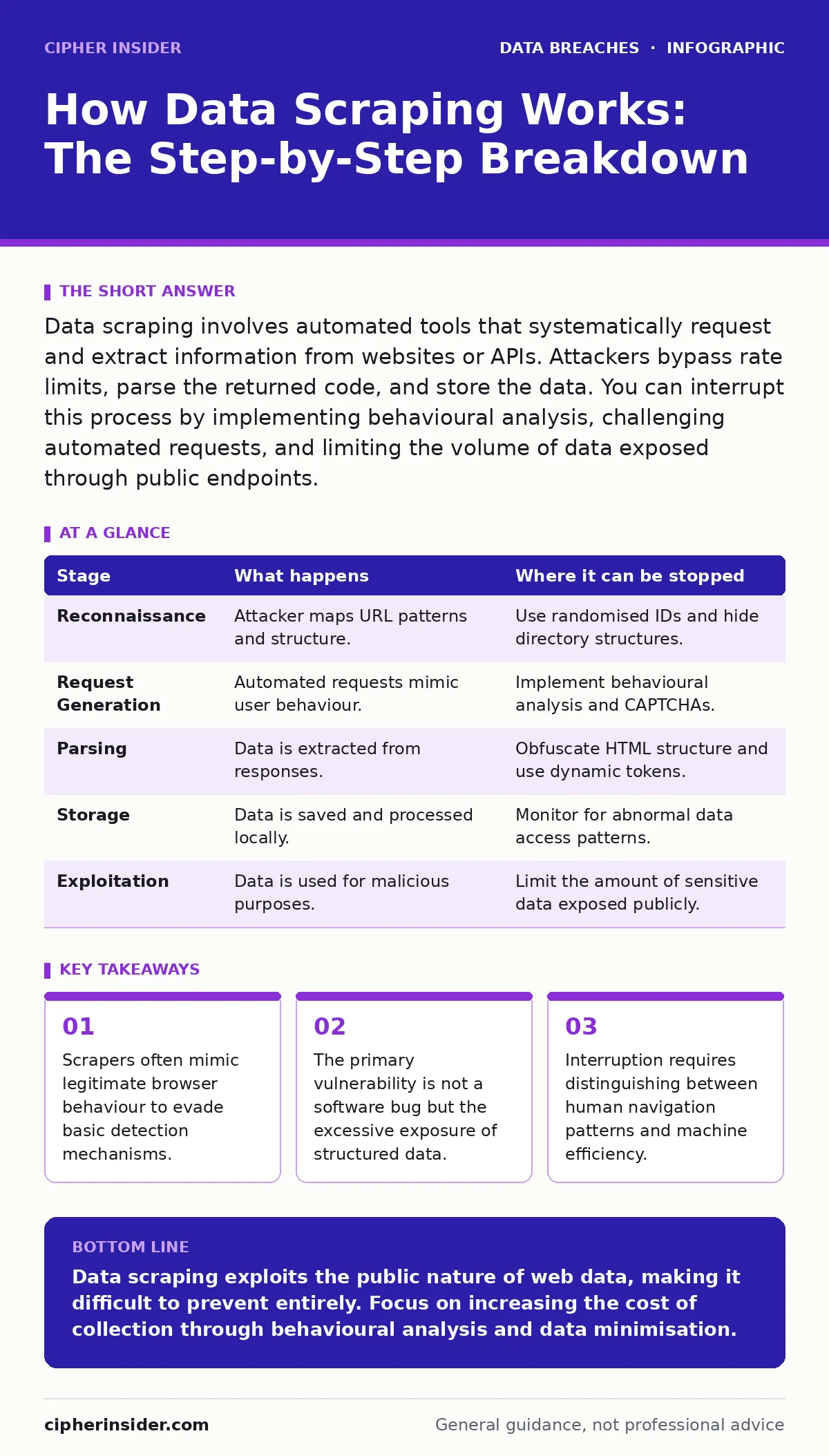
| Stage | What happens | Where it can be stopped |
|---|---|---|
| Reconnaissance | Attacker maps URL patterns and structure. | Use randomised IDs and hide directory structures. |
| Request Generation | Automated requests mimic user behaviour. | Implement behavioural analysis and CAPTCHAs. |
| Parsing | Data is extracted from responses. | Obfuscate HTML structure and use dynamic tokens. |
| Storage | Data is saved and processed locally. | Monitor for abnormal data access patterns. |
| Exploitation | Data is used for malicious purposes. | Limit the amount of sensitive data exposed publicly. |
The Limits of Technical Defences
Technical measures alone are insufficient. The core issue is the exposure of data. If you must publish data, you must accept that it can be scraped. The goal is not to prevent all scraping, but to make it difficult enough that only determined attackers attempt it. This is a cost-imposition strategy.
You must also consider the human element. Employees may inadvertently expose sensitive data through public forums or documentation. Third-party risk assessments can help identify where your data is exposed outside your direct control. By understanding the full surface of your data, you can prioritise your defences.
Continuous Monitoring and Adaptation
Scraping techniques evolve. As you implement new defences, attackers adapt their tools. You must continuously monitor your traffic for anomalies. Look for patterns that deviate from normal user behaviour, such as high volumes of requests for specific endpoints.
This is an ongoing process. There is no final solution. You must regularly review your exposed data and adjust your defences accordingly. This requires a combination of technical tools and human oversight. By staying vigilant, you can reduce the risk of large-scale data harvesting.
Key takeaways
- Scrapers often mimic legitimate browser behaviour to evade basic detection mechanisms.
- The primary vulnerability is not a software bug but the excessive exposure of structured data.
- Interruption requires distinguishing between human navigation patterns and machine efficiency.
Data scraping exploits the public nature of web data, making it difficult to prevent entirely. Focus on increasing the cost of collection through behavioural analysis and data minimisation.
Frequently asked questions
Can I completely stop data scraping?
No, because scrapers access data that is publicly available to all users. You can only make it more difficult and expensive for them to collect.
How do I detect if I am being scraped?
Monitor for unusual traffic patterns, such as high request rates from single IPs or consistent access to specific data endpoints.
Is data scraping illegal?
It depends on the jurisdiction and the terms of service. While accessing public data is often legal, bypassing technical barriers or violating terms may not be.
What is the difference between scraping and crawling?
Crawling is the process of discovering links, while scraping is the process of extracting specific data from those pages. Scrapers often use crawling techniques.
How this guide was produced: written by the Cipher Insider editorial team with AI assistance, checked against the public references listed below, and reviewed when the facts change. See our editorial policy or report an error.