
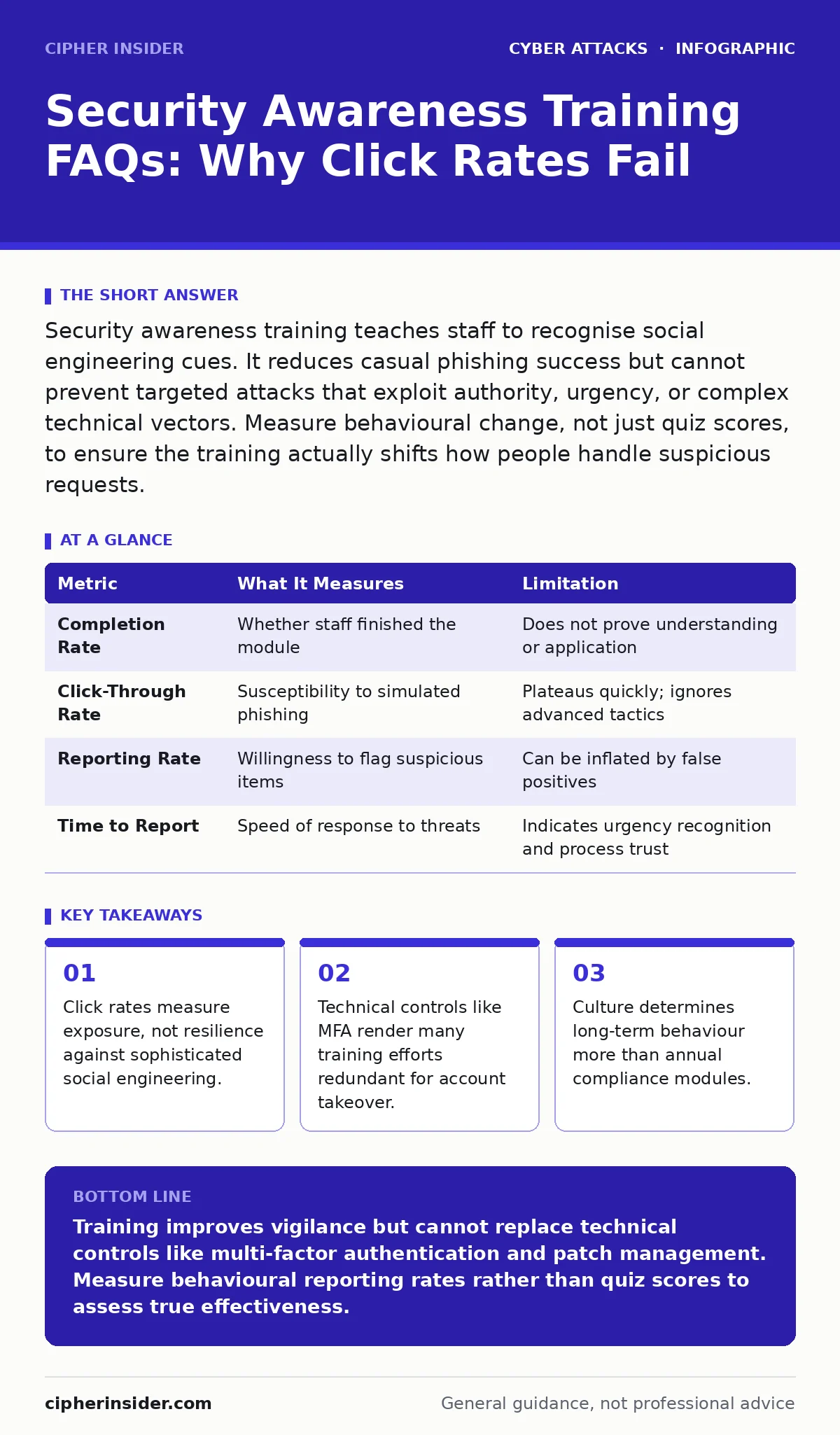
Security awareness training teaches staff to recognise social engineering cues. It reduces casual phishing success but cannot prevent targeted attacks that exploit authority, urgency, or complex technical vectors. Measure behavioural change, not just quiz scores, to ensure the training actually shifts how people handle suspicious requests.
Does security awareness training actually reduce breaches?
Training reduces the volume of successful casual phishing attempts by teaching you to spot generic red flags. It does not stop targeted attacks that exploit specific knowledge about your role or organisation. The reduction in incidents correlates more strongly with technical controls than with training alone. You must view training as one layer of defence, not a standalone solution.
Why do click rates stop improving after a year?
Click rates plateau because you quickly learn to avoid obvious scams with poor grammar or suspicious domains. Attackers then shift tactics to use legitimate-looking infrastructure and subtle psychological pressure. This creates a false sense of security where staff believe they are immune. The metric itself becomes less useful as the threat adapts to your improved detection skills.
What is the difference between phishing and spear phishing?
Phishing casts a wide net to trick anyone, while spear phishing targets a specific individual with personalised details. Spear phishing often uses data harvested from social media or previous breaches to appear credible. It requires less technical effort but more research. This makes it harder to defend against using generic training alone.
How do I spot a callback phishing attempt?
Callback phishing involves an attacker asking you to call a provided number to verify an issue. The number often routes to a spoofed display or a legitimate service provider. The attacker then uses your call-back to establish trust or capture credentials. Always use official contact channels from known sources, not numbers provided in unsolicited messages. See our guide on callback phishing for detailed technical analysis.
Why does multi-factor authentication make training less critical?
Multi-factor authentication adds a second verification step that attackers cannot bypass with a stolen password alone. It renders many phishing attacks useless because the attacker cannot provide the second factor. This technical control reduces the reliance on human vigilance for account protection. Training then shifts focus from password security to recognising broader social engineering tactics.
How do USB drop attacks bypass email filters?
USB drop attacks involve planting infected physical drives in areas where staff will find them. These devices bypass email and network filters entirely because they connect directly to the hardware. They often auto-run malicious scripts when inserted. Physical security policies and disabling auto-run features are more effective than awareness training here. Refer to our coverage of USB drop attacks for mitigation strategies.
What role does security culture play in long-term success?
Security culture is the shared set of norms that dictate how staff handle risk and uncertainty. Training provides knowledge, but culture determines whether you apply it under pressure. A blame-free culture encourages reporting mistakes, which provides data for better training. A punitive culture drives incidents underground, hiding the real risk profile. Explore our guide on security culture to understand how to build this environment.
How do I measure training effectiveness beyond quizzes?
Quizzes test memory, not behaviour. Effective measurement involves observing how staff respond to simulated or real threats over time. Look for increases in reported incidents, which indicates higher vigilance. Track the time taken to report suspicious activity. Faster reporting reduces the window for attackers to act. This behavioural data is more valuable than completion rates.
| Metric | What It Measures | Limitation |
|---|---|---|
| Completion Rate | Whether staff finished the module | Does not prove understanding or application |
| Click-Through Rate | Susceptibility to simulated phishing | Plateaus quickly; ignores advanced tactics |
| Reporting Rate | Willingness to flag suspicious items | Can be inflated by false positives |
| Time to Report | Speed of response to threats | Indicates urgency recognition and process trust |
Why do drive-by downloads evade user awareness?
Drive-by downloads exploit vulnerabilities in browsers or plugins without any user interaction. You do not need to click a link for the malware to install. Awareness training cannot prevent this because there is no human decision point. Patch management and keeping software updated are the only effective defences. Read our analysis of drive-by downloads for technical context.
How do evil twin Wi-Fi attacks compromise users?
An evil twin is a rogue wireless access point that mimics a legitimate network name. It intercepts traffic between your device and the internet. Users often connect automatically, unaware of the switch. This allows attackers to perform session hijacking or man-in-the-middle attacks. See our guide on evil twin Wi-Fi attacks for detection methods.
What is the hidden cost of over-reliance on training?
Over-reliance on training creates a false sense of security that delays investment in technical controls. It assumes humans are the weakest link, ignoring that systems are often more vulnerable. This leads to budget misallocation where prevention tools are underfunded. You must balance human factors with automated defence mechanisms.
How do botnet attacks relate to user awareness?
Botnets often consist of compromised devices infected through user actions like clicking malicious links. These devices are then used for large-scale attacks. Awareness training helps prevent the initial infection that joins the botnet. However, once part of a botnet, the device is controlled remotely. Our guide on botnet attacks explains the infrastructure behind these networks.
Can training prevent adversary-in-the-middle phishing?
Adversary-in-the-middle phishing uses real-time proxies to intercept and modify login sessions. The user sees a legitimate login page and enters credentials. The proxy forwards the data to the real service, maintaining the session. Training is largely ineffective here because the experience appears normal. Technical solutions like certificate pinning are required. Refer to our guide on adversity-in-the-middle phishing for deeper technical details.
Key takeaways
- Click rates measure exposure, not resilience against sophisticated social engineering.
- Technical controls like MFA render many training efforts redundant for account takeover.
- Culture determines long-term behaviour more than annual compliance modules.
Training improves vigilance but cannot replace technical controls like multi-factor authentication and patch management. Measure behavioural reporting rates rather than quiz scores to assess true effectiveness.
Frequently asked questions
How often should security awareness training be conducted?
Continuous, micro-learning sessions are more effective than annual bulk training. Regular exposure keeps threats top-of-mind without causing fatigue.
Should I use simulated phishing attacks?
Simulations are useful for testing detection rates but must not be punitive. They should serve as learning opportunities rather than traps for staff.
What is the most common mistake in training programmes?
Focusing solely on phishing when other vectors like physical security or social media misuse pose significant risks.
Does training help with ransomware?
Training helps prevent the initial infection via phishing, but ransomware often spreads through unpatched vulnerabilities. Technical hygiene is equally critical.
How this guide was produced: written by the Cipher Insider editorial team with AI assistance, checked against the public references listed below, and reviewed when the facts change. See our editorial policy or report an error.