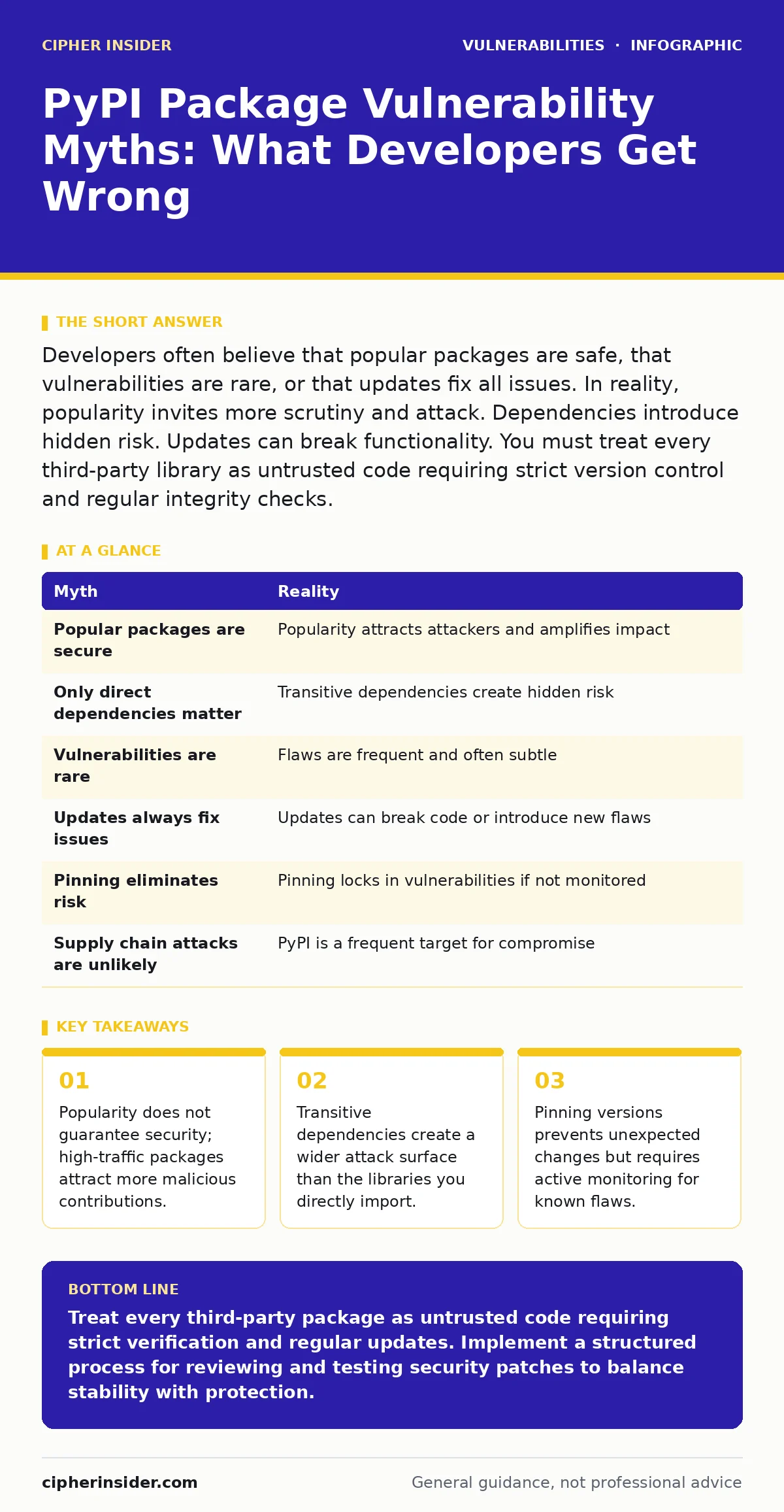
Developers often believe that popular packages are safe, that vulnerabilities are rare, or that updates fix all issues. In reality, popularity invites more scrutiny and attack. Dependencies introduce hidden risk. Updates can break functionality. You must treat every third-party library as untrusted code requiring strict version control and regular integrity checks.
Myth: Popular Packages Are Secure Because Many People Use Them
Reality: Wide adoption increases the incentive for attackers to compromise a package rather than guaranteeing its safety. A library used by thousands of projects presents a high-value target for supply chain attacks. Attackers may submit malicious pull requests, hijack maintainer accounts, or introduce subtle backdoors that remain undetected for months. The sheer number of users does not filter out malicious code; it amplifies the impact of a single compromise. You cannot assume safety based on download counts or star ratings.
Imagine a widely used logging library that suddenly includes a hidden function to exfiltrate environment variables. Because the package is trusted and widely distributed, the malicious code executes on thousands of servers before anyone notices. This scenario highlights why popularity is a risk multiplier, not a shield. You must verify the integrity of the package regardless of its market share. Relying on community size as a security control is a fundamental error in risk assessment.
Myth: Only Direct Dependencies Pose a Security Risk
Reality: Your application imports direct dependencies, but those libraries import their own dependencies, creating a deep tree of transitive dependencies. You often have no visibility into these nested libraries. A secure direct dependency might rely on an outdated, vulnerable transitive package. This hidden layer expands your attack surface significantly. You might patch the top-level library, but the underlying vulnerability in a sub-dependency remains active.
Suppose you use a web framework that depends on a specific JSON parser. The framework is secure, but the JSON parser has a known deserialization flaw. Your application is vulnerable despite your direct dependency being clean. This is why you must map your entire dependency tree. Tools that only check direct imports miss the majority of potential entry points. Understanding the full chain of trust is necessary for accurate risk evaluation.
Myth: Vulnerabilities in Libraries Are Rare and Easy to Find
Reality: Vulnerabilities in Python packages are frequent and often subtle. Many flaws are logic errors or configuration issues rather than obvious bugs. Static analysis tools may miss complex interaction flaws between libraries. Manual review is time-consuming and prone to error. The Python Package Index hosts millions of packages, many maintained by single individuals with limited security expertise. This volume creates a large surface area for undiscovered flaws.
You cannot assume that a package is free of defects simply because it passes basic tests. Logic errors, such as improper input validation or insecure default settings, are common. These flaws may not trigger immediate crashes but can lead to data leakage or privilege escalation under specific conditions. Regular security audits and automated scanning are necessary to detect these hidden issues. Relying on the absence of public reports is a false sense of security.
Myth: Updating Packages Always Fixes Security Issues
Reality: Updating a package can introduce new vulnerabilities or break existing functionality. New releases may include untested code or depend on newer, insecure libraries. Blindly updating to the latest version without testing can destabilise your application. Furthermore, some vulnerabilities are not fixed in minor patches but require major version upgrades that involve significant code changes. You must balance security fixes with stability requirements.
Suppose a critical security patch for a database driver requires a major version upgrade. Applying this update might break your application’s connection logic. You are forced to choose between remaining vulnerable or risking downtime. This trade-off highlights the need for a structured update process. You should test updates in a staging environment before deployment. Keeping a backlog of pending security fixes allows you to apply them when resources permit, rather than reacting in panic. This approach aligns with effective remediation tracking practices.
Myth: Pinning Package Versions Eliminates All Risk
Reality: Pinning versions to specific hashes or numbers prevents unexpected updates, but it does not protect against vulnerabilities in the pinned version itself. If a flaw is discovered in your pinned package, you remain exposed until you manually update and test the new version. Pinning also prevents you from receiving security patches automatically. You must actively monitor pinned packages for new advisories and apply updates promptly.
Imagine you pin a cryptographic library to a specific version for stability. A new vulnerability is discovered in that version. Because your system is locked to the old version, you cannot receive the automatic fix. You must manually identify the patch, test it, and deploy it. This manual process introduces delay and human error. Pinning is a control for stability, not a security solution. You need a process to review and update pinned versions regularly.
See also: Remediation Tracking Mistakes That Leave Systems Exposed · Detecting VPN Appliance Vulnerabilities: Signs, Tools and Blind Spots
Myth: PyPI Packages Are Not Subject to Supply Chain Attacks
Reality: The Python ecosystem is a frequent target for supply chain attacks. Attackers may compromise package maintainers, hijack package names, or inject malicious code into legitimate packages. These attacks bypass traditional perimeter defences because the malicious code is delivered through trusted channels. You must treat every package as potentially compromised. Verifying the source and integrity of packages is critical.
Suppose an attacker compromises the account of a popular package maintainer. They publish a new version with hidden malware. Your automated build process pulls the update and deploys it. The malicious code executes with the same privileges as your application. This scenario demonstrates the need for strict access controls and code signing. You should verify package signatures and maintain a whitelist of trusted maintainers. This vigilance is similar to securing IoT device vulnerabilities, where trust in connected components is often misplaced.
| Myth | Reality |
|---|---|
| Popular packages are secure | Popularity attracts attackers and amplifies impact |
| Only direct dependencies matter | Transitive dependencies create hidden risk |
| Vulnerabilities are rare | Flaws are frequent and often subtle |
| Updates always fix issues | Updates can break code or introduce new flaws |
| Pinning eliminates risk | Pinning locks in vulnerabilities if not monitored |
| Supply chain attacks are unlikely | PyPI is a frequent target for compromise |
Key takeaways
- Popularity does not guarantee security; high-traffic packages attract more malicious contributions.
- Transitive dependencies create a wider attack surface than the libraries you directly import.
- Pinning versions prevents unexpected changes but requires active monitoring for known flaws.
Treat every third-party package as untrusted code requiring strict verification and regular updates. Implement a structured process for reviewing and testing security patches to balance stability with protection.
Frequently asked questions
How do I check for vulnerabilities in my Python dependencies?
Use automated dependency scanning tools that analyse your requirements file and report known vulnerabilities. Integrate these tools into your CI/CD pipeline for continuous monitoring.
What is the difference between direct and transitive dependencies?
Direct dependencies are libraries you explicitly import. Transitive dependencies are libraries imported by your direct dependencies. Both can contain vulnerabilities, but transitive ones are often overlooked.
Should I always update to the latest package version?
No. Update only after testing the new version in a staging environment. Blind updates can break functionality or introduce new security flaws. Prioritise critical security patches.
How can I protect against supply chain attacks in PyPI?
Verify package signatures, use hash pinning for critical packages, and monitor maintainer accounts for suspicious activity. Implement strict access controls and code review processes.
How this guide was produced: written by the Cipher Insider editorial team with AI assistance, checked against the public references listed below, and reviewed when the facts change. See our editorial policy or report an error.