
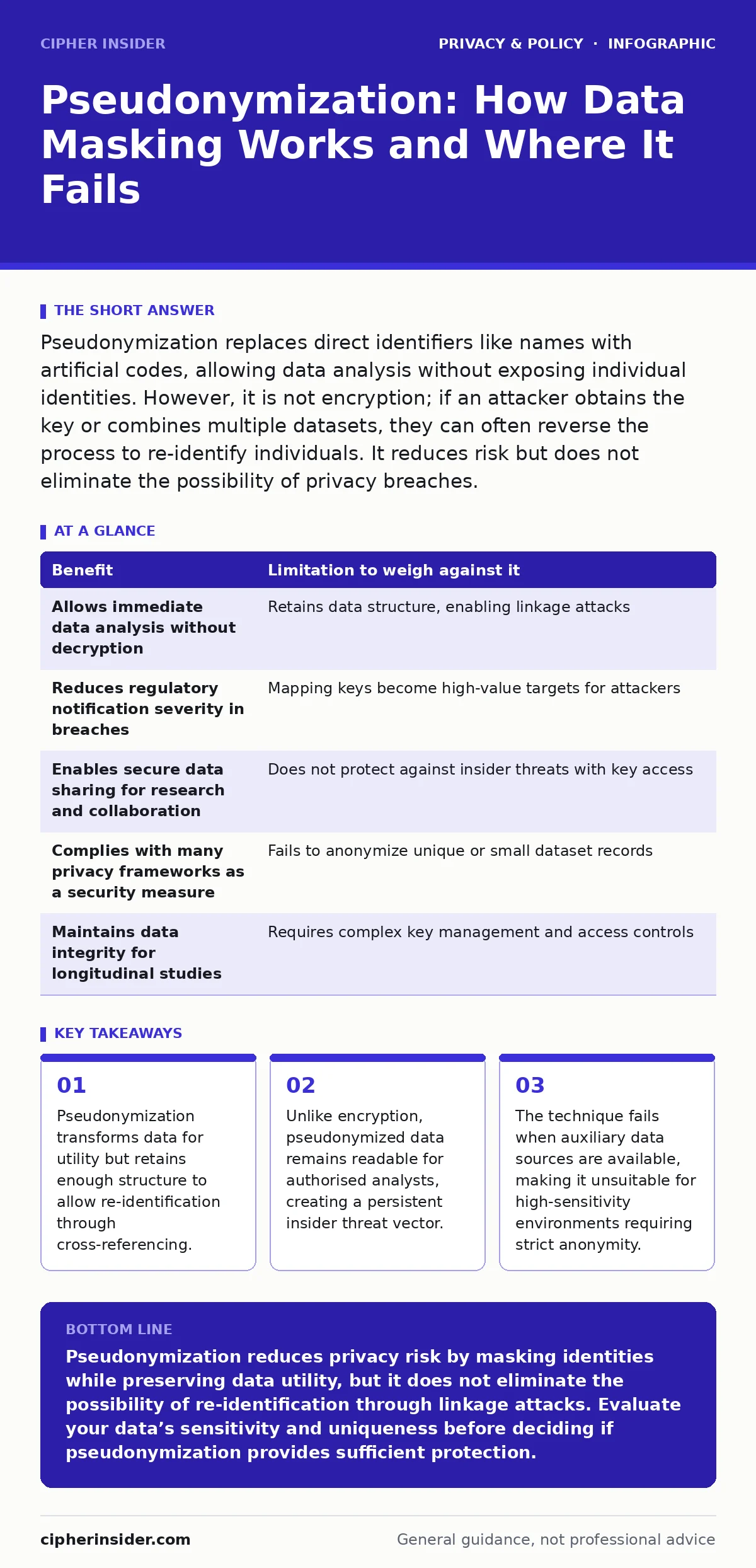
Pseudonymization replaces direct identifiers like names with artificial codes, allowing data analysis without exposing individual identities. However, it is not encryption; if an attacker obtains the key or combines multiple datasets, they can often reverse the process to re-identify individuals. It reduces risk but does not eliminate the possibility of privacy breaches.
The Mechanics of Identity Substitution
Pseudonymization is a data processing technique that replaces direct identifiers with artificial identifiers, known as pseudonyms. Unlike encryption, which scrambles data into an unreadable format requiring a specific key to unlock, pseudonymization maintains the original data structure. For example, a database might replace "John Smith" with "User_8492". The name is gone, but the age, purchase history, and medical records remain linked to that code.
This distinction matters because it determines how the data can be used. Encrypted data is useless for analysis until decrypted. Pseudonymized data is immediately usable for statistical modelling, machine learning training, or operational reporting. You can analyse trends in patient recovery times without ever seeing a patient’s name. This utility is the primary driver for its adoption in healthcare, finance, and research sectors.
However, this utility comes with a structural vulnerability. Because the data remains structured and consistent, the same pseudonym always refers to the same individual. If you encounter "User_8492" in a sales log and later in a complaint log, you can link those records. This consistency is what makes the data valuable for analysis, but it is also what makes it vulnerable to linkage attacks, where external information is used to map the pseudonym back to a real identity.
The Illusion of Anonymity
A common misconception is that pseudonymization achieves anonymity. It does not. Anonymization removes or alters data so thoroughly that an individual can no longer be identified, even by the data controller. Pseudonymization merely obscures the identity while keeping the door open for re-identification. The data controller retains the "key" or mapping table that links pseudonyms to real identities.
This creates a specific risk profile. If an attacker compromises your database, they do not get names immediately. They get codes. But if they also compromise your mapping table, or if they can guess the mapping through brute-force or social engineering, the privacy barrier collapses. The data is no longer pseudonymized; it is fully identified. This is why pseudonymization is often described as a risk-reduction measure rather than a privacy guarantee.
The danger increases when data is shared. Suppose you send pseudonymized customer data to a third-party analytics firm. If that firm also holds other data about those customers, such as browsing history or location tracking patterns, they can combine the datasets. If the intersection of data points is unique enough, they can identify "User_8492" without ever seeing your mapping key. This phenomenon is known as a re-identification attack, and it is the primary limitation of pseudonymization.
Concrete Benefits of Data Masking
The primary benefit of pseudonymization is the preservation of data utility while reducing immediate privacy exposure. Organisations can perform complex analyses, such as detecting fraud patterns or improving product recommendations, without exposing sensitive personal information to every employee who accesses the data. This aligns with the principle of least privilege, where users only access the data they strictly need.
It also facilitates compliance with data protection regulations. Many legal frameworks require that personal data be protected against unauthorised access. Pseudonymization is explicitly recognised as a security measure that reduces the regulatory burden. If data is pseudonymized, a breach may not trigger the same severe notification requirements as a breach of fully identified data, provided the pseudonyms cannot be easily reversed.
Furthermore, it enables secure data sharing between entities. Research institutions can collaborate on large datasets without transferring raw personal information. The data remains useful for scientific inquiry, but the risk of exposing individual participants is significantly lowered. This is particularly valuable in fields like epidemiology, where broad data sets are necessary to track disease spread, but patient privacy is paramount.
Honest Limitations and Hidden Costs
The most significant limitation is the persistence of the re-identification risk. As long as the data retains its structure and consistency, it can potentially be linked to other data sources. This is especially true for small datasets or those containing rare attributes. If a dataset contains only one person with a specific rare medical condition, that person is identifiable even if their name is replaced. The uniqueness of the data point acts as a de facto identifier.
There is also a hidden operational cost. Implementing pseudonymization requires robust key management. The mapping tables that link pseudonyms to real identities become high-value targets for attackers. If these tables are stored in the same environment as the pseudonymized data, a single breach compromises both. Separating them adds complexity and latency to data retrieval processes, which can slow down operations and increase infrastructure costs.
Additionally, pseudonymization does not protect against insider threats. Employees with access to both the pseudonymized data and the mapping key can still view personal information. The technique shifts the risk from external attackers to internal trust issues. You must implement strict access controls and audit logs to monitor who accesses the mapping tables, adding another layer of administrative overhead.
Trade-offs in Practice
| Benefit | Limitation to weigh against it |
|---|---|
| Allows immediate data analysis without decryption | Retains data structure, enabling linkage attacks |
| Reduces regulatory notification severity in breaches | Mapping keys become high-value targets for attackers |
| Enables secure data sharing for research and collaboration | Does not protect against insider threats with key access |
| Complies with many privacy frameworks as a security measure | Fails to anonymize unique or small dataset records |
| Maintains data integrity for longitudinal studies | Requires complex key management and access controls |
See also: What is online tracking: how data follows you and how to stop it · Differential Privacy Meaning: How Noise Protects Your Data
When It Is Worth It
Pseudonymization is worth implementing when the primary goal is to balance data utility with privacy reduction. It is ideal for internal analytics, where employees need to analyse trends but do not need to know individual identities. For instance, a marketing team can analyse customer purchase behaviour to improve segmentation without accessing customer names or addresses.
It is also suitable for sharing data with trusted third parties who have their own security controls. If you are sending data to a reputable research partner, pseudonymization allows them to use the data for their studies while preventing them from immediately identifying individuals. This is particularly effective when the data contains no rare or unique attributes that could lead to easy re-identification.
Suppose you are building a machine learning model for fraud detection. You need historical transaction data to train the algorithm. Pseudonymizing the customer identifiers allows the model to learn patterns without exposing client identities to the data scientists. This is a classic use case where the benefit of utility outweighs the residual risk of re-identification.
When It Is Not
Pseudonymization is not worth it when the data contains highly sensitive information that could cause severe harm if re-identified. In such cases, full anonymization or strict encryption is required. If the dataset includes health records, political opinions, or financial details, the risk of re-identification is too high to rely solely on pseudonymization.
It is also ineffective for small datasets or those with high granularity. If you have a dataset of ten employees, pseudonymizing their names does little to protect their privacy, as their roles, salaries, and locations may uniquely identify them. In these scenarios, the data should be aggregated or suppressed rather than pseudonymized.
Finally, avoid pseudonymization if you cannot securely manage the mapping keys. If your organisation lacks the resources to implement strict access controls and audit logging, the pseudonymization process becomes a liability. The mapping tables may be easier to protect than the entire dataset, but they still require significant security investment. For more on managing access rights across devices, see our guide on smartphone privacy settings.
Key takeaways
- Pseudonymization transforms data for utility but retains enough structure to allow re-identification through cross-referencing.
- Unlike encryption, pseudonymized data remains readable for authorised analysts, creating a persistent insider threat vector.
- The technique fails when auxiliary data sources are available, making it unsuitable for high-sensitivity environments requiring strict anonymity.
Pseudonymization reduces privacy risk by masking identities while preserving data utility, but it does not eliminate the possibility of re-identification through linkage attacks. Evaluate your data’s sensitivity and uniqueness before deciding if pseudonymization provides sufficient protection.
Frequently asked questions
Is pseudonymization the same as encryption?
No. Encryption scrambles data into an unreadable format, while pseudonymization replaces identifiers with codes that maintain the data’s structure for analysis.
Can pseudonymized data be used for machine learning?
Yes. Pseudonymization is often preferred for machine learning because it allows algorithms to process structured data without exposing personal identifiers.
Does pseudonymization comply with GDPR?
Yes. The GDPR recognizes pseudonymization as a security measure that reduces regulatory obligations, provided the data cannot be attributed to a specific individual without additional information.
How do I prevent re-identification attacks?
Combine pseudonymization with data minimization, access controls, and regular risk assessments. Avoid sharing pseudonymized data with parties who may hold complementary datasets.
How this guide was produced: written by the Cipher Insider editorial team with AI assistance, checked against the public references listed below, and reviewed when the facts change. See our editorial policy or report an error.