
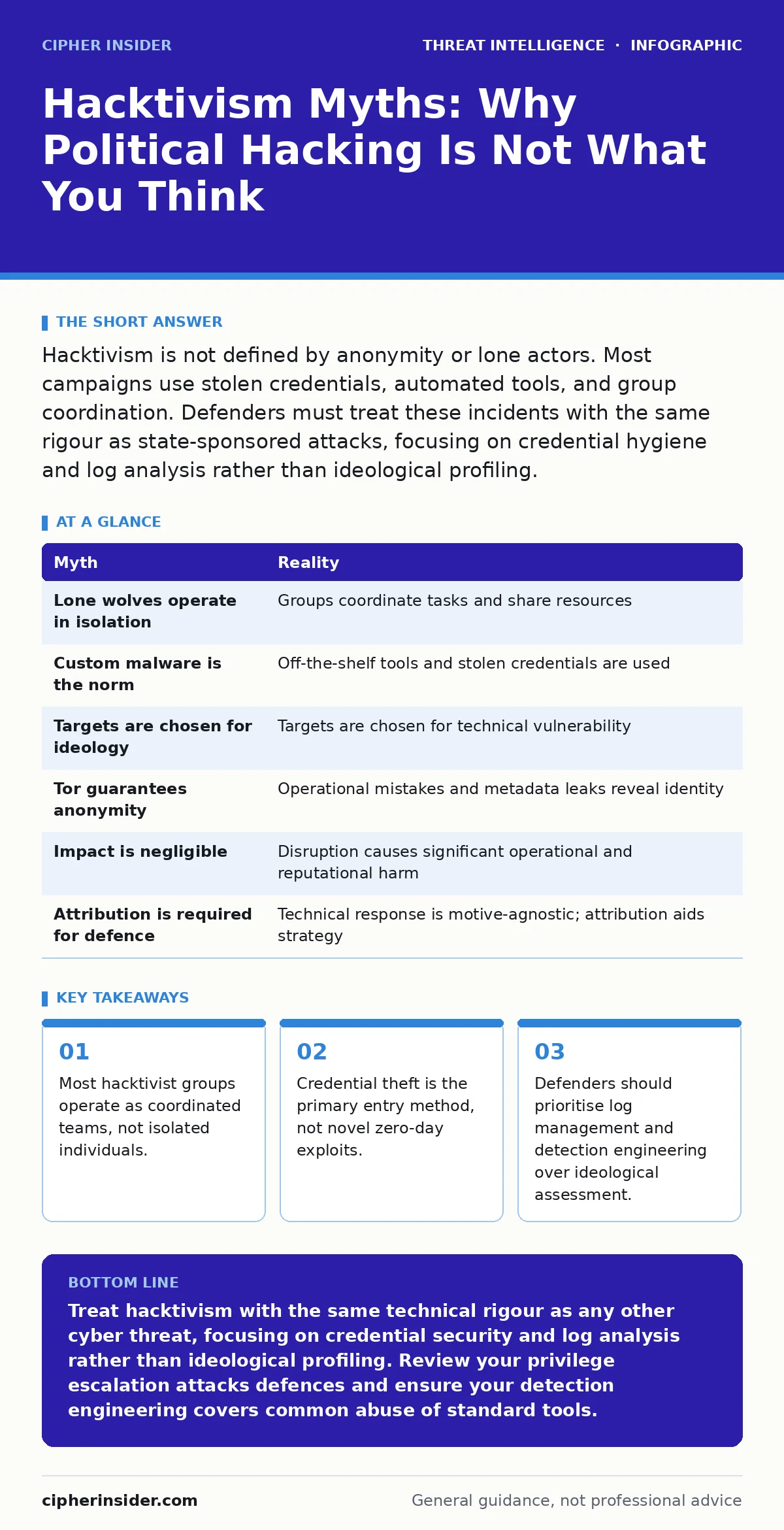
Hacktivism is not defined by anonymity or lone actors. Most campaigns use stolen credentials, automated tools, and group coordination. Defenders must treat these incidents with the same rigour as state-sponsored attacks, focusing on credential hygiene and log analysis rather than ideological profiling.
Myth: Hacktivism Is Performed by Lone Wolves
Reality: The image of a solitary figure in a dark room typing furiously is a cinematic construct that misrepresents how digital activism operates in practice. Most hacktivist campaigns require significant coordination, code sharing, and resource pooling.
Imagine a campaign targeting a specific corporation. The group likely divides labour among members who specialise in reconnaissance, web application testing, and public relations. This structure mirrors traditional criminal organisations or state-sponsored teams. You will rarely find a single individual capable of maintaining the infrastructure, evading detection, and managing the narrative simultaneously.
The operational security required to remain anonymous for long periods demands multiple sets of eyes. One person may handle the technical intrusion while another manages the communication channels to avoid leaving digital fingerprints. This division of labour makes attribution difficult but also makes the group more resilient. If one member is identified, the others can continue the operation.
Myth: Hacktivists Use Novel, Custom-Built Malware
Reality: Hacktivists rarely develop their own malware or zero-day exploits. They rely on off-the-shelf tools, open-source frameworks, and stolen credentials to achieve their objectives. Developing custom software requires advanced programming skills and significant time, which most groups lack.
Instead of writing complex code, these groups often use tools designed for legitimate security testing. They repurpose scripts that automate common attacks, such as SQL injection or cross-site scripting. The sophistication of the tool does not determine the impact of the breach. A simple script that exploits a misconfigured server can cause more damage than a complex, custom-built worm.
This reliance on common tools means that the indicators of compromise are often well-known. Security teams can detect these activities if their monitoring systems are configured correctly. The challenge is not identifying unknown code but recognising the misuse of known utilities. You must focus on behaviour rather than signature matching to catch these activities early.
Myth: Ideology Dictates the Target Selection
Reality: While political or social motives drive hacktivism, the choice of target is often dictated by technical vulnerability rather than symbolic value. A group may claim to target a large corporation for its policies, but the actual attack vector is a weak password or an unpatched server.
Suppose a group wants to protest against a specific industry. They will scan for any entity within that sector that presents an easy entry point. The target is chosen because it is accessible, not necessarily because it is the most ideologically significant. This pragmatic approach means that smaller organisations with poor security hygiene are often hit harder than larger, better-protected entities.
Defenders must understand that being a target is often a matter of luck rather than malice. Your organisation may be attacked simply because it was the next vulnerable system found in a scan. This reality underscores the need for basic security hygiene. You cannot control who is angry at you, but you can control how easy it is for them to break in.
Myth: Anonymity Is Guaranteed by Tor and Proxies
Reality: Using the Tor network or proxy servers does not guarantee anonymity. Operational security mistakes, such as reusing credentials or leaking metadata, often reveal the true identity of the attackers. Tor hides the IP address, but it does not hide the content of the communication or the user's behaviour.
If a hacktivist logs into a service using the same username and password they use elsewhere, they create a linkable identity. Even if the traffic is routed through Tor, the authentication event itself can be tied to a specific account. Furthermore, many websites block Tor traffic or require additional verification, which can force attackers to reveal more information than intended.
You should not assume that traffic coming from Tor is untraceable in the long run. Correlation attacks, where an observer monitors both the entry and exit nodes, can de-anonymise users. Additionally, if the attacker makes a mistake in their scripting or leaves behind a unique identifier in the code, their identity can be exposed. Anonymity is a fragile state that requires constant, disciplined maintenance.
Myth: Hacktivism Is Low-Impact and Easily Contained
Reality: Hacktivist attacks can cause significant operational disruption and financial loss. Denial of service attacks can take websites offline for days, while data leaks can damage reputations and lead to legal consequences. The impact is not limited to the technical layer but extends to public perception and stakeholder trust.
Imagine a healthcare provider suffering a denial of service attack during a critical period. The inability to access patient records or schedule appointments can have serious real-world consequences. The attackers may not have intended to cause harm, but the result is the same as a malicious attack. The disruption itself is the weapon.
Defenders must treat these incidents with the same seriousness as any other cyber threat. The cost of recovery, including public relations efforts and legal fees, can be substantial. You cannot dismiss an attack as "just hacktivism" and ignore the operational impact. The goal is to maintain availability and integrity, regardless of the attacker's motive.
See also: Detection Engineering: How to Build Signals That Catch Threats · Deploy Honeypots: A Step-by-Step Implementation Plan
Myth: Attribution Is Unnecessary for Defence
Reality: Knowing who is behind an attack does not change the immediate technical response. Whether the attacker is a state actor, a criminal group, or a hacktivist, the initial steps to contain the breach are the same. Focus on isolating affected systems, revoking compromised credentials, and restoring data from backups.
However, attribution can inform long-term strategy. Understanding the motive and methods of the attacker helps you predict future targets and behaviours. If a group is known for targeting specific sectors, you can adjust your monitoring and detection engineering to look for similar patterns. This is not about naming and shaming but about improving your defensive posture.
You should integrate threat intelligence into your daily operations. Use IOC enrichment to understand the context of indicators found in your logs. This helps you distinguish between noise and genuine threats. By understanding the broader landscape of threat actors, you can prioritise your efforts more effectively.
| Myth | Reality |
|---|---|
| Lone wolves operate in isolation | Groups coordinate tasks and share resources |
| Custom malware is the norm | Off-the-shelf tools and stolen credentials are used |
| Targets are chosen for ideology | Targets are chosen for technical vulnerability |
| Tor guarantees anonymity | Operational mistakes and metadata leaks reveal identity |
| Impact is negligible | Disruption causes significant operational and reputational harm |
| Attribution is required for defence | Technical response is motive-agnostic; attribution aids strategy |
Key takeaways
- Most hacktivist groups operate as coordinated teams, not isolated individuals.
- Credential theft is the primary entry method, not novel zero-day exploits.
- Defenders should prioritise log management and detection engineering over ideological assessment.
Treat hacktivism with the same technical rigour as any other cyber threat, focusing on credential security and log analysis rather than ideological profiling. Review your privilege escalation attacks defences and ensure your detection engineering covers common abuse of standard tools.
Frequently asked questions
How do I distinguish hacktivism from criminal hacking?
Look for public claims of responsibility and political or social messaging. Criminal hacks are usually silent, seeking financial gain or data theft without public attribution.
Should I block all Tor traffic?
Blocking Tor can reduce noise but may also hinder legitimate users. Instead, monitor Tor traffic for suspicious behaviour and apply stricter authentication requirements.
What is the first step if I suspect a hacktivist attack?
Isolate affected systems to prevent further damage. Preserve logs for forensic analysis and revoke any credentials that may have been compromised.
Can honeypots help detect hacktivists?
Yes, honeypots can attract attackers and provide early warning. They allow you to study their tactics and tools without risking your production environment.
How this guide was produced: written by the Cipher Insider editorial team with AI assistance, checked against the public references listed below, and reviewed when the facts change. See our editorial policy or report an error.